
LOBELIA
Plant Detective: The Secret World of Cardinal Flowers
by karen blackerby logan
There is nothing quite like sitting quietly in the garden with a sketchbook, playing plant detective and watching nature unfold it’s quiet magic. Lately, I’ve been completely captivated by our native Cardinal Flower (Lobelia cardinalis). Watching it through a biomimicry lens, studying how its physical structures, evolutionary strategies, and relationships with pollinators weave together, has provided me with profound insight into a beautiful evolutionary mutualism.
While I was out observing and drawing, a ruby-throated hummingbird came by for a visit, giving me a front-row seat to one of nature's magical partnerships in action.
sketchbook entry about cardinal flowers [karen blackerby logan]
Cardinal Flower and Hummingbird Mutualism
If you look closely at a Cardinal Flower, the details of its design tells a story of co-evolution.
Hummingbirds have exceptional vision for red, unlike bees, which generally cannot see the red color spectrum and lack the physical aspects to access deep nectar. The flower's red, deep tubular structure is a beacon, perfectly matched for the Ruby-Throated Hummingbird's vision and long, slender beaks.
Even more fascinating is the engineering inside the stamen tube. The Cardinal Flower features a hollow angled, stamen tube with brush-like anthers at the tip, safely holding the female stigma inside until the timing is right. When a hummingbird dips its beak in for a drink of nectar, its forehead makes direct contact with this angled brush tube coated in pollen. The pollen precisely transfers onto the bird's forehead, ready to be carried off to pollinate the next flower.
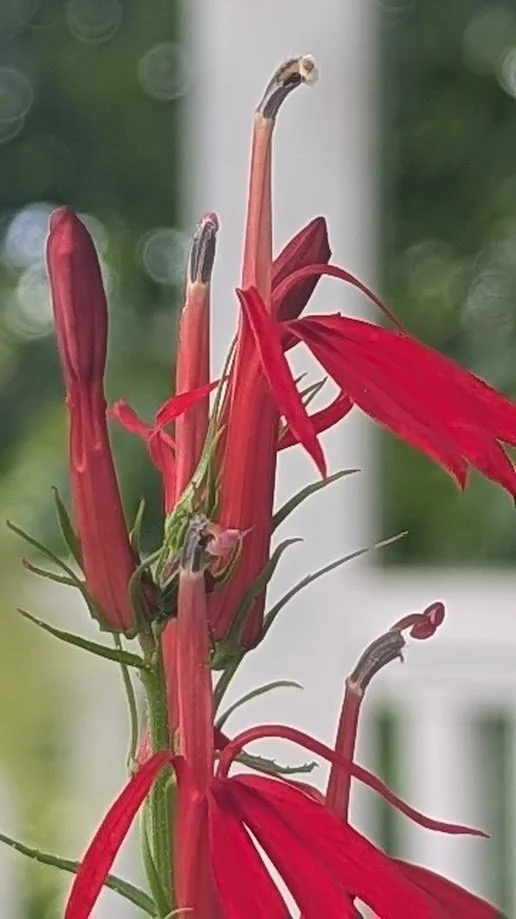
Detail of male phase (upper) and female phase (lower) [image credit: karen blackerby logan]
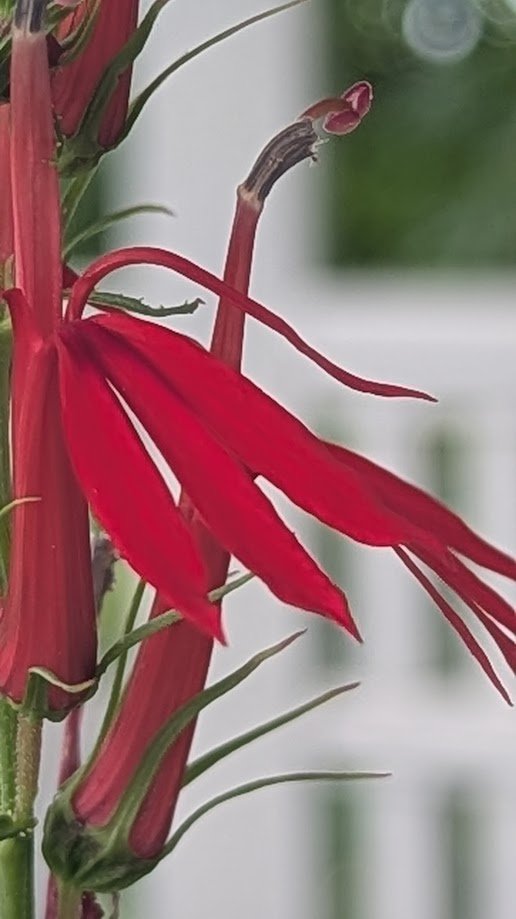
Detail female phase and petal arrangement [image credit: karen blackerby logan]
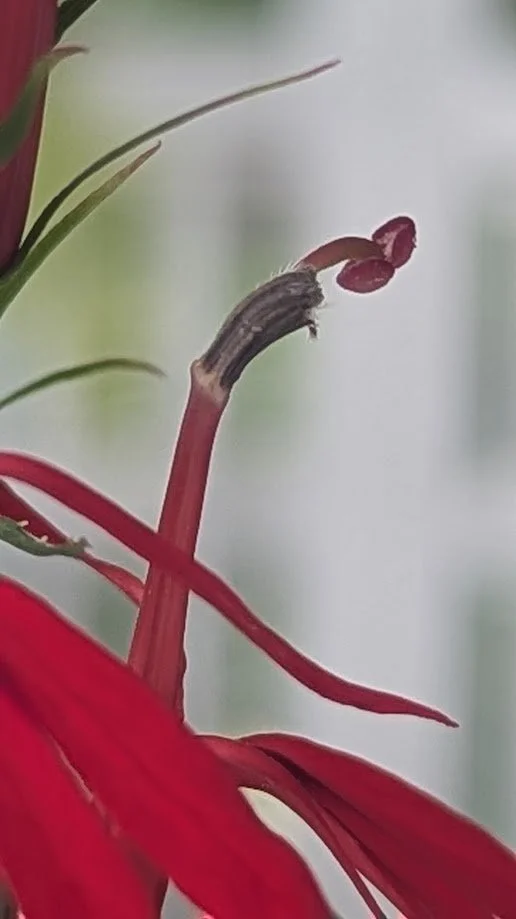
Close up of female phase [image credit: karen blackerby logan]
Pollination Strategy
Cardinal Flowers bloom in vertical spires, opening sequentially from the bottom up. Because hummingbirds naturally forage in this same upward direction (where the lower blooms offer the most nectar), self-pollination is prevented.
Each individual flower goes through two distinct phases:
The Male Phase: When the lower blooms first open up, the pollen is available on the anthers, while the female stigma is tucked away in the hollow fused stamen tube .
The Female Phase: As the season progresses and the hummingbirds work their way up the stalk, the older lower blooms age and the pollen phase is complete. The stigmas finally push their way through and open up, ready to catch fresh pollen brought by another hummingbird from a different Cardinal Flower.
The petals are designed for this partnership as well. The two side petals curl back while the lower three cleft petals droop into a funnel-like bullseye for the hummingbird to swoop in. In contrast, the Great Blue Lobelia’s (Lobelia siphilitica) "landing pad" lower petal evolved specifically to invite heavy-bodied native bees to land on.
This evolutionary split between the Cardinal Flower and the Great Blue Lobelia is a great lesson in resource sharing and pollination efficiency, allowing each plant to optimize its own unique pollinator specialist.
Lobelia Starship Deep Rose & Scarlet Bronze Leaf
Lobelia Starship Deep Rose & Scarlet Bronze Leaf. Rich bronze or purple foliage throughout the growing season. Adds a bold color for the late summer to early autumn garden.
Lobelias in your Garden
While Cardinal Flowers are hummingbird magnets, Great Blue Lobelias are native bee havens and they both deserve a special place in your garden.
In nature, you’ll typically find these North American natives growing in wet, swampy soils, woodland edges, or low, damp spots in the landscape. If you have a rain garden, a spot near a pond or stream, or just a part-shade garden that holds moisture well, they will thrive. With consistently moist soil, they can thrive in sun as well.
Whether you fall in love with the classic native Cardinal Flower, the deep foliage of 'Queen Victoria' (a Royal Horticultural Society Award winner), or the slightly more compact Starship series, these plants bring an incredible sense of place, wonder, and life to the garden.
Grab a sketchbook, find a quiet spot near your flower beds, and see what stories your own garden plants are waiting to tell!
Lobelia ‘Great Blue’. A blue counterpart of the Cardinal Flower. Desirable plant for woodland gardens especially since it blooms bright blue in late summer.

Lobelia siphilitica and Aster
*************************
CARE
Prefer fertile, evenly moist soil.
Can be divided every 2-3 years in spring.
Allow to self sow.
Winter over with stems on.
Can be pinched back before flowering to produce more compact plants
*************************
USES
Woodland paths
Perennial beds and border gardens with moist, well-drained soil.
Given enough water they can be fine with more sun.
Great choice for partial shade gardens
Well-suited for use in rain gardens, around ponds and streams and other moist areas.
Pairs well with ferns and heuchera