
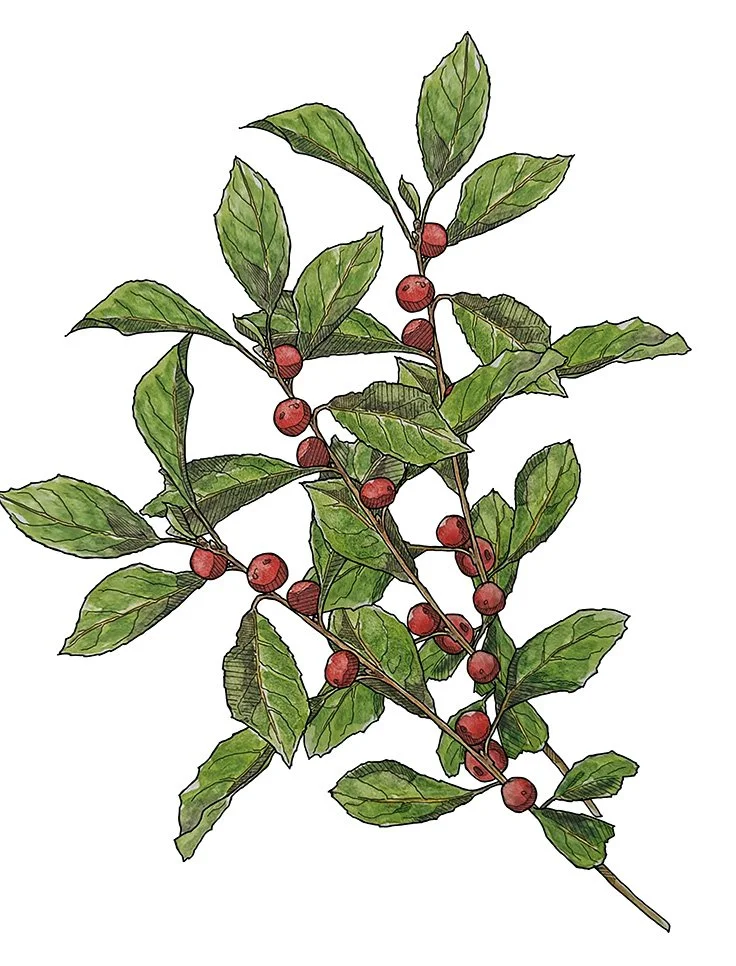
WINTERBERRY
The Iconic New England Winter Shrub
by karen blackerby logan
When I picture a New England landscape in winter, one native shrub steps forward to light up the woods and wetlands: Winterberry (Ilex verticillata). Unlike its glossy, evergreen cousins in the holly family, common winterberry is deciduous. Its purplish-green foliage turns dark and drops with the frost, leaving behind clusters of bright red berries clinging to the bare, gray branches. These red berries have become synonymous with winter and the holiday season.
A Botanical Portrait
Native to wetlands and damp thickets across the eastern United States, winterberry is an upright, medium-sized shrub typically reaching 4 to 10 feet tall, featuring evolutionary adaptations tailored for its native habitat:
Deciduous Shrub: By dropping its leaves in winter, winterberry creates a high-contrast visual display. Those brilliant red berries stand out against snow or gray winter skies, serving as a shining beacon to foraging birds.
Root System: Below ground, winterberry features a robust root system whose branching patterns mirror its above-ground structure, acting as a natural anchor in muddy, saturated soils and stabilizing stream banks and wetland edges.
Foliage & Fruit: The leaves are thick, waxy, and feature fine serrations along the margins. If you look closely at where the leaf meets the stem (the leaf axil), you'll find the origin point of its signature berries.
Four-Season Ecological Interest
Winterberry isn't just a winter showstopper; it supports a vibrant local web of life all year round:
Spring: Inconspicuous, honey-scented blooms emerge, drawing in native spring pollinators.
Summer: Provides a lush, dense green backdrop of foliage that works wonderfully in rain gardens, waterfront plantings, or naturalized screening hedges. (It thrives in acidic, moist soils, is salt-tolerant, though it prefers not to dry out completely).
Fall & Winter: The foliage darkens, drops, and leaves behind the fruit display that acts as an essential emergency food source for native overwintering birds, who in turn help disperse seeds across the landscape.
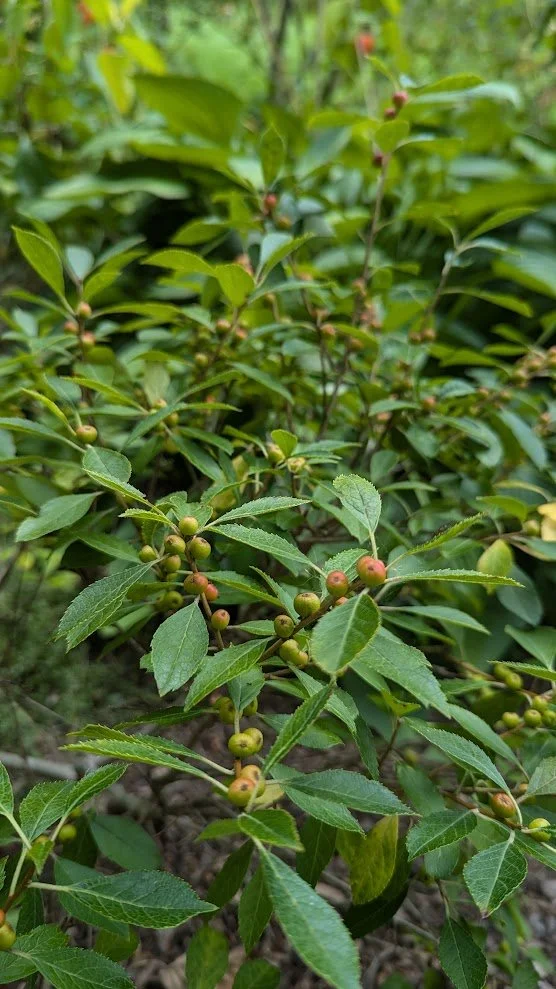
Berries starting to ripen [image credit: karen blackerby logan]
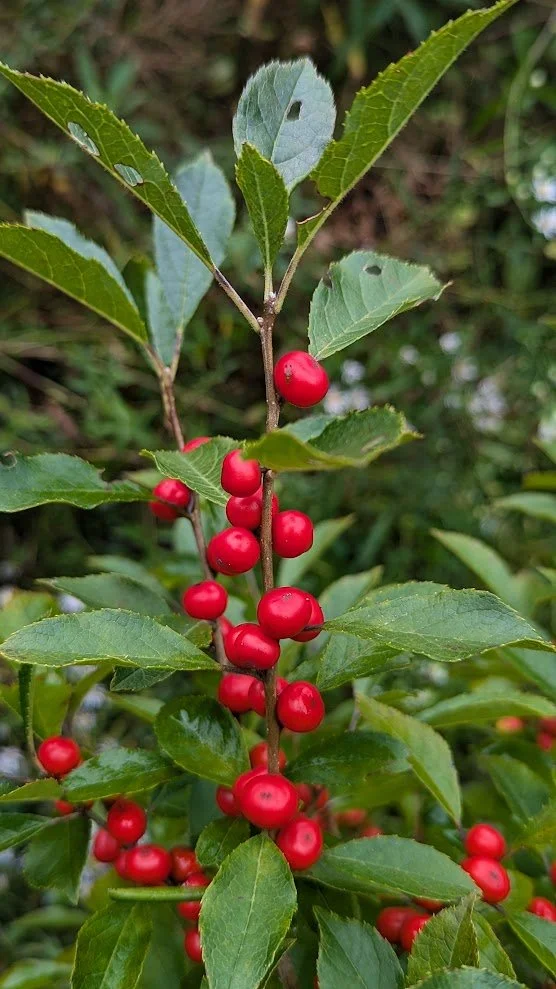
Ripened berries [image credit: karen blackerby logan]
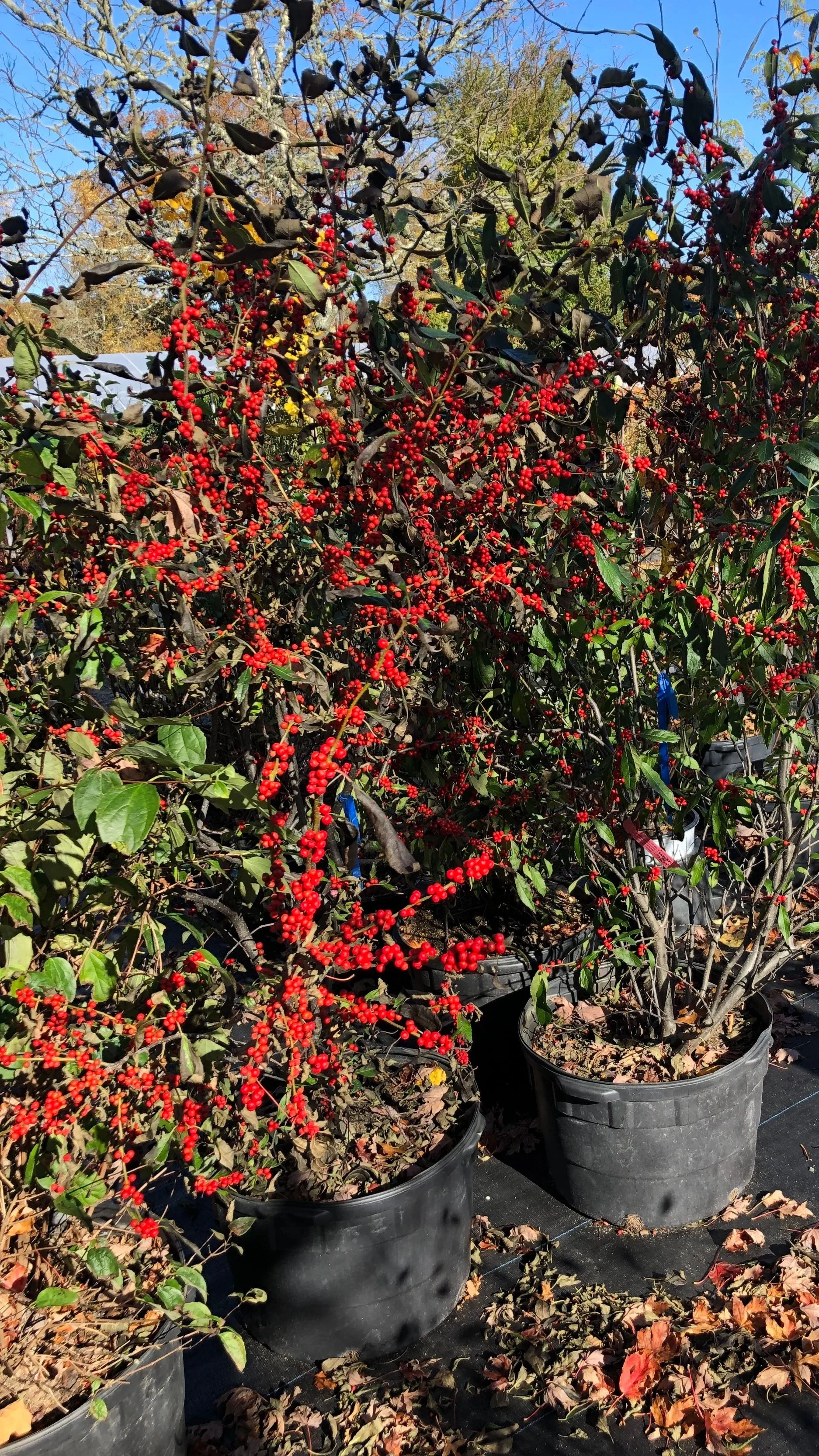
Leaves falling off and berries remain
******************
Cultivars for Every Landscape
Because winterberry is dioecious, meaning individual plants are strictly male or female, you must plant in multiples (at least one male pollinator for every group of female fruit-bearing shrubs) to get that iconic berry display. Popular cultivars include:
Female Fruit-Bearers: Winter Red (classic, heavy-fruiting), Winter Gold (striking amber-orange berries), and Little Goblin Red (a compact, 3-4 ft option perfect smaller spaces).
Male Pollinators: Southern Gentleman (pairs with Winter Red or Winter Gold) and Little Goblin Guy (designed specifically to pollinate the Little Goblin series).
******************
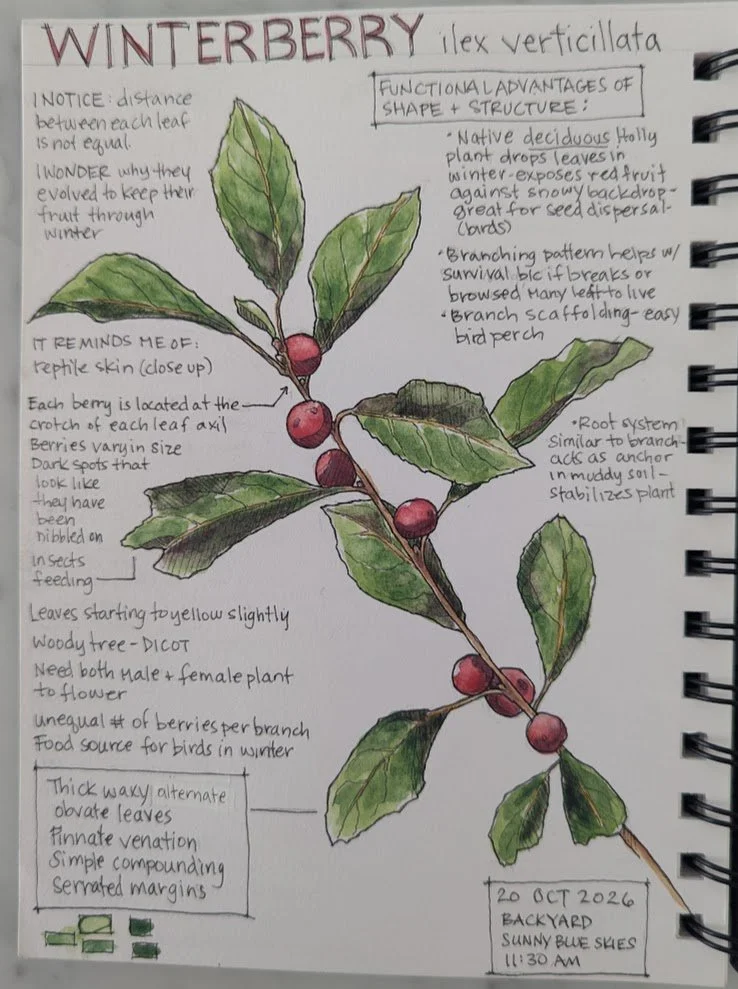
Deepening
Connection:
Winterberry Through a Nature Journaling Lens
When we encounter a plant like winterberry in the colder months, it offers a wonderful invitation to slow down. This is where I find nature journaling to become such a powerful practice.
Nature journaling isn’t about creating a botanical masterpiece or worrying about whether you can draw; it’s a tool for shifting from passive viewing to active sensory engagement. When you stand before a winterberry shrub this fall and winter:
Take a few slow breaths in the crisp air. Notice the crunch of frozen ground beneath your feet and the stark, geometry of the bare branches.
Instead of just noting "it has red berries," use your journal to ask functional questions: Why are the berries clustered so tightly at the leaf nodes? How does dropping its leaves help the plant conserve energy and signal to birds?
Try sketching just a single twig. Notice how the alternate leaves left tiny scars on the bark, or how the bark's texture differs from other shrubs around it.
By moving past simple observation into active, curious inquiry, we don't just learn about the plant, we tune our own nervous systems to the rhythms of the natural world, stepping gently into the role of environmental stewards.