
BONES OF THE GARDEN
Broadleaf evergreens
Often in spring, it’s easy to get excited about the fresh smells and colors of early spring flowers that first burst to life after winter. But beneath all that seasonal excitement, it’s the evergreens that quietly hold everything together. They are the bones of the garden, the structure and backdrop. While flowers come and go, evergreens carry the landscape through every season. Broadleaf evergreens, in particular, offer year-round texture and depth, anchoring the garden in winter and elevating it in spring, summer, and fall. They don’t just fill space, they give the garden its shape.
Rhdodendrons are wonderful for year round screening
Skip Cherry Laurel
The Benefits of Broadleaf Evergreens
They provide year round interest
Great for privacy screening
Drought resistant, once established
Provides habitats for birds and other small animals
Pollinator friendly!
Great for Martha’s Vineyards climate zone 7A
Winter Sun Mahonia
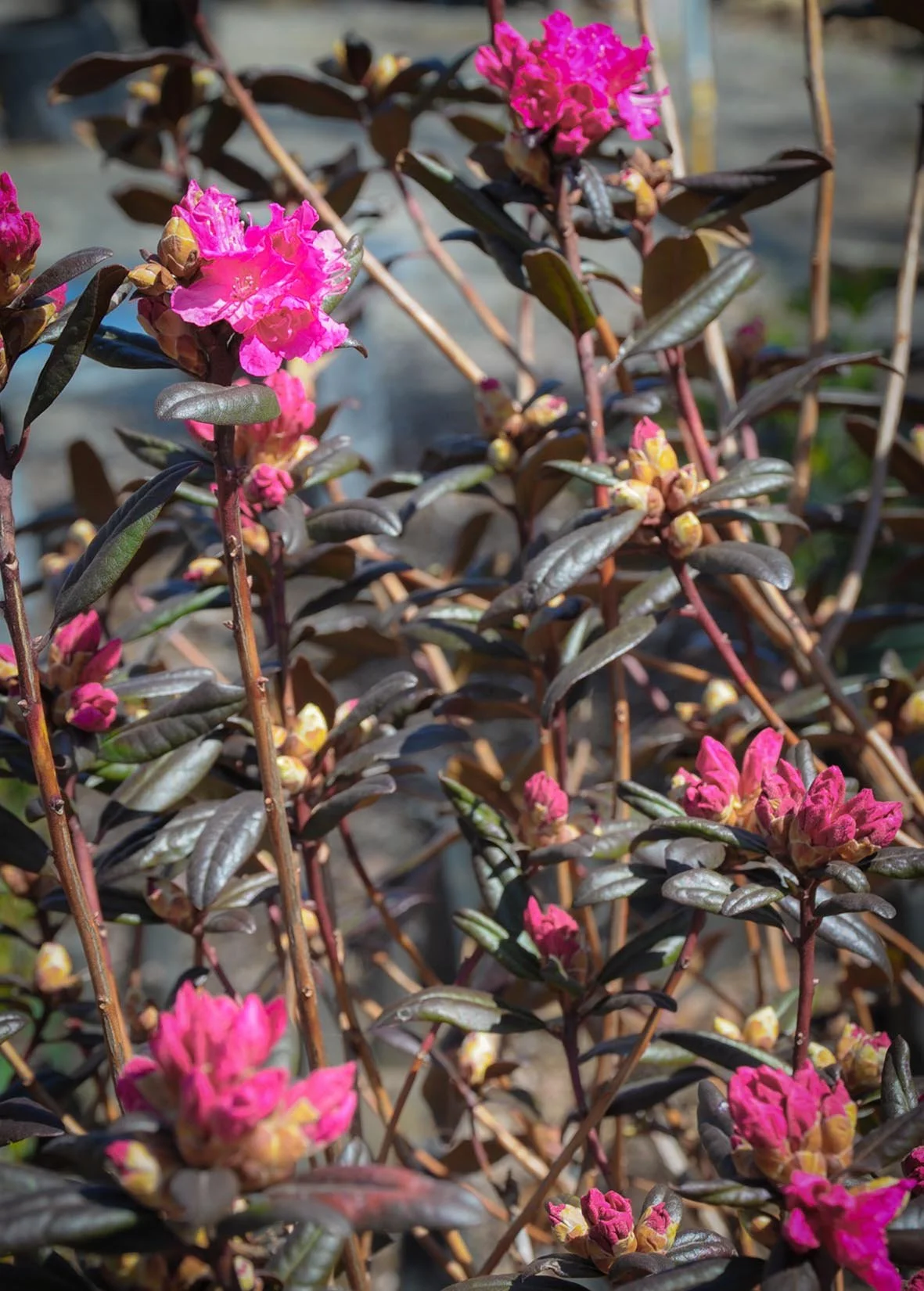
Most broadleaf evergreens have a spectacular display of spring blooms!
Even better, they don’t all flower at once. Skimmia and Pieris japonica lead the way in early spring, followed by azaleas and rhododendrons creating a long, layered season of color.
Pieris japonica
Japanese Skimmia
Azalea
Rhododendron
****************
BROADLEAF EVERGREENS
__________________________________________________
SKIP CHERRY LAURELS
Skip Cherry Laurels are vibrant evergreen trees that can create dense privacy hedges for any yard. Skip laurels grow to be 10-18 feet tall and 5-7 feet wide, with a moderate growth rate of roughly 24 inches per year. While they thrive in full sunlight, Skip laurels also fare very well in the shade. Their dense foliage is glossy green year-round. In the springtime, you’ll be rewarded with fragrant white blossoms that attract all kinds of pollinators. In fall and winter, Skip laurel trees produce red berries that attract songbirds.
Make excellent privacy screens
Green year-round
Fragrant, white blossoms in spring
Drought-tolerant
Smaller leaves than other laurels that give a neat, compact look
Deer-resistant
Skip Cherry Laurel
Skip Cherry Laurel
****************
MAHONIA
Mahonia x media ‘Winter Sun’ is a small to medium evergreen shrub growing up to 10 feet tall and 5 feet wide, with an upright form and large fern-like leaves arranged in whorls on sturdy, branching stems. In late fall to early winter, it produces fragrant yellow flower spikes followed by clusters of waxy blue berries loved by birds. A striking focal point in the winter garden.
PLANTING TIP
Plant Winter Sun Mahonia in a sheltered site, ideally with an eastern exposure. It prefers moist, well-drained soil. Plant it where its winter blooms and fragrance can be enjoyed up close, along a path or near a seating area.
Winter Sun Mahonia
Winter Sun Mahonia and Daffodils
Winter Sun Mahonia
****************
AZALEAS
This spring, our flowering shrubs include the familiar evergreen rhododendrons and azaleas. Azaleas are part of the rhododendron family and represent a diverse genus with many species, including both evergreen and deciduous forms. In general, deciduous azaleas bloom slightly later than evergreen types, flowering on old wood before the new leaves emerge.
Some deciduous, fragrant azaleas:
Azalea viscosum, native swamp azalea: These bloom a little later and often bloom before the foliage emerges, making them extra showy. The fragrant blooms will perfume your entire property, growing 8-10ft tall and 6-8ft wide.
My Mary: A yellow, fragrant, deciduous, spring blooming azalea that attracts pollinators and butterflies, growing 4-5ft tall.
Rhododendron prunifolium: This is a species azalea (not a hybrid). It is a native wild azalea.
There are some deciduous Weston hybrids with viscosum that stay smaller. If an 8ft shrub is too big for your spot try one of these :
Lemon Drop: A yellow blooming fragrant deciduous azalea
Innocence: A white blooming fragrant deciduous azalea
To see these deciduous azaleas in their full splendor they will be blooming in a few weeks at the Polly Hill Arboretum!
deciduous azalea

Azalea 'Landmark', evergreen azalea
****************
BUXUS (BOXWOOD)
Buxus is an evergreen deer resistant shrub that typically bloom in May. They do best in some afternoon shade and are a great back drop for deciduous plantings. Even though the flowers seem insignificant, they still produce nectar and pollen for beneficial insects.
Buxus sempervirens: This variety has an elegant columnar habit with a soft and lush foliage of ovate, lustrous leaves. Its deep green foliage has shown good resistance to boxwood blight.
Buxus microphylla var. japonica 'Winter Gem' : “An excellent evergreen shrub for small hedges. Among the hardiest of the small-leaved boxwoods, the rich green foliage can acquire a golden bronze hue in cold winter zones, but is one of the first to become green again in spring. Makes a wonderful addition to formal gardens, providing year-round interest.” (monrovia)
Buxus x Green Gem
Buxus x Green Mountain
Buxus x Winter Gem
Buxus microphylla v. Japonica Morris
****************
HOLLIES
We love hollies at Vineyard Gardens! Our appreciation traces back to Chuck Wiley, the original owner, who grew up near Fernbrook Nursery in New Jersey, known for its beautiful American hollies (Ilex opaca). That early exposure sparked a lifelong admiration. American hollies are also more deer resistant than many other types, and for berry production, you’ll need both a male and female plant nearby.

American holly, Ilex opaca
“The stout, stiff branches of this pyramidal evergreen bear dark green, non-glossy, spine-tipped leaves. Bright red berries occur on the female plants. Many varieties are grown for ornament, shade, and hedges. You must have both a male and female plant to have berries, The male must be the same holly species as the female and bloom at the same time. This is a slow-growing tree (but slower growing is stronger). Berries are attractive and a good winter food source for birds.” (Ladybird Johnson Wildflower Center) The height of American holly grows up to 25ft. They can be pruned to be kept smaller.
Ilex opaca ‘Jersey Knight’: A male cultivar that is considered to be a good pollinator. Typically grows 7-8’ tall and spreads to 3-4’ wide over the first 10 years.
Ilex opaca ‘Jersey Princess’
Ilex opaca ‘Portia Orton’
Ilex opaca ‘Satyr Hill’
Inkberry, Ilex glabra
“A mound-shaped, colony-forming shrub 6-12 ft. tall and wide. Lance-shaped, sparingly-toothed, glossy, leathery foliage varies in color from dark- to light-green both in summer and fall. Inconspicuous flowers are followed by black berries which persist well into winter. This species differs from all other evergreen hollies by lacking spines on the leaves, only having teeth toward the tip of the leaves.” (Ladybird Johnson Wildflower Center)
Ilex glabra ‘Compacta’
Ilex glabra ‘Shamrock’
Ilex x Oak leaf
Inkberry, Ilex glabra ‘Shamrock’
Winterberry, Ilex verticillata
“The leaves of Common winterberry are not shaped with sharp teeth like other hollies and are not evergreen. The purplish green foliage turns black, in fact, with the first frost. The inconspicuous flowers, however, are followed by dense clusters of bright red berries that remain on the branches throughout winter. Winterberry is a globular, upright, medium-sized shrub, typically 6-10 ft. tall. Extremely showy in late fall and early winter when covered with their bright red fruit, these shrubs are either male or female--a trait typical of the holly family. Birds are readily attracted to them.” (Ladybird Johnson Wildflower Center)
Ilex verticillata Southern Gentleman
Ilex verticillata Winter Gold
Ilex verticillata Winter Red
Ilex verticillata Little Goblin Guy
Ilex verticillata Little Goblin Red