• Home
  • ABOUT
    • PROJECTS
    • Landscape Teams
    • LANDSCAPE DESIGN
    • LANDSCAPE CONSTRUCTION
    • LANDSCAPE MAINTENANCE
    • Nursery
    • SALES & DISCOUNTS
    • BULK MATERIAL
    • PLANT PROFILES
  • Application
  • EVENTS
  • FIELD NOTES
  • TESTIMONIALS
  • Contact
Menu

Vineyard Gardens

484 State Road
West Tisbury, MA, 02575
508.693.8512
Landscaping & Garden Center

Your Custom Text Here

Vineyard Gardens

  • Home
  • ABOUT
  • LANDSCAPING
    • PROJECTS
    • Landscape Teams
    • LANDSCAPE DESIGN
    • LANDSCAPE CONSTRUCTION
    • LANDSCAPE MAINTENANCE
  • NURSERY
    • Nursery
    • SALES & DISCOUNTS
    • BULK MATERIAL
    • PLANT PROFILES
  • Application
  • EVENTS
  • FIELD NOTES
  • TESTIMONIALS
  • Contact

[PLANT PROFILE] FORGET ME NOTS

April 13, 2023 Karen Logan

Forget Me Nots illustration by karen blackerby logan

FORGET ME NOTS

(MYOSOTIS)

ORIGIN

Myosotis is a Greek word meaning mouse’s ear which it’s foliage is thought to resemble. It is native to Europe and is in the family Boraginacea.

AN EARLY SEASON PLANT

We sell them early in the season in 5” black perennial pots.

  • This year our Forget Me Nots (Myosotis) are available in blue and pink. We do not carry pink every year.

  • The Myosotis we carry is Myosotis sylvatica or woodland Myosotis.

  • Forget Me Nots readily reseed themselves and will make their home throughout your garden. This is a good thing but it can also be a problem that is easily solved with a little weeding. Pull them out where you do not want them. Yet with their pretty blue flowers in early summer you may have trouble pulling them out! Another way to control their spread is to deadhead them right after flowering before they have time to set seed and spread.

  • They are beautiful flowers to have in a woodland border.

Forget Me Nots are only available in Spring!

tip of the week

grow massachusetts

In SPRING PLANTS, PERENNIALS, APRIL, PLANT PROFILES Tags Forget Me Nots, Myosotis, Spring perennials, vineyard gardens, woodland border perennial
Comment

[PLANT PROFILE] ASPARAGUS

March 29, 2023 Karen Logan

ASPARAGUS COMING SOON!

WE WILL LET YOU KNOW WHEN THEY ARRIVE. ONCE THEY ARRIVE THERE IS A SHORT PLANTING WINDOW!

In the past we carried Jersey Giant and Purple Passion.

“There are a few perennial vegetables which actually are some of the easiest ones to grow. My all-time favorite is asparagus which can live for 20 or more years. Asparagus continually get bigger and more productive with just a little bit of care. The most important way to care for them is to keep the weeds out in order for them to thrive. They are one of the first vegetables to come up every spring and are absolutely delicious and healthy. “ Chuck Wiley, owner & founder of Vineyard Gardens Landscaping

Bare root asparagus

GROWING

Asparagus are a long lived perennial and should be planted in a dedicated bed.

  • Asparagus requires well drained fertile soil and can not tolerate wet feet.

  • Ensure planting site is well weeded.

  • Plant in full sun.

  • An excellent weed killing technique is to cover with cardboard 8 weeks prior to planting.

  • Make an 8” deep trench with a 4” ridge and loose soil down the middle.

  • Plant one bare root asparagus every 1’ between plants and 3’ between rows.

  • Splay the long roots down the sides of the ridge.

  • Water well to establish.

  • Top dress asparagus bed with plenty of premium compost every fall.

  • Since the roots are deep, you can hoe out weeds to about 3” deep as long as you do it before March 15th.

HARVESTING

Plants need to establish for 2 or 3 seasons before their first harvest, then they have abundant yields.

  • In the third year, harvest tender spring shoots at about 4.5”.

  • Do not harvest until shoots are pencil thick.

GET YOUR HANDS MUDDY & HAVE FUN!

In PERENNIALS, SPRING PLANTS, VEGETABLE GARDENS, MARCH, PLANT PROFILES Tags asparagus, bare root asparagus, growing asparagus, harvesting asparagus, Jersey Giant Asparagus, Purple Passion Asparagus
Comment

[PLANT PROFILE] PANSIES & VIOLAS

March 22, 2023 Karen Logan

Pansy illustration by karen blackerby logan

pansies & tulips

PANSIES & VIOLAS

“Kids love the story of the fairy that lives in the pansy flower that Lauren Crosby made up. She would tell the story to kids during field trips to Vineyard Gardens. First she would carefully peel the outer 5 petals, one at a time. Exposing the female reproductive structure standing tall in the center. This was the fairy that lived inside the pansy.” -Chris Wiley, owner&founder at Vineyard Gardens Nursery

A BRIEF HISTORY

Pansies & Violas are of the genus Viola. The original plant species was viola tricolor, a wildflower of Europe and Central Asia. To the modern horticulturist, the pansy is the larger of the two flowering cultivars. The pansy is a hybrid plant cultivated as a garden flower. The name pansy is derived from the word pensee meaning “thought” and was regarded as a symbol of remembrance.

CARE & INFORMATION

  • Both do well in full sun or partial shade and need well drained soil. They like cool weather and can survive light frosts, snow and even sometimes overwinter. They are one of the first flowers available in spring.

  • They tend to get long and leggy in the heat of summer. Dead heading will extend bloom.

  • They dry beautifully when laid flat within pages of heavy books, and once dried can be used to make cards or other art projects.

In SPRING PLANTS, MARCH, PLANT PROFILES Tags Pansies, Violas, Care for pansies violas, pansies for art, pansy symbol of rememberance
Comment

VIBURNUM

September 21, 2022 Karen Logan

Viburnum plicatum

VIBURNUM

Viburnum are a very popular landscape shrub, both attractive and useful. With the many cultivars available it’s likely to find one to suit your garden. Fragrant viburnums flower in the spring and gives way to berries in the fall. If you’d like your viburnum to produce berries for the birds, you'll need to plant several different varieties that bloom at the same time so plants can cross-pollinate.

***************************************

Fall Interest Viburnums

There are many viburnums which have fabulous fall color and berries.

  • Viburnum trilobum (Highbush Cranberry): Known for its berry production in the fall. Dark green leaves turn purplish-red in autumn, alongside drooping clusters of bright red berries. Typically matures to 8-12 feet tall.

  • Viburnum plicatum: These are Chris Wiley’s favorite Viburnum in flower.

  • Viburnum dilatatum 'Cardinal Candy': Known for their drooping red berries.

  • Viburnum dilatatum 'Michael Dodge': Known for their drooping yellow berries.

Viburnum dilatatum ‘Michael Dodge’ and some Virginia Creeper

Viburnum plicatum

Native Viburnums

  • Viburnum dentatum (arrowwood viburnum): Native to Martha’s Vineyard, Viburnum dentatum grows wild all over Chilmark and the woods of West Tisbury.. Non-fragrant flat-topped white flowers appear in late spring. Flowers give way to blue-black, berries which are quite attractive to birds and wildlife. Tolerates light shade. It is useful in restoration projects or in natural plantings. Deer resistant. We carry a cultivar called Blue Muffin.


Evergreen Viburnums

  • Viburnum 'Pragense (Prague viburnum): Creamy white flowers in spring gives way to berries in early fall which first appear red and then change to glossy black. Typically matures to 10-12 feet tall. Plant in full sun to part shade.

  • Viburnum rhytidophyllum (Leatherleaf viburnum): A large rough textured evergreen shrub. Creamy white flowers in spring.


Fragrant Spring Blooming Viburnums

  • Viburnum carlessi (Korean Spice viburnum): A wonderfully fragrant cultivar. Reddish pink buds open in late March/early April and progress into 3” snowball like clusters of fragrant blooms. Plant in sun to part shade. Typically matures to 4-5 feet tall but may reach a height of 8' in the right conditions.

  • Viburnum carlocephalum (Fragrant Viburnum): A multi stemmed shrub with an open and rounded form. Fragrant snow-ball type blooms in the spring and reddish fall color. Fruit production happens best when planted in groups. Good drought tolerance once established. Grows 6-10 feet tall and wide.

  • Viburnum burkwoodii (Burkwood Viburnum): An early spring beauty is Viburnum x burkwoodii which is from a group of Viburnums called Korean Spice or Snowball Viburnum. Burkwood Viburnum grows quite large, under ideal conditions 10’ x 10. It blooms clusters of pinkish white spring flowers with an insanely delicious fragrance in late April-early May. Beautiful dark green foliage. Use as a hedge, screen or accent plant.

Fragrant Viburnum

Viburnum x burkwoodii

Viburnum x burkwoodii [photo credit: keith kurman]

autumn garden

maple trees

for best fall color

In SEPTEMBER, SHRUBS, FALL PLANTS, PLANT PROFILES Tags fall shrubs, viburnum, fragrant viburnums
Comment

[PLANT PROFILE] LOBELIA

September 12, 2022 Karen Logan

Lobelia ‘Great Blue’. A blue counterpart of the Cardinal Flower. Desirable plant for woodland gardens especially since it blooms bright blue in late summer.

LOBELIA

30% off

A North American native plant that has spires of colorful hood-like flowers that open from bottom to top. Lobelias are typically found in wet, swampy soil or woodlands. They are a perfect choice for low spots in your garden that stay too wet for most plants. Although, given enough water Lobelias will be fine with more sun. They are an excellent choice for partial shade gardens.

Two perennial species we carry are Lobelia siphilitica, the Native Great Blue, and Lobelia cardinalis, Cardinal flower.

We carry the Lobelia cardinalis in its native green leaf form, as well as Queen Victoria, a red leaf form that won the Royal Horticultural Society’s Award of Garden Merit. A newer cardinalis hybrid we are offering is the Starship Series. This series is a little shorter and better branched. We usually have it in scarlet, rose and sometimes blue.

Lobelia Starship Deep Rose & Scarlet Bronze Leaf

Lobelia Starship Deep Rose & Scarlet Bronze Leaf. Rich bronze or purple foliage throughout the growing season. Adds a bold color for the late summer to early autumn garden.

*************************

CARE

  • Prefer fertile, evenly moist soil.

  • Can be divided every 2-3 years in spring.

  • Allow to self sow.

  • Winter over with stems on.

  • Can be pinched back before flowering to produce more compact plants

*************************

USES

  • Woodland paths

  • Perennial beds and border gardens with moist, well-drained soil.

  • Given enough water they can be fine with more sun.

  • Great choice for partial shade gardens

  • Well-suited for use in rain gardens, around ponds and streams and other moist areas.

Attracts butterflies and hummingbirds. Pairs well with ferns or heuchera.

Lobelia siphilitica and Aster

Ornamental Grasses

Autumn Garden

In GARDEN TIPS, FALL PLANTS, SEPTEMBER, PLANT PROFILES Tags perennial plant, fall blooms, Lobelia, Lobelia Great Blue, Lobelia Starship Deep Rose, Lobelia Starship Scarlet, Cardinal Flower
Comment

[PLANT PROFILE] CRAPE MYRTLE

September 6, 2022 Karen Logan

September Border: Crape Myrtle is the white ‘Natchez’ & Vitex

Lagerstroemia

[CRAPE MYRTLE]

An all-season performer that shows off colorful foliage in fall, attractive exfoliating bark in winter and showy flowers in the summer! Crape Myrtle bloom from July to September, with some varieties blooming until first frost. Flowers have a crepe like texture and range in color from red, purple, pink, orchid and white. There are several varieties that range in size from 2-foot shrubby dwarfs to large trees.

Crape Myrtles’ showy flowers adds a punch of color in late summer & early fall.

Crape Myrtle (front), Rudbeckia & Hibiscus

*************************

HISTORY

Better known by their common name of Crape Myrtle, Lagerstroemia is a genus of about 50 plants native to the Indian subcontinent and Southeast Asia. The Genus is named after the director of the Swedish East India Company, Magnus van Lagerstrom, who supplied Carl Linnaeus with plants he collected.

Only 2 species are primarily used in gardening and landscape horticulture. The Lagerstroemia indica from China and Korea was introduced to Charleston, North Carolina in 1790 by French botanist Andre Michaux. In the wild it is a large multi stemmed shrub but 200 years of cultivation have resulted in a huge number of cultivars with varying characteristics.

Another species from Japan Lagerstroemia fauriei is becoming increasingly important as a landscape plant and as a parent in hybrids with L. Indica. This species is more resistant to fungal diseases, has highly ornamental bark and is more cold hardy than L. Indica making it valuable as genetic material for hybridization.

FALL IS A GREAT TIME TO PLANT. allowS CRAPE MYRTLE time to establish their roots before going dormant in winter.

Lagerstroemia Berry Dazzle

CARE

  • Prefer full sun. The more sun the more blooms!

  • Once established, Crape Myrtles are quite drought tolerant.

  • They need good drainage.

  • A common mistake is over-pruning.

    *************************

    USES

    Crape myrtles make great additions to any size garden. Some ideas for how to use them:

  • Plant multiple dwarf or medium-size varieties together to form a hedge.

  • Use dwarf varieties as colorful additions in borders and beds.

  • Dwarf varieties make excellent choices for large containers.

  • A good choice near walkways and driveways.

  • Use larger varieties as an individual accent

*************************

we have dwarf varieties available to add to your garden if you don’t have space for a larger speciman.

Crape Myrtle ‘Like a Latte’ [photo: walters gardens]

CRAPE MYRTLE VARIETIES WE HAVE AVAILABLE

Lagerstroemia 'Like A Latte' (Dwarf)

Lagerstroemia 'Barista Cherry Mocha' (Dwarf)

Lagerstroemia 'Tuscarora'

Lagerstroemia 'Tonto'

Lagerstroemia 'Muskogee'

Lagerstroemia 'Muskogee Lavender'

Lagerstroemia 'Natchez White'


Lagerstroemia 'Cherry Mocha' [photo: walters garden]

Crape Myrtle ‘Tuscarora’ [photo: monrovia]

Crape Myrtle ‘Muskogee’ [photo credit: monrovia]

Tonto Crape Myrtle [photo: monrovia]

Fall Trees & Shrubs

Autumn Garden

In GARDEN TIPS, FALL PLANTS, SEPTEMBER, PLANT PROFILES Tags perennial plant, fall blooms, crape myrtle, fall tree
Comment

[PLANT PROFILE] ANEMONE

September 1, 2022 Karen Logan

Anemone [illustration by karen blackerby logan]

JAPANESE ANEMONE

[WINDFLOWER]

A common name for Anemone is windflower because the delicate poppy-like flowers sway in the breeze. The Greek word anemos translates as "wind."

Japanese Anemones add a wonderful splash of color to the autumn garden when other perennials are beginning to fade. With one of the longest bloom times, they are a great season extender in a perennial garden. They spread when they are happy and can tolerate moist soils!

*************************

CARE

  • Japanese Anemones are fabulous perennials that thrive ideally in a little afternoon shade. They can tolerate full sun as long as the soil is moist.

  • They prefer rich, moist soil. Water the plants regularly when it does not rain.

  • Bloom time: Mid-Summer to Late Fall 6-8 weeks

USES

Borders, cottage gardens, coastal gardens, naturalized areas such as meadows

White anemomes stand out nicely at night. White gardens are sometimes called moonlight gardens .where the white flowers light up at night.

Japanese Anemone and Impatiens balfourii [photo by keith kurman] Anemones contain basal leaf clumps from which long flower stems grow to support delicate flowers.

Japanese anemone bloom abundantly from mid-summer to late fall, giving gardeners a shade-loving alternative to the autumn mums and asters.

**********************************

JAPANESE ANEMONES WE CARRY AT VINEYARD GARDENS

Japanese Anemones are mostly hybrids. Some are taller than others, up to 3 feet. The more popular ones are single flowers but we often carry a pink double called Pamina. Next year we are ordering a white double called Whirlwind.

  • Wild Swan: White with a bluish tinge behind the petals

  • Honorine Jobert: White single flowers

  • September Charm: Pink single flowers

  • Robustissima: Pink single flowers

  • Bressingham Glow: Pink flowers

  • Pamina: Pink double flowers


    **********************************

Japanese Anemone in their full glory and the bees taking it all in!

Anemones

fall blooming anemones

Autumn Garden

In GARDEN TIPS, FALL PLANTS, SEPTEMBER, PLANT PROFILES Tags perennial plant, Anemone, Japanese Anemone, fall blooms
Comment

[PLANT PROFILE] CLERODENDRUM

August 1, 2022 Karen Logan

Clerodendrum trichotomum

CLERODENDRUM TRICHOTOMUM

[HARLEQUIN GLORY-BOWER]

In mid-summer and fall Clerodendrum adds a striking show when other woody plants are not in bloom!

MID-SUMMER BLOOM

Clerodendrum trichotomum (Harlequin Glory-Bower) is the only Clerodendrum hardy this far north. A deer resistant, flowering, deciduous shrub that begins blooming mid-summer with fragrant soft white flowers. The flowers have a sweet delicate aroma and are large enough to make a statement. A great addition to a late season garden when many other shrubs are not in bloom.

FALL INTEREST

In the fall, Clerodendrum has a wonderful effect. The flowers turn into a very interesting seed pod, bright purplish-blue berries adorned by thick star-shaped red calyces. In addition, the foliage changes into a beautiful yellow fall color. A show stopper indeed!

Clerodendrum has large heart shaped leaves which produce a peanut odor when crushed.

attracts Hummingbirds, butterflies, honeybees & other pollinators!


WHERE TO PLANT

  • Clerodendrum is a large shrub that grows between 8-10’ tall.

  • Stands best alone because it takes over. Plant it where it has plenty of room to spread and colonize. It will spread as far as you let it but it can be controlled.

  • Full sun to part shade. Clerodendrum prefers full sun for best shape and flowering but can tolerate and flower in partial shade. In partial shade, it’s already loose habit will be even more open.

“Our Clerodendrum is blooming now and fills our entire patio with a sweet fragrance!” Chris Wiley, co-owner Vineyard Gardens

Clerodendrum trichotomum in the spring/early summer

Clerodendrum trichotomum in the summer

Clerodendrum trichotomum in the fall.

Clerodendrum

Clerodendrum

deer resistant

PLANTS

August Plants

In GARDEN TIPS, AUGUST, DEER RESISTANT, PLANT PROFILES Tags flowering shrubs, Deer resistant shrubs, pollinator friendly shrubs, harlequin glory bower, mid summer flowering shrub, Clerodendrum trichotomum
Comment

[PLANT PROFILE] CALYCANTHUS

July 19, 2022 Karen Logan

CALYCANTHUS 'APHRODITE’

Calycanthus 'Aphrodite', a Proven Winners selection, is a cross between our native calycanthus and Asian species x Sinocalycanthus. It is a large shrub with glossy leaves that can grow between 5-10ft tall by 5-10ft wide. Calycanthus 'Aprodite' does well in full sun and can also handle partial shade.

In JULY, SHRUBS, PLANT PROFILES Tags Calycanthus 'Aphrodite', shrub, flowering shrub
Comment

[PLANT PROFILE] HEUCHERA

June 30, 2022 Karen Logan

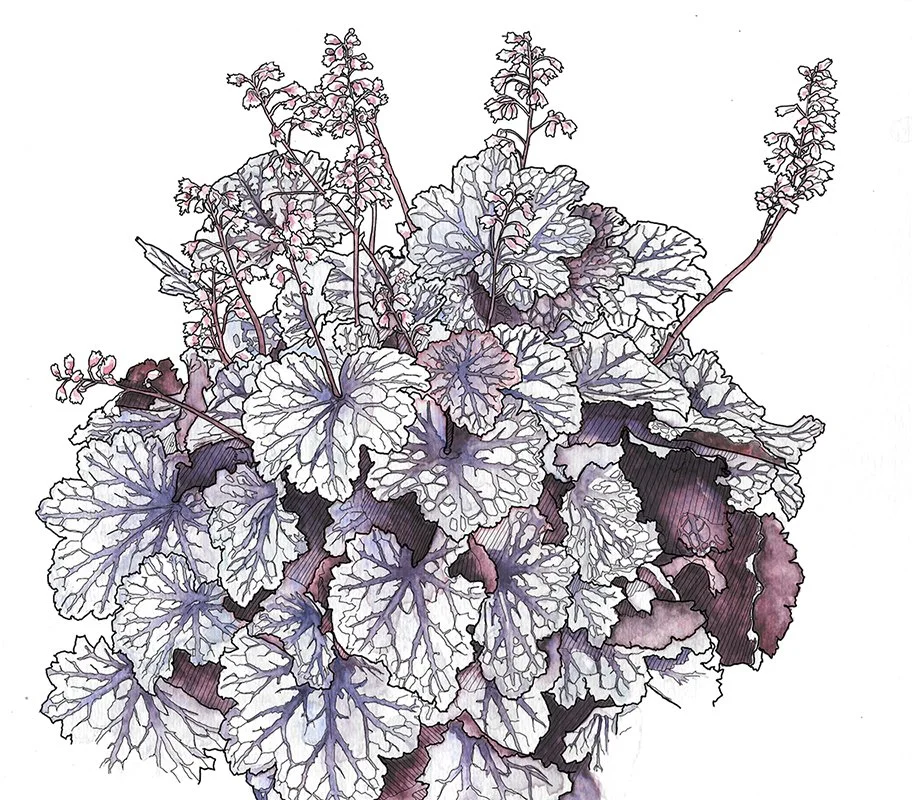
Heuchera [illustration by karen blackerby logan]

HEUCHERA

(CORAL BELLS)

Foliage Stars of the Shade Garden

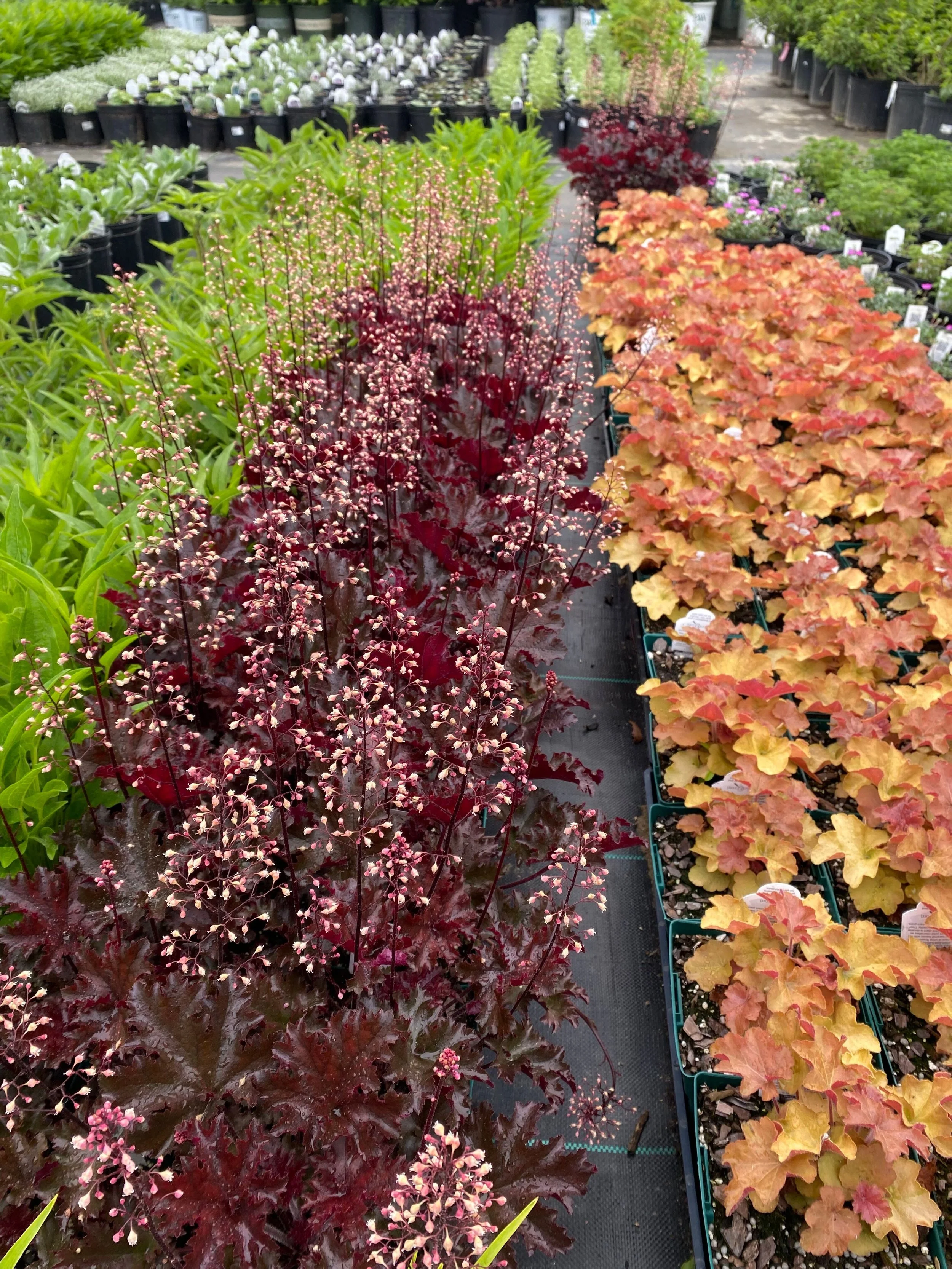
When it comes to perennials that combine long-lasting beauty, versatility, and ecological benefits, few plants rival Heuchera, commonly known as Coral Bells. These North American natives are prized for their dazzling foliage and delicate blooms, making them a favorite in shade gardens, woodland edges, and even containers.

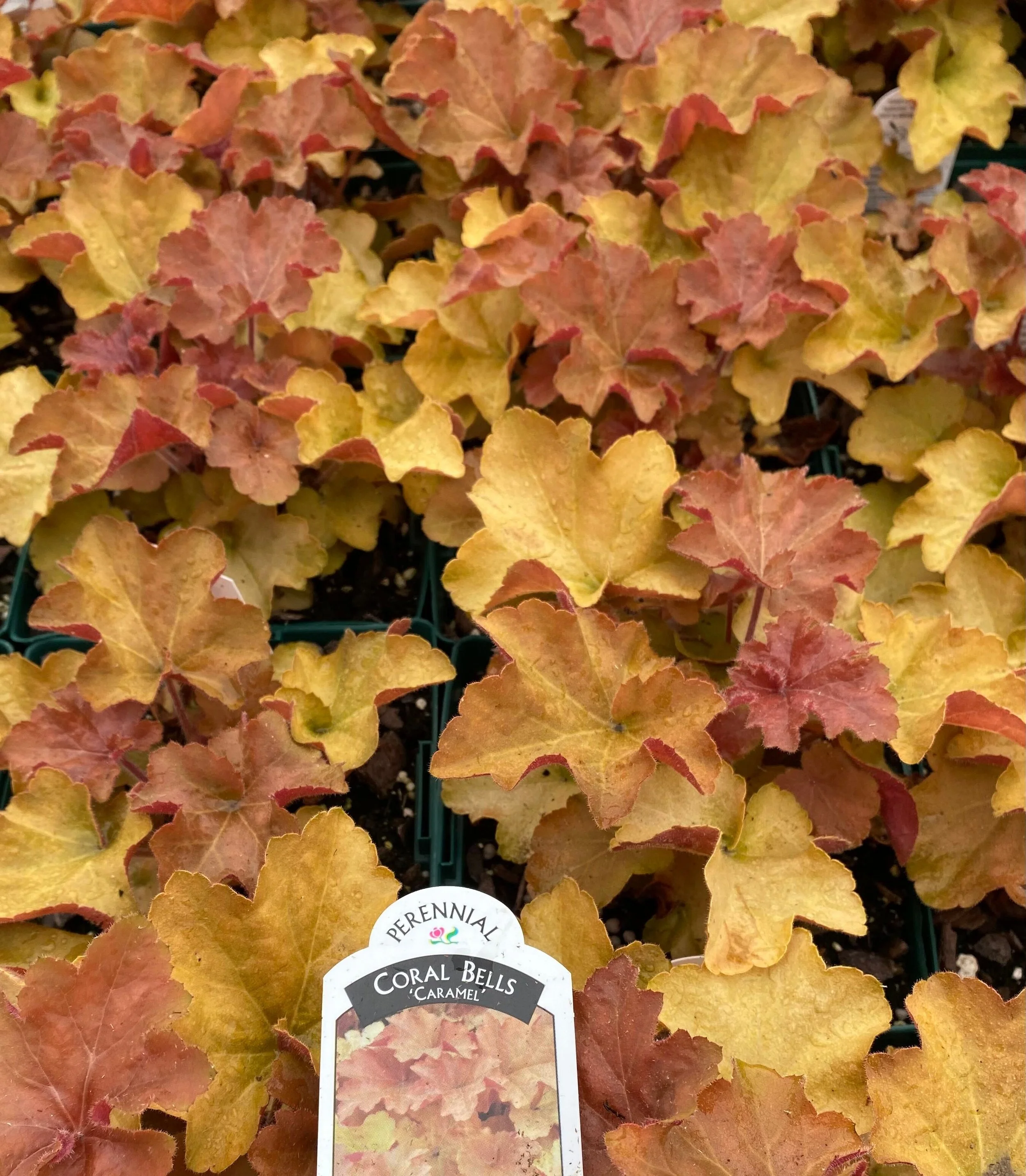
Heuchera ‘Dolce Silver Gumdrop’

Not Just Pretty Leaves

While many gardeners love Heucheras for their richly colored leaves, from lime green to burgundy and even dark purple, their graceful flowers are not to be overlooked. Each summer, tall flower stalks rise above the foliage, blooming for 3-4 weeks with airy, bell-shaped flowers that attract hummingbirds. The flowers of Heuchera sanguinea give the plant its common name, Coral Bells, with vivid cerise blooms native to warm, dry canyons in Mexico, Arizona, and New Mexico.

A Foliage Powerhouse

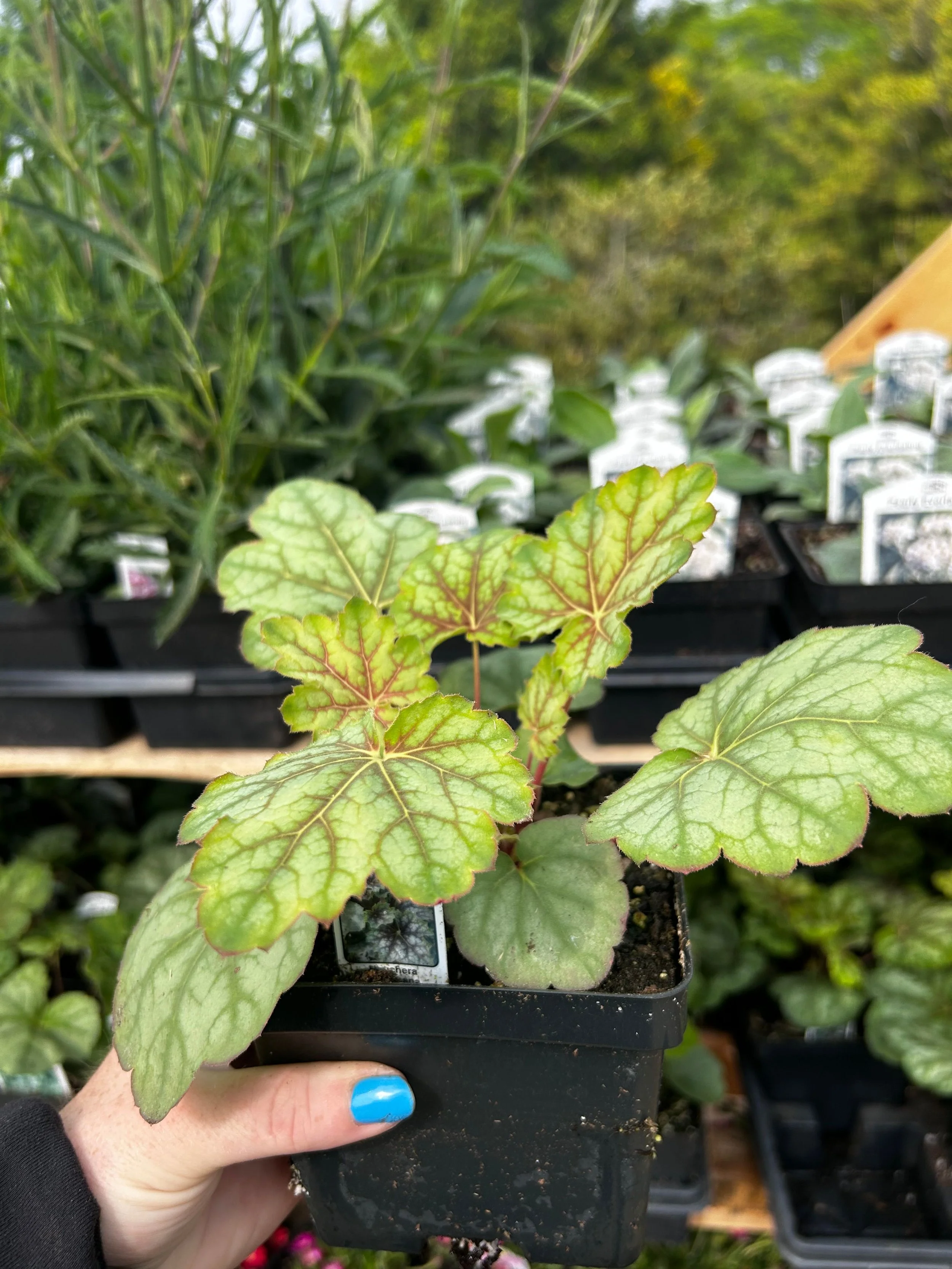
Heucheras are truly standout foliage plants. Their rosettes of textured leaves stick around from early spring through late fall, and some cultivars are even semi-evergreen in mild climates. With a low, mounding habit, most varieties reach 8–12 inches in height and 1–2 feet in spread, while the flower spikes add height, 1-3 feet, during bloom.

There has been an explosion of Heucheras cultivars in the last decade. Hybridization is common, due to the fact that the species often intergrade with one another. The increasingly popular Heucherellas (Heuchera × Tiarella) combine the best traits of both parent plants.

Try planting ground covers instead of mulching. They are just as effective, if not more so, at keeping out the weeds!

Heuchera ‘Dolce ‘Cherry Truffles’

Heuchera

Heuchera americana ‘Dales Strain’, the one we do from seed.

Where & How to Plant

Light:

  • Most Heucheras thrive in partial shade or dappled sunlight, but many red and yellow-leafed varieties tolerate more sun.

  • In the Mid-Atlantic and Northeast, shade is usually best for optimal performance.

Soil & Water:

  • Plant in well-drained, compost-rich soil. Keep consistently moist, especially in containers.

  • Heucheras are ideal for woodland gardens, rock gardens, slopes, and as ground covers beneath trees and shrubs.

Heucheras are DEER REISISTANT!

Heucherella Pink Revolution

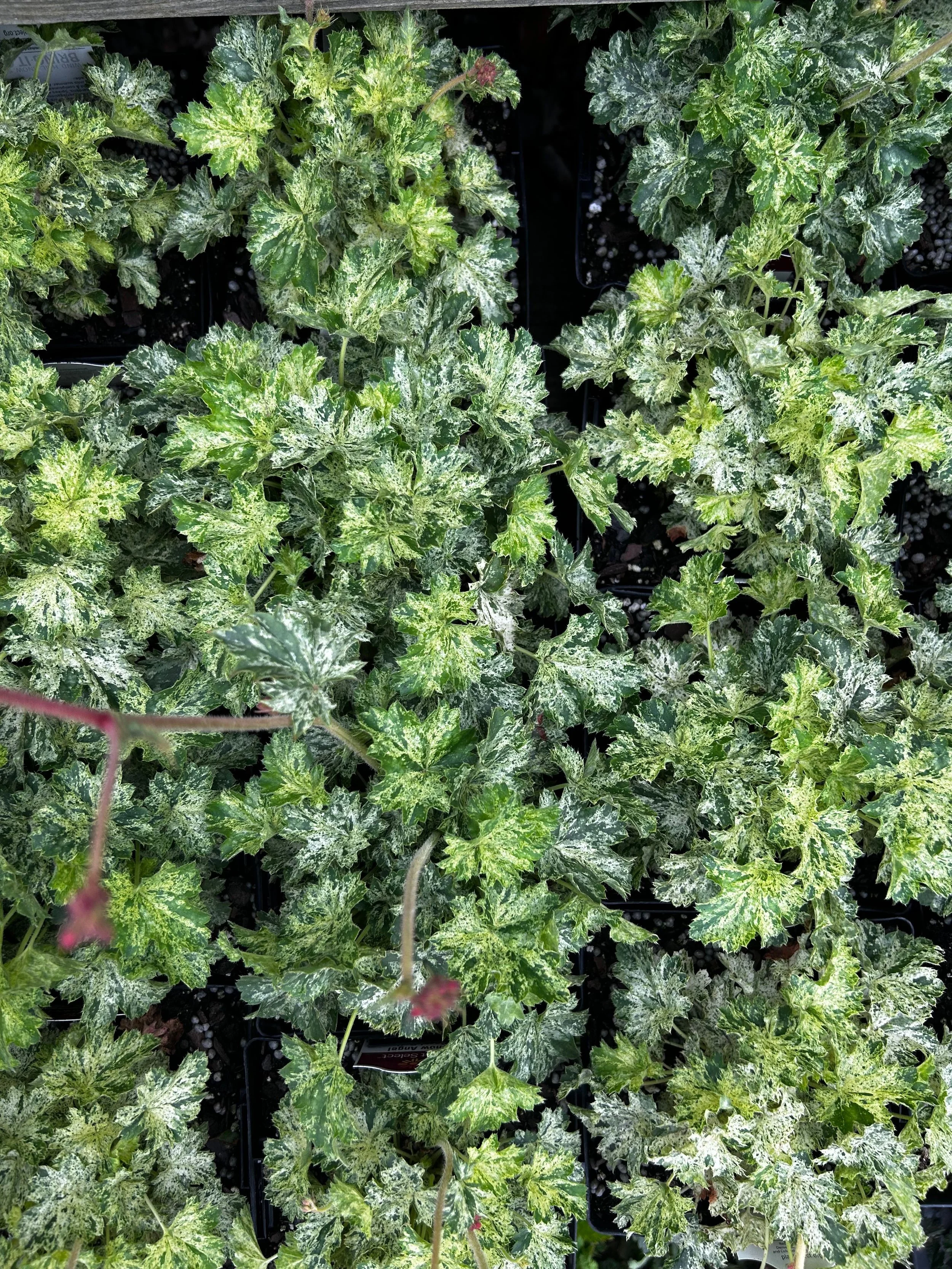
Heuchera Snow Angel

Heucherella Dayglow pink

Design Pairings & Garden Uses

Heucheras are beautiful alone but shine even more when paired with other foliage-rich or shade-loving perennials:

  • Great companions: Ferns, caladiums, hostas, bleeding hearts, iris, astilbe

  • Ideal uses: Mass plantings, underplanting for trees and shrubs, borders, container gardens, and ground cover alternatives to mulch

    Tip: Consider replacing traditional mulch with ground covers like Heuchera. Not only are they effective at suppressing weeds, they add beauty and habitat too.

Our Favorites

  • Heuchera villosa ‘Autumn Bride’: A native cultivar with large green leaves and tall white blooms. Especially striking when planted in mass and blends beautifully with other plants.

  • Heuchera americana ‘Dale’s Strain’: One of several we grow from seed. It’s a reliable, low-maintenance ground cover under shrubs.

There are 37 species of Heuchera and dozens of cultivars now available, the diversity of Heucheras is greater than ever. Their ability to hybridize easily has led to a stunning array of colors and leaf textures, so whether you're designing a native garden or adding structure to your shaded beds, Coral Bells deliver beauty that lasts well beyond their bloom.

Looking to add more color and habitat to your garden? Visit our nursery to explore our vast array of Heuchera and discover the perfect variety for your landscape.

groundcover

sweet woodruff

groundcover

forget me nots

In GARDEN TIPS, GROUNDCOVERS, JUNE, PLANT PROFILES Tags Heuchera, ground cover, foliage plants, Coral Bells
Comment

[PLANT PROFILE] SWEET WOODRUFF

May 11, 2022 Karen Logan

Sweet Woodruff

SWEET WOODRUFF

(Galium odoratum)

Sweet Woodruff is a lovely plant that will spread like a ground cover in your garden. It has small white flowers in spring through early summer. It’s vigorous but not aggressive and can coexist nicely with bulbs that will come right up through it. They spread stoloniferously by sending out stolons or side shoots just beneath the soil surface.

Sweet Woodruff

WHERE TO PLANT SWEET WOODRUFF

  • An ideal ground cover. Plant as a ground cover around shrubs.

  • A wonderful border accent in woodland gardens.

  • It thrives in rich garden soil, in part to full shade.

OTHER GROUNDCOVERS

  • Other ground covers that do well in shade include the more common evergreen pachysandra and Vinca minor, Periwinkle.

  • Pachysandra: We carry the Japanese spurge, pachysandra terminalis. Our favorite is the native one, Pachysandra procumbens.

  • Vinca: We carry Vinca minor Bowles, with the early summer blooming blue flowers and the white flowering Vinca minor. We also carry Illumination, a vinca cultivar with yellow variegated foliage and a blue flower.

  • Epimedium, barrenwort: Another less common groundcover that thrives in shade is Epimedium. Epimedium Spine Tingler is a cultivar that is available now. This year we also have Frohnleiten, Rubrum, Sulphureum, Niveum, Pink Champagne, Domino and Amber Queen, which won the RHA (Royal Horticultural Award) of Merit.

  • Ferns: Ferns can spread nicely like ground covers such as Matteuca struthiopteris (the Ostrich fern), Dennstaedtia punctiloba (Hay Scented Fern) and Onoclea sensibilis. Dennstaedtia punctiloba and Onoclea sensibilis are both hard to find. We don’t have either in stock right now.

  • Geum: The native Geum has been mentioned as a good ground cover. Geum triflorum has beautiful seed pods.

  • Thyme: Creeping and wooly thymes are ground covers we like to recommend for sun. Creeping thyme comes in white flowers (albiflorus), red flowers (coccineus) or pink chintz with pink flowers. We also carry creeping lemon and Elfin thyme.

  • Laurentia fluviatilis, Blue Star Creeper and Pratia: Two other interesting plants that spread like ground covers.

    And there are plenty more! 

Try planting ground covers at the base of your shrubs instead of mulching. Ground covers are very effective at keeping weeds out!

Pachysandra

Sweet Woodruff and French Lavender

Pachysandra

Epimedium Spine Tingler

Epimedium x Domino

Epimedium new growth

Viinca, white flower

GARDEN TIPS

MAY

PLANT PROFILE

CREEPING PHLOX

In PERENNIALS, EVERGREENS, GROUNDCOVERS, MAY, PLANT PROFILES Tags Sweet Woodruff, Epimedium, groundcover, creeping thyme, Blue star creeper, perennial groundcovers, evergreen groundcover, Geum, ferns
Comment
← Newer Posts

484 State Rd. West Tisbury, MA 02575

mon - fri 8am - 4pm // sat 8am - 1pm

Closed Sundays

(508) 693.8512