• Home
  • ABOUT
    • PROJECTS
    • SPRING CHECKLIST 2026
    • Landscape Teams
    • LANDSCAPE DESIGN
    • LANDSCAPE CONSTRUCTION
    • LANDSCAPE MAINTENANCE
    • Nursery
    • BULK MATERIAL
    • PLANT PROFILES
  • Application
  • EVENTS
  • FIELD NOTES
  • TESTIMONIALS
  • Contact
Menu

Vineyard Gardens

484 State Road
West Tisbury, MA, 02575
508.693.8512
Landscaping & Garden Center

Your Custom Text Here

Vineyard Gardens

  • Home
  • ABOUT
  • LANDSCAPING
    • PROJECTS
    • SPRING CHECKLIST 2026
    • Landscape Teams
    • LANDSCAPE DESIGN
    • LANDSCAPE CONSTRUCTION
    • LANDSCAPE MAINTENANCE
  • NURSERY
    • Nursery
    • BULK MATERIAL
    • PLANT PROFILES
  • Application
  • EVENTS
  • FIELD NOTES
  • TESTIMONIALS
  • Contact

POLLINATOR GARDENING

June 10, 2026 Karen Logan

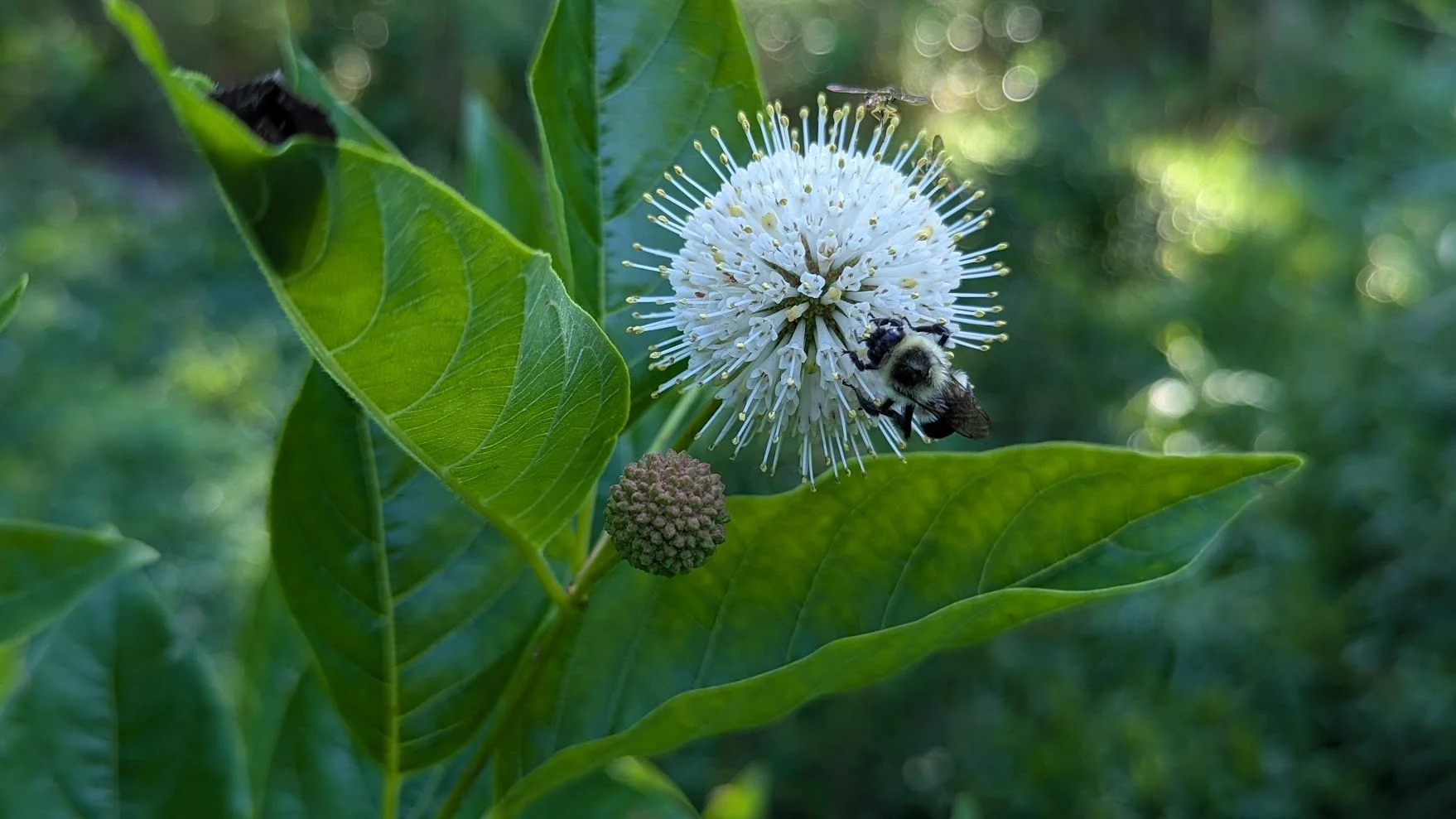
Cephalanthus occidentalis, Buttonbush [photo by karen blackerby logan]

POLLINATION

DYNAMICS

Generalists vs Specialists

Do you want your garden to come alive this summer with bees, butterflies, birds and beneficial insects?

To create a thriving sanctuary, let’s look closely at how nature feeds itself. In the world of pollination, insects generally fall into two different categories: generalists and specialists. Understanding the difference is the secret to unlocking local biodiversity in your backyard.

While many gardeners are familiar with generalist pollinators that visit any colorful flower, regional conservation research shows that a healthy ecosystem depends on specialist relationships as well. Think of generalist pollinators, like bumblebees or standard honeybees that are perfectly happy foraging across a massive variety of different flowers.

Specialists, on the other hand, are strictly tied to specific native plant families. According to data from the Vermont Center for Ecostudies (VCE), roughly 25% of our native bee species are pollen specialists. Over thousands of years, these insects have co-evolved alongside specific native plants. They require pollen from specific native plant genera to feed their larvae. Without these specific plants, their reproductive cycle fails. If that exact native plant isn't in your neighborhood, those specialist bees simply cannot survive. A garden filled with non-native flowers might look pretty, but to a quarter of our native pollinators, it is a food desert.

Pollination is complex, co-evolved partnerships between insects and their host plants.

Great Golden Digger Wasp on Monarda punctata Spotted beebalm one of it’s favorite native nectar sources [photo by karen blackerby logan]

Mason Bee (generalist) on High Bush Blueberry [photo by karen blackerby logan]

Monarch on Swamp Milkweed [photo by karen blackerby logan]

Larval Specialists

The Wild Seed Project highlights that specialization extends far beyond bees to butterflies, beetles and moths as well. While adult butterflies are nectar generalists, their caterpillars are strictly host-plant specific, meaning they can only digest the leaves of the exact native plants they co-evolved with. Because a female butterfly will only lay her eggs on these specific hosts, losing the plants means losing the butterflies entirely. The Monarch's total reliance on milkweed is the classic example, but hundreds of our local species share these exact same strict dependencies. Many native beetles are obligate host-plant specialists relying entirely on specific plant families for their food, shelter, and reproductive lifecycle.

Monarch caterpillar on Common Milkweed [photo by karen blackerby logan]

Monarch on Common Milkweed [photo by karen blackerby logan]

Moths, Beetles & Bats: Nightime Pollinators

Did you know that moths, beetles and bats are actually powerhouse pollinators? Recent research shows they are incredibly efficient at keeping our ecosystems healthy, tracking down native plants using specialized evening scents of specific native plants. This is where the magic of a native moon garden comes in. Curated specifically to come alive at dusk, storing the sun’s energy during the day and the flowers open up in the evening. A moon garden uses white or pale flowers and silvery foliage to reflect the moonlight, and their strong, sweet fragrances act as a natural runway guide for nocturnal pollinators. By planting native favorites like Evening Primrose, Sweet Pepperbush, and Swamp Milkweed, you can create an enchanting evening landscape that feeds the moths once the sun sets.

Clethra (Sweet Pepperbush) [photo by karen blackerby logan]

***********

The Magic of Pollination

Our pollinator friends are performing one of the most magical reproductive partnerships.

Flowers offer sweet nectar and protein-rich pollen as an invitation. As an insect lands to eat, sticky pollen grains hitch a ride on its fuzzy legs and body. When it flies to the next bloom, some of that pollen rubs off onto the female part of the flower (called the stigma). From there, a tiny microscopic miracle takes place: the pollen grain grows a tiny tube that tunnels all the way down the center of the flower (style) into the ovary, fertilizing the egg inside. That fertilized egg transforms into an embryo wrapped safely inside a seed. As the seeds develop, the flower's ovary swells up to protect them and that swollen structure is the fruit!

Take a Closer Look: Next time you bite into a fresh summer strawberry, take a peek at the outside. Those tiny "seeds" on the exterior, and the microscopic hairs attached to them, are the direct remnants of the exact moment a tiny pollinator visited that flower weeks ago!

[Videos] Allium buzzing with bees. Oak Leaf Hydrangeas on the Highline in NYC.

***********

Why Native

Plants Matter

By introducing native "keystone" plants into our yards we are actively protecting these ancient, irreplaceable relationships.

This beautiful, interconnected cycle is exactly why native plants matter so much. Because some pollinators rely on very specific plants to complete their life cycles, choosing native species is the single most important thing you can do for your landscape. Native plants have co-evolved alongside local pollinators for thousands of years, making them the absolute best hosts for supporting their life cycles.

Lately, there has been an inspiring surge of understanding around the importance of caring for the native ecosystem through native plants to protect our pollinators. More and more of our customers are looking to grow pollinator-friendly gardens and actively cultivate a healthy, native landscape right in their own backyards. To meet this need, horticulturalists are continually conducting ongoing research and field trials on plants that stand out as true pollinator favorites.

At Vineyard Gardens, we’re passionate about helping you create vibrant, pollinator-friendly gardens using native and well-researched perennials. Whether you're starting entirely fresh or enhancing an existing, established landscape, your choices make a real, measurable difference for pollinator health and biodiversity.

Not sure where to begin? Check out the Cape Cod Native Plants website for a fantastic online tool to help you select the right plants for your site conditions.

St Johns Wort

Echinacea purpurea

Rudbeckia fulgida Goldsturm

Learn more : Native Plant List / Cape & The Islands
Learn more: Native Plant Finder / National Wildlife Federation

***********

Pollinator

Power Plants:

Our Favorite Perennials

Here’s a list of powerhouse plants that will invite pollinators and energize your garden all season long:

Mondarda, Spotted Beebalm [photo by karen blackerby logan]

Native Pollinator Perennial :

  • Ageratum (Coelestinum)

  • Goldenrod (Solidago flexicaulis)

  • Joe Pye Weed (Eutrochium ‘Gateway’)

  • Solomon’s Seal (Polygonatum)

  • Blazing Star (Liatris spicata)

  • Mallow ‘Rose’ (Hibiscus moscheutos)

  • Butterfly Milkweed (Asclepias tuberosa)

  • Evening Primrose (Oenothera biennis)

  • Aromatic Aster (Symphyotrichum oblongifolius)

  • Woods Purple Aster (Eurybia divaricata)

  • Baptisia (Baptisia australis)

  • Beebalm (Monarda didyma)

  • Black-eyed Susan (Rudbeckia fulgida)

  • Purple Coneflower (Echinacea purpurea)

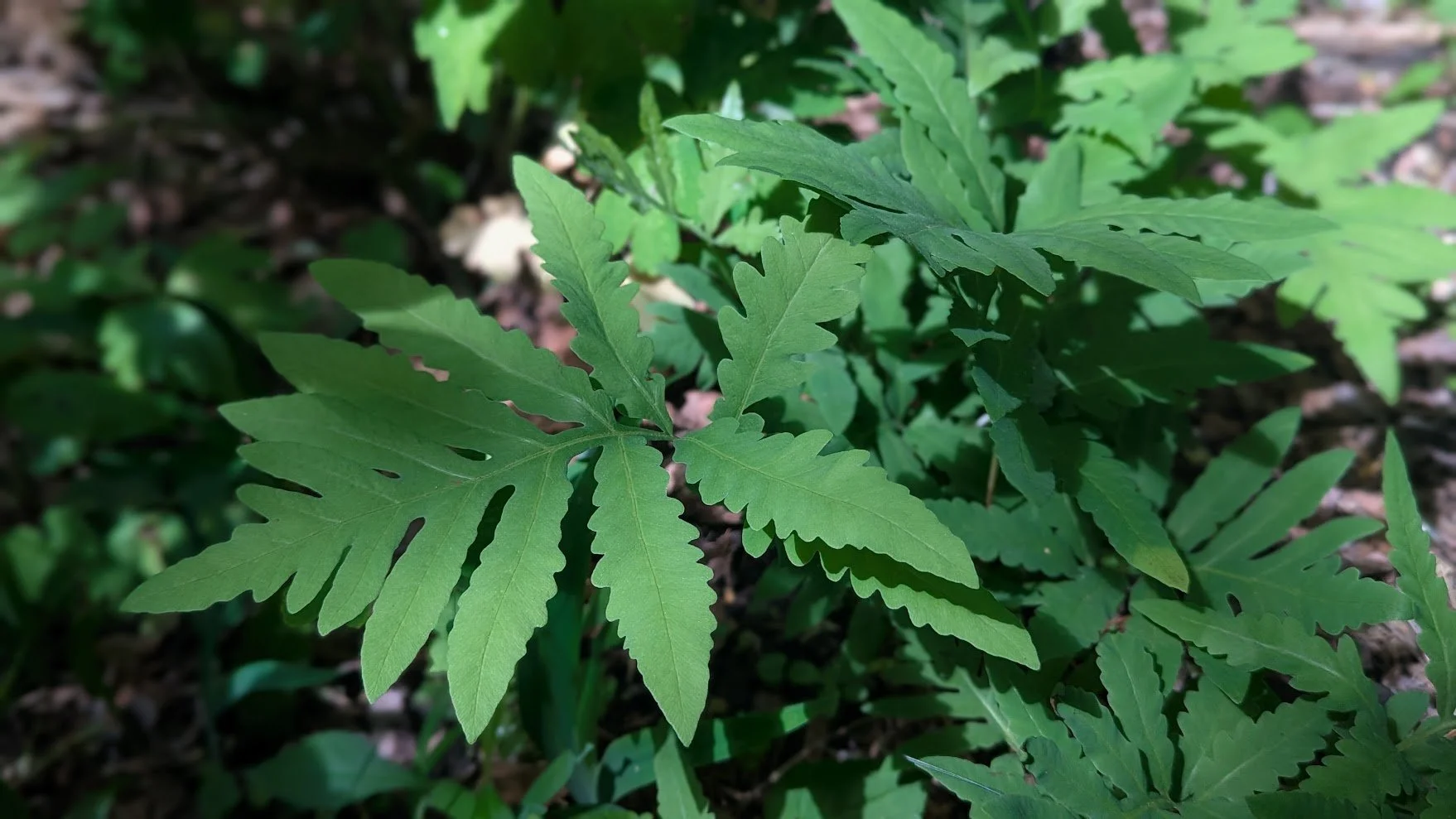
  • Cutleaf Coneflower (Rudbeckia laciniata)

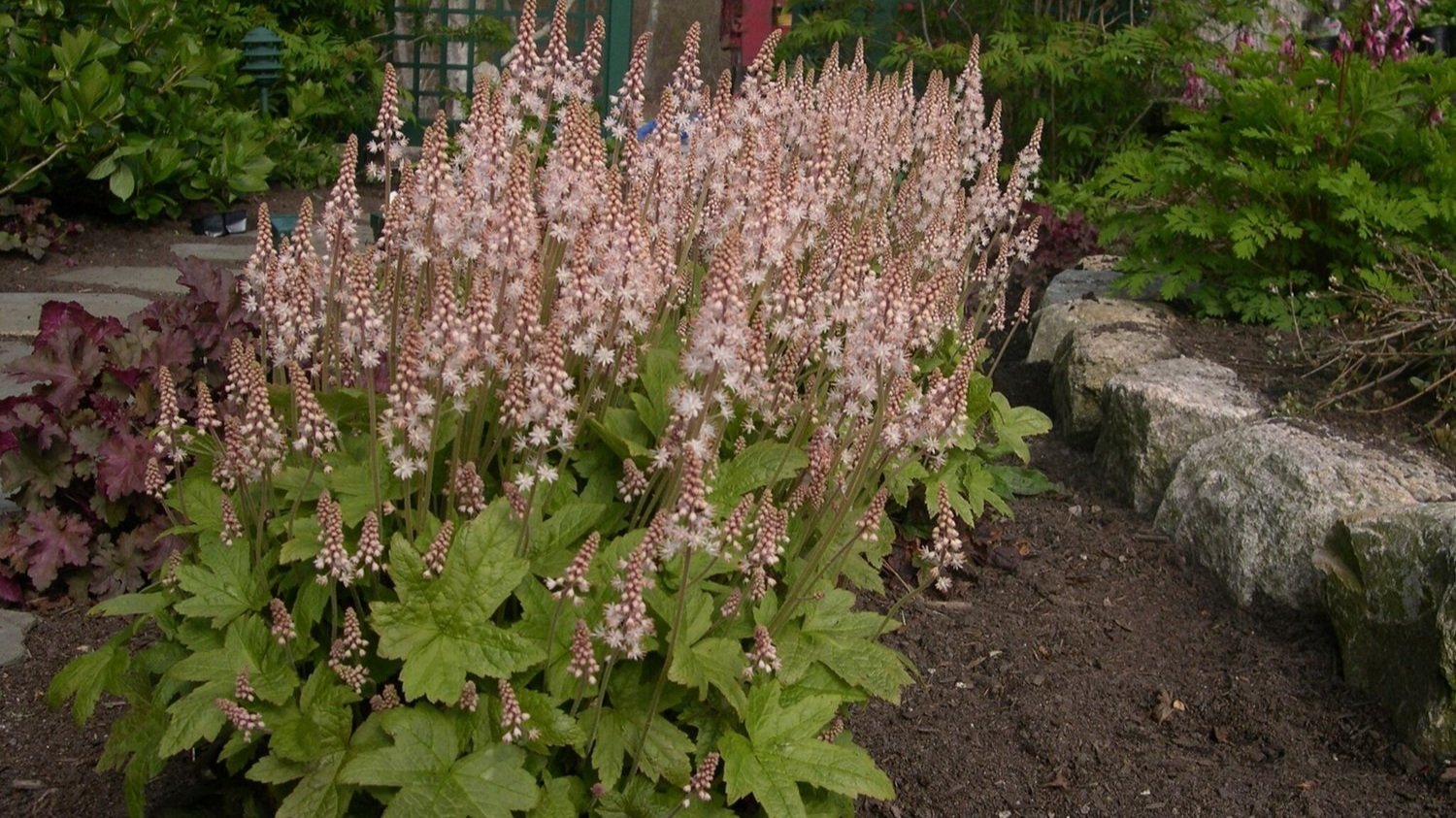
  • Foamflower (Tiarella cordifolia)

Lavender

Pollinator Perennials:

  • Agastache (‘Kudos’ Coral, Ambrosia, Mandarin, Blue Fortune, Black Adder, Little Adder)

  • Bluebeard (Caryopteris)

  • Coneflower (Echinacea) – Sombrero Series, White Swan, Green Twister

  • Coreopsis – Solanna™ Bright Touch, UpTick™ Gold & Bronze

  • Goldenrod (Solidago)

  • Lavender (Lavandula)

  • Milkweed (Asclepias)

  • Phlox (Phlox paniculata)

  • Salvia

  • Perennial Sunflower (Helianthus)

  • Stonecrop (Sedum)

  • Yarrow (Achillea)

Asters

Sedum, Butterfly Milkweed, Quickfire Hydrangea

Swamp Milkweed

***********

POLLINATOR FRIENDLY SHRUBS

Clethra, Sweet Pepperbush

Native Pollinator Shrubs:

  • Lowbush Blueberry (Vaccinium angustifolium)

  • Winterberry (Ilex verticillata)

  • Beach Plum (Prunus maritima)

  • Arrowwood Viburnum (Viburnum dentatum)

  • Inkberry (Ilex glabra)

  • Sweet Pepperbush (Clethra alnifolia)

  • American Elderberry (Sambucus nigra ssp. canadensis)

  • Highbush Blueberry (Vaccinium corymbosum)

  • Sweet Fern (Comptonia peregrina)

  • Willow (Salix)

  • Buttonbush (Cephalanthus occidentalis)

St. John’s Wort - Hypericum

Pollinator Shrubs:

  • Double File Viburnum (Viburnum plicatum)

  • Fothergilla

  • Lilac (Syringa vulgaris)

  • Ninebark (Physocarpus)

  • Oakleaf Hydrangea (Hydrangea quercifolia)

  • St. John’s Wort (Hypericum)

Buttonbush [photo by karen blackerby logan]

Purple Leaf Sand Cherry [photo by karen blackerby logan]

Elderberry [photo by karen blackerby logan]

***********

POLLINATOR FRIENDLY TREES

Eastern Redbud (Cercis canadensis Pendula) [photo by keith kurman]

Native Pollinator Trees:

  • Red Maple (Acer rubrum)

  • Tulip Tree (Liriodendron tulipifera)

  • Sassafras (Sassafras albidum)

  • White Oak (Quercus alba)

  • American Holly (Ilex opaca)

  • Eastern Redbud (Cercis canadensis)

  • Magnolia virginiana

  • Dogwoods – Gray, Silky, Red-twig, Pagoda, Flowering

Additional Pollinator Trees:

  • Magnolia (Magnolia grandiflora 'Little Gem')

  • Stewartia

***********

READY FOR

POLLINATOR

GUESTS THIS

SUMMER?


Let your garden be a living, blooming, buzzing celebration of life.

Visit us at Vineyard Gardens to explore our selection of native and pollinator-friendly plants.

Agastache, Allium, Rudbeckia

Foam Flower, Tiarella cordifolia

Native Eastern Red Columbine (Aquilegia canadensis) [photo by karen blackerby logan]

St. John’s Wort & Cleome (pollinators and deer resistant) [photo by keith kurman]

NATIVE POLLINATOR RESOURCES
HOMEGROWN NATIONAL PARK: DOUG TALLAMY
In GARDEN TIPS, PERENNIALS, SHRUBS, JUNE, FIELD NOTES Tags pollinator plants, pollinator friendly perennials, pollinator friendly shrubs, pollinator friendly trees, native plants
Comment

ASTILBE

June 9, 2026 Karen Logan

Astilbe illustration by karen blackerby logan

ASTILBE

Bring Vibrant Texture and Color to Your Shade Garden

GROWING ASTILBE

If you have a shady corner where other flowering plants refuse to thrive, Astilbe is a wonderful solution. These spectacular, clump-forming perennials illuminate dark garden beds with bold swaths of color and intricate texture from late spring through mid-summer.

Astilbes are instantly recognizable by their feathery, plume-like flowers, which come in rich shades of red, pink, lavender, purple, and crisp white. But the beauty doesn't stop at the blossoms, their glossy, fern-like foliage is equally striking, showing off hues of deep green, bronze, and copper-brown. While they are historically celebrated as deer-resistant additions to the landscape, local island deer have occasionally been spotted snacking on them recently, so it's always wise to keep an eye on them!

ASTIBLE ATTRACT BUTTERFLIES!

***************

COMPANION PLANTING

Perfect Combinations for Moisture & Shade

Astilbes love company, provided their neighbors share their love of cool roots and afternoon shade. They are fantastic for attracting butterflies to the garden! To create a lush, multi-layered look, try pairing them with these moisture-loving favorites:

  • Shrubs: Hydrangeas or Hypericum (St. John's Wort).

  • Perennials: Rodgersia (Roger’s Flower), Snakeroot (Cimicifuga/Actaea), Meadow Rue (Thalictrum), and a diverse mix of hardy ferns.

***************

CARE

Skip the Deadheading!

With most summer perennials, gardeners are trained to consistently snip off faded flowers to trigger a second flush of blooms. Astilbe is the exception. Cutting back spent Astilbe blooms won’t bring more flowers, and you’ll actually miss out on a key attribute! Their dried, copper-toned flower heads possess immense ornamental value and structure. We recommend leaving them standing to add architectural interest to your borders clear into autumn, though you can cut them down at any time if you prefer a tidier look.

  • Soil & Sun: Plant in partial to full shade. They absolutely thrive in a loamy, humus-rich soil that holds moisture well.

  • Watering: Check your plants regularly. Astilbes require plenty of water and consistent moisture. Water deeply to promote a robust, resilient root system and protect them from scorching afternoon sun.

  • Feeding: Apply a high-quality organic fertilizer in early spring as new growth emerges.

  • Dividing: Astilbes are robust growers that quickly form broad clumps. Divide your overgrown clumps every 3 to 4 years in the spring.

***************

Astilbe Varieties

Vineyard Gardens carries 25 to 30 different cultivars at the nursery, offering an incredible range of heights, bloom times, and colors. Here are a few standout favorites to look for on your next visit:

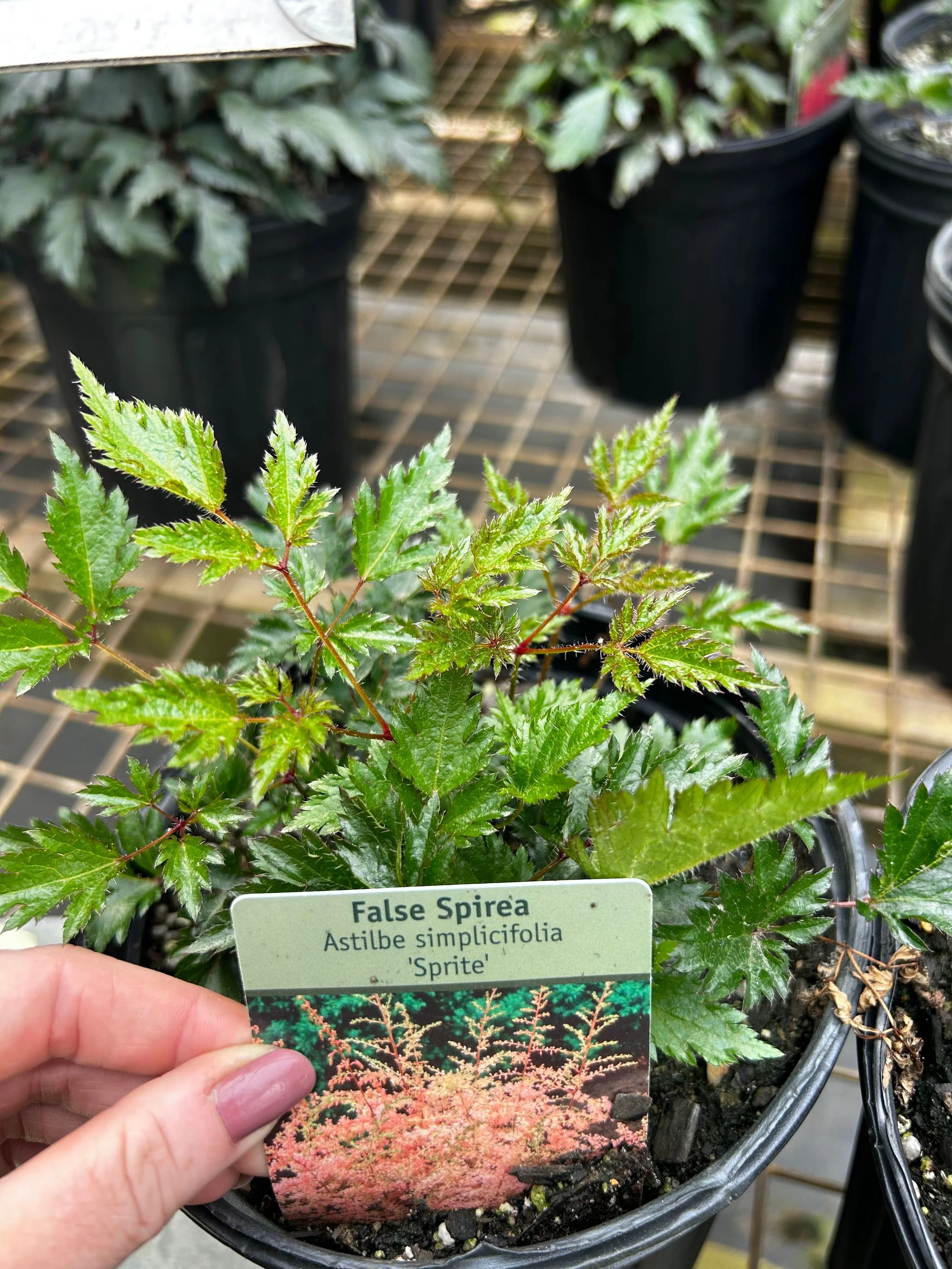
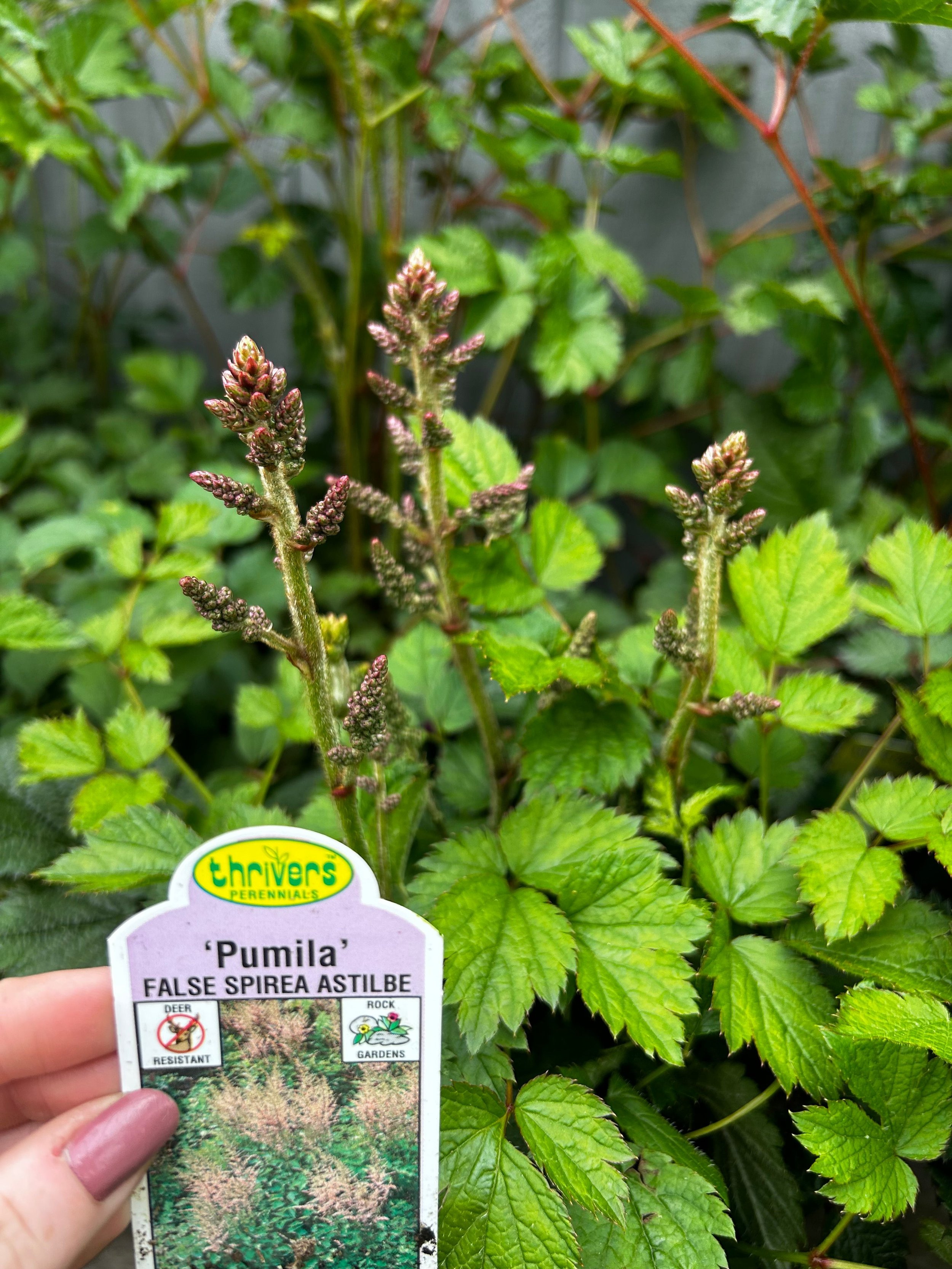
  • Astilbe chinensis 'Pumila': A fantastic, low-growing variety that spreads to form a dense, weed-suppressing ground cover. (10” tall)

  • Astilbe 'Hennie Graafland': A lovely, delicate dwarf variety perfect for front-of-the-border edging. (12”–18” tall)

  • Astilbe 'Montgomery': Features deep red plumes over dark, bronze-tinted foliage. (20"–24” tall)

  • Astilbe chinensis 'Superba': One of our absolute tallest pink selections, making a massive architectural statement. (24”–48” tall)

  • Astilbe chinensis 'Mighty Red Quin': A robust, towering giant featuring massive, ruby-red plumes late in the season. (39”–47” tall)

  • Other varieties we regularly stock include: Erika, Mighty Pip, Purple Candles, Bressingham Beauty, Delft Lace, Little Visions in Pink, Straussenfeder (Ostrich Plume), Deutschland, Visions, and Mauve.

    Stop by the nursery this week to wander through our shade houses and find the perfect texture combination for your woodland garden beds!

JUNE GARDENING TIPS
In PERENNIALS, PLANT PROFILES, JUNE Tags summer blooms, perennial plants, astilbe, shade perennials
Comment

SALVIAS

June 1, 2026 Karen Logan

SALVIAS

Members of the mint family, Salvias are famous for their incredible diversity, boasting over 900 species worldwide. While about 50 of these are native to North America. However, for those of us gardening in Massachusetts, the Lyre-leaf Sage (Salvia lyrata) is our region's only true native sage. No matter the variety, Salvias are renowned as absolute pollinator magnets, featuring nectar-rich blooms that act as an irresistible beacon for hummingbirds, butterflies, and a wide variety of local pollinators.

Salvia Leucantha

Salvia Blue Monday

Salvia nemorosa (perennial)

***********

GROWING SALVIA

How to Plant & Grow Salvia for Success

Salvias are sun-loving, low-maintenance perennials that reward you with vibrant blooms and incredible pollinator activity all season long. Whether you are looking for classic blues and purples or want to branch out into vibrant pinks, fuchsias, whites, or reds, there is a variety for every palette. These tough, deer-resistant plants are exceptionally easy to care for. Here is how to give your new Salvias the absolute best start in your landscape:

  • Choose the Right Spot: Select a location that receives full sun (at least 6 hours of direct sunlight daily) and has excellent drainage. Salvias absolutely do not like soggy roots.

  • Prepare the Soil: Dig a hole twice the width of the plant’s container to give the roots plenty of room to expand. Mix a 3-inch layer of high-quality compost into the existing soil to enrich and improve drainage.

  • Plant with Care: Gently remove the Salvia from its nursery pot. Place it in the hole so the top of the root ball sits perfectly level with the surrounding soil line.

  • Space for Growth: Space your plants 1 to 3 feet apart, depending on the specific variety. Proper spacing ensures excellent airflow and gives the plant room to reach its mature size.

  • Backfill and Firm: Fill in the hole around the plant with your soil mix, pressing down gently with your hands to eliminate air pockets and stabilize the root ball.

  • Water Deeply: Give your newly planted Salvias a thorough, deep soaking to settle the soil and reduce transplant shock.

  • Mulch: Apply a thin layer of mulch around the base of the plant to retain moisture, suppress weeds, and regulate soil temperature.

  • Encourage More Blooms: Deadheading spent flowers encourages repeat blooming. Follow the flower stem down to the base and cut just above the foliage for a clean finish and more blossoms.

  • Spring Cleanup: Wait until early spring, when you see signs of new growth, to cut back old stems. This helps protect the plant during winter and gives you a clearer view of what's emerging.

  • Divide Every 3 Years: To keep your Salvias vigorous, divide clumps every 3 years. The best time to divide is in early spring, before new growth fully emerges.

While Salvias are remarkably drought-tolerant once established, consistent watering during their first few weeks in the ground is key to healthy, deep root development. With just a bit of maintenance, Salvias reward you with long-lasting color and a steady stream of pollinators.

Salvia nemorosa

Salvia Purple Rain

***********

PERENNIAL SALVIAS

While most perennial salvias bloom in early summer, you can easily extend their performance by deadheading the faded flower spikes. They will reward you with a fantastic second flush of blooms later in the same season!

Salvia Wind Walker Red

————————

A perennial species of

Salvia that is 4’ tall.

Graceful arching stems

with brilliant red flowers

bloom from late June

through fall. Cut this

Salvia back to 6” in

early summer to keep

stems shorter and

stronger. Hummingbirds

love it!

Perennial Salvia Varieties

Salvia nemorosa Species (Meadow Sage)

These are the classic garden staples known for their upright flower spikes and compact, mounded foliage.

  • 'Salvatore Blue': Features aromatic, royal purple-blue spikes that add wonderful vertical interest and deep color to garden beds and planters.

  • 'Caradonna': Features striking, dark purple stems that contrast beautifully with its violet-blue flowers.

  • 'Dark Matter': Deeply saturated, near-black buds that open into intense violet-blue spikes.

  • 'Blue Marvel' & 'Rose Marvel': Some of the largest flower spikes in the genus, providing an extra-bold splash of blue or rose-pink.

  • 'White Profusion': A high-performance variety completely covered in crisp, clean white flowers that rebloom beautifully.

  • 'Snow Hill': A dependable, classic white selection that forms a tidy, cool mound in the border.

  • 'Blue by You': An early bloomer featuring rich blue-purple spikes and excellent heat tolerance.

  • 'Violet Riot': Forms a dense, uniform mound packed with vivid violet-blue flowers.

  • 'East Friesland': A compact old favorite featuring rich violet-purple spikes.

  • 'Feathers Peacock': Feathery foliage and soft lavender-blue flowers.

The 'Lyrical' Series

Known for their robust growth, strong branching, and high flower count per stem.

  • 'Lyrical Blue': Deep indigo-blue petals contrasted beautifully by rich burgundy accents.

  • 'Lyrical Rose': Bright rose-pink flower spikes that bring a soft warmth to the garden.

Other Salvias

  • 'Midnight Model': Produces striking, intense violet-blue flowers on a round, dense, perfectly neat clump.

  • 'Evening Attire': Features huge, vivid violet-blue flowers packed tightly into a highly refined, upright habit.

  • 'Moulin Rouge': Makes a dramatic statement with oversized, rich rosy-pink flower spikes.

  • 'Rhythm and Blues': Striking tricolor blue-purple blooms.

  • Salvia greggii (Mirage™ Series): Woody, drought-tolerant mounds with aromatic foliage.

  • Salvia verticillata 'Purple Rain': An "oldie but goodie" featuring arching stems with smoky purple whorls of flowers that look incredibly soft and romantic.

Biennial Sages

Biennials spend their first year growing lush foliage and explode into dramatic, oversized blooms in their second year.

  • Salvia argentea (Silver Sage): A striking, clump-forming biennial grown as much for its texture as its flowers. It features massive, fuzzy, woolly silver leaves that look like velvet, topped with elegant white flowers.

  • Salvia sclarea (Clary Sage): A biennial species native to the Mediterranean basin that we proudly grow from seed right here! This is a massive, very showy architectural plant that features huge spikes bearing large, colorful bracts that last all summer.

    • The Straight Species: Features pink blooms with darker pink edges.

    • Salvia sclarea var. turkestanica: A beautiful variety featuring striking white flecks and pink bracts.

Salvia nemorosa

Salvia madrensis

Salvia greggii Mirage Salmon

***********

ANNUALS: SEASON EXTENDERS

Plant them now and they will be gorgeous in the fall!

Annual Salvias are absolute powerhouses in the garden, providing non-stop color from early summer straight into late fall. From unique varieties we start right here from seed to high-performance selections grown from premium plugs, these plants are the ultimate season extenders. In fact, hardy varieties like Pineapple Sage will often stay in full bloom well into November! To get the absolute most out of them, we recommend planting them early in the season so they have plenty of time to reach their magnificent mature size. While they do beautifully in both patio containers and garden beds, keep in mind that they put all their energy into a single season and will not come back next year.

Planning Ahead

It's the perfect time to think about late summer and autumn interest, when designing your garden beds now. Our late-blooming 'season-extender' Salvias are the perfect tool to keep your landscape vibrant and colorful long after other perennials have faded.

Salvia guaranitica Black and Blue

Salvia Wendy’s Wish

Salvia Summer Jewel Pink

***********

Vineyard Gardens Seed-Grown Favorites

There is a special charm to plants grown from seed right here at the nursery. These selections are famous for their exotic, oversized bracts and incredibly long-lasting color.

  • Clary Sage (Salvia sclarea): Produces massive, architectural flower spikes with prominent, colorful bracts that look delightfully exotic and last all summer.

  • Salvia horminium Blue Monday: A true Vineyard Gardens favorite featuring striking, intense blue-violet top leaves (bracts) that retain their deep color for months.

  • Salvia horminium Rose Sundae: A gorgeous sister variety to 'Blue Monday,' boasting soft, vivid rose-pink bracts that add a beautiful warmth to cottage gardens and bouquets.

  • Salvia patens Patio Sky Blue (Gentian Sage): Breathtaking sky-blue flowers, set on a compact habit perfect for pots.

'Plug-Grown' Annuals

Grown from specialized starter plugs, these high-performance cultivars grow rapidly into robust, heavy-blooming plants for your large containers and garden beds.

  • Salvia guaranitica 'Black and Blue' (Anise-Scented Sage): Featuring deep cobalt-blue tubular flowers emerging from dramatic, near-black calyxes.

  • 'Amistad' (Andrew’s Recommendation): A top pick by Andrew! This spectacular hybrid boasts massive, continuous spikes of royal purple flowers sitting on sharp black stems. It is an absolute magnet for hummingbirds.

  • 'Indigo Spires': A deep, rich blue showstopper with extra-long flower spikes. This tough variety keeps going and going. It will still be blooming beautifully alongside your fall asters and mums!

  • 'Skyscraper Orange': Brings unique, warm sunset-orange tones to the annual border on sturdy, upright stems.

  • 'Skyscraper Pink': Features densely packed, bright pink trumpets that stand up beautifully to summer heat.

  • 'Unplugged Pink': A compact, tidy selection covered in soft pink spikes, perfect for mid-sized patio containers.

  • 'Rockin’ Deep Purple': A tough, modern hybrid loaded with rich, royal purple blooms that require no deadheading to keep flowering.

  • 'Rockin’ Blue Suede Shoes': Features soft, light blue petals contrasted against crisp, deep black calyxes.

  • 'Rockin’ Fuchsia': Vibrant, neon-fuchsia blossoms that scream for attention from across the yard.

  • 'Wendy’s Wish': A massive customer favorite featuring brilliant, hot-magenta pink flowers with colorful fluted calyxes.

  • 'Love and Wishes': Another popular favorite, displaying a sophisticated, deep antique shade of reddish-pink and dark maroon stems.

  • Salvia leucantha ('Mexican Bush Sage'): The ultimate late-season extender. This magnificent, velvety-textured plant saves its main explosion of soft purple and white spikes for autumn, blooming beautifully deep into October.

Salvia Blue Monday

Salvia Amistad

Salvia Wendy’s Wish

***********

Salvias in the Herb House

Explore our fantastic selection of aromatic, edible sages!

  • Salvia elegans ‘Pineapple Sage’ (annual): A spectacular annual herb and a magnificent season extender. The species name elegans reflects its tender nature, meaning it will not overwinter in our climate. However, it grows at an astonishing rate if you get it in the ground early! When planted in spring or early summer, a simple 4-inch nursery pot of Pineapple Sage will easily reach 4 to 5 feet tall and wide in a single season. In late summer and throughout autumn, it bears brilliant, tubular red flower spikes. As a delightful bonus, its lush green foliage releases a sweet pineapple aroma when brushed.

  • Salvia officinalis ‘Culinary Sages’ (Perennial)

    These hardy perennial sages are wonderful in the kitchen and bring beautiful, year-round texture to the herb garden. While the straight species and 'Berggarten' remain the two absolute classics for culinary use, we also carry these gorgeous, highly ornamental varieties:

    • Purple Leaf Sage: Features rich, smoky-purple foliage that adds dark, dramatic depth to herb planters.

    • Golden Sage: Boasts bright green leaves beautifully variegated with wide, chartreuse-gold margins.

    • Tricolor Sage: A stunning, highly ornamental selection with striking variegated foliage splashed in shades of purple, pink, and creamy white.

Tricolor variegated Sage

LEARN MORE: PERENNIAL HERBS
CONTAINER PLANTING
In PERENNIALS, ANNUALS, JUNE, PLANT PROFILES Tags salvia, vineyard garden salvia sale, growing salvia, care for salvia, black and blue salvia, blue salvia, clary sage

AMSONIA

May 27, 2026 Karen Logan

AMSONIA

A Native Perennial with Spring Flowers and Fall Color

Long ago, Amsonia tabernaemontana (commonly known as Bluestar) first caught my eye with its distinct mounded shape and delicate blue flowers. Later that same year, it grabbed my attention all over again when its foliage transformed into a brilliant, glowing yellow fall color. Amsonia’s rounded shape and sturdy form result from many individual stems with the exact right length to round it out. When in bloom, clusters of small, soft-blue, star-shaped flowers adorn the tip of every stem, hence its common name, Bluestar. It is no surprise that Amsonia tabernaemontana was named one of the Top 75 Garden Plants by the American Horticultural Society! With stunning spring blooms, fine texture, radiant autumn color, and excellent deer resistance, this genus offers incredible multi-season interest.

Amsonia

Amsonia tabernaemontana Bluestar

Amsonia

AMSONIA WE CARRY AT VINEYARD GARDENS

While plants are botanically classified by the similarities in their flowers, their foliage can vary wildly. This is beautifully true for the different Amsonias sitting on our nursery tables:

  • Amsonia tabernaemontana (Eastern Bluestar): This lovely native species has dense clusters of pale blue spring flowers and golden fall foliage.

  • 'Blue Ice': A compact cultivar of the native species that stays lower to the ground, with deeper dark-blue buds and a long bloom time. Perfect for smaller garden borders or containers.

  • Amsonia hubrichtii: This species offers a completely different look. It features exceptionally narrow, needle-like leaves lining the stems that create a soft, feathery texture in the wind. It turns a fiery copper-gold in October.

Why the Deer Leave It Alone: The stems and foliage of Amsonia contain a bitter, milky sap that serves as a highly effective natural defense system that deters predation by deer and rabbits.

Blue Ice Blue Star

Stiff Bluestar

Amsonia hubrichtii

Easy Care & Growing Conditions

Because these are native US prairie plants, they are incredibly tough and unfussy once established.

  • Soil: They prefer well-drained soil but aren't picky about soil fertility.

  • Sunlight: Full sun is ideal for the best form and optimal fall color. However, Amsonia tabernaemontana will tolerate partial shade (though it may bloom a bit less vigorously).

Amsonia hubrichtii in Vinieyard Gardens garden bed

Amsonia hubrichtii

Amsonia Bluestar

Since that first encounter years ago, my appreciation for this genus has only grown!

DEER RESISTENT PLANTS
In PERENNIALS, PLANT PROFILES, NATIVE PLANTS Tags Amsonia, Blue Star, Blue Ice, Amsonia hubrichtii, Amsonia tabernamontana, spring blooms, fall color
Comment

ROSES

May 25, 2026 Karen Logan

Roses [illustration by karen blackerby logan]

The Perfect Fit:

Roses in the

Vineyard Garden

With so many breathtaking varieties available, how do you choose the right rose for your landscape? Whether you are looking to cover a classic picket fence, fill a sunny border, or plant a low-maintenance native, Vineyard Gardens is here to help you select the perfect match for your property.

Here is a breakdown of the primary rose categories and a sampling of the beautiful varieties we are carrying at the nursery this season.

David Austin Roses photo by keith kurman

David Austin Roses

CLIMBING ROSES

Climbing roses are spectacular for adding vertical color to fences, arbors, or trellises. You can easily train these vigorous growers to climb in any direction by gently tying the canes as they grow.

  • New Dawn: One of the most popular climbing roses. Its pale pink blooms offer the iconic look famously seen draping over the white fences of Edgartown.

  • Zephirine Drouhin: A stunning, thornless climber featuring deep rose-pink flowers and a strong, fruity fragrance. Great for training over high-traffic walkways, arches, seating areas, or doorways where you won't have to worry about anyone getting snagged.

  • Tess of the d'Urbervilles (David Austin): A compact climber producing striking crimson-red blooms with a medium, classic Old Rose fragrance.

  • Bathsheba (David Austin): An elegant climber sporting apricot-toned flowers and a unique, beautiful scent.

Climbing New Dawn Rose (David Austin Roses)

Climbing New Dawn Rose

SHRUB ROSES

Shrub roses are upright, bushy plants that offer incredible versatility. They are perfect for hedges, mixed garden beds, or stand-alone focal points.

Classic & Native Shrub Favorites

  • Knock Out® Roses: Famous for a reason! These are exceptional, continuous repeat-bloomers that flower much longer than traditional rose bushes. They maintain a tidy, mounded shape when pruned correctly (note: they do not climb).

  • Rosa palustris (Swamp Rose): A fantastic native, multi-branched shrub boasting intensely fragrant pink blooms and fleshy red rose hips. This plant is a true ecological powerhouse; as a keystone wetland species, it prevents soil erosion while supporting an incredible diversity of wildlife. It serves as a vital larval host for multiple native moths, provides safe, dense nesting sites for songbirds, and offers a critical food source for native bees, butterflies, and birds.

  • Julia Child: Features warm, pale yellow flowers paired with a delicious licorice and clove scent.

  • Seafoam: A low, sprawling shrub covered in creamy white blooms with a light, delicate fragrance.

  • Blanc Double de Coubert: A rugged rugosa hybrid known for its intensely fragrant, pure white double blooms.

David Austin Shrub Roses:

David Austin varieties are world-renowned for combining the romantic, multi-petaled double flowers of Old Roses with the disease resistance and repeat-blooming power of modern varieties.

  • Vanessa Bell: Soft, pale yellow flowers with a fragrance reminiscent of green tea. Forms a bushy, upright shrub (4’ x 3’).

  • Desdemona: Beautiful white blooms flushed with a pinkish hue. Features a complex Old Rose fragrance with hints of almond blossom, cucumber, and lemon zest.

  • Gertrude Jekyll: A large shrub with bright pink blooms and a quintessential, rich Old Rose scent.

  • Olivia Rose Austin: A well-balanced medium shrub with soft, mid-pink flowers and a delightful, fruity fragrance.

  • The Fairy: A charming, smaller shrub that stays compact, producing clusters of light pink flowers with a mild scent.

Knockout Roses

Rosa double pink knockout.

GROUND COVER ROSES

These low-growing, sprawling varieties are ideal for the front of garden borders, slopes, or erosion control. They thrive in full sun and add a vibrant carpet of color.

  • Rosa rugosa (Beach Rose): Our naturalized beach rose is hands-down the most salt-tolerant and drought-tolerant rose around. Perfect for coastal Island landscapes.

MINIATURE & CONTAINER ROSES

Do you dream of growing roses but have limited garden space? We’ve brought in a few different varieties of dwarf roses to give you the opportunity to grow these great cut flowers right on your patio or deck!

Rose mini

ROSE CARE

To get the absolute most out of your roses, keep these three golden rules in mind: Roses love full sun, well-drained soil, and plenty of organic nutrients!

  • Feed Them Now: Spring is the perfect time to apply a high-quality fertilizer to kickstart the blooming season. We highly recommend Espoma Plant-tone or Rose-tone for organic, steady feeding.

  • Mind the Drainage: Whether planting in a garden bed or a large patio container, ensure the roots never sit in waterlogged soil.

Looking for something different? We’ve only scratched the surface of the incredible rose varieties we carry. Stop by Vineyard Gardens, and our team will help you find the perfect rose to elevate your home landscape!

PLANT PROFILE: PEONIES
MAY GARDEN TIPS
In GROUNDCOVERS, PERENNIALS, MAY, SHRUBS, PLANT PROFILES Tags Roses, climbing roses, groundcover roses, knockout roses, shrub roses, miniature roses, rosa rugosa, New Dawn Rose
Comment

PEONIES

May 10, 2026 Karen Logan

Tree Peony ‘Hoki’

PEONIES

The Queen of the Spring Garden

Peonies are a stunning genus of woodland plants, prized for their exceptionally large, showy blooms that take center stage in late May and June. These garden favorites prefer rich, well-drained soil and are surprisingly low-maintenance once established.

Unlike many flowering perennials, peonies require very little fertilizer; a simple top-dressing of organic compost in the spring provides all the nutrients they need. To keep your plants healthy, keep an eye out for Botrytis, a black fungal growth that can cause stems to wilt. If you spot it, carefully prune the affected area immediately and dispose of it in the trash (do not compost it) to prevent the fungus from spreading.

Looking for the perfect addition to your mixed beds? Our garden peonies are hardy, clump-forming perennials that thrive in full to part shade.

*************

PAEONIA LACTIFLORA (HERBACEOUS)

Paeonia lactiflora is a herbaceous, low growing (1-2') clump-forming perennial. Commonly called garden peonies, they are ideal for mixed perennial beds in full to part shade (3+ hours of direct sunlight).

With May being a windy month on the Island, it’s important to remember that these garden peonies require structural support. Their giant, ornamental flowers become quite top-heavy and are liable to snap during spring rain or wind. At Vineyard Gardens, we carry specifically designed peony cages to ensure your floral show stays upright all season long. Be sure to pick some up with your next purchase!

Note: Herbaceous peonies die back completely to the ground in winter, returning with fresh growth each spring.

Paeonia lactiflora we’d like to highlight:

  • Moon River (double soft cream and pink fragrant flowers)

  • Sarah Bernhardt (double pink flowers)

  • Coral Sunset (semi double coral blooms)

  • Jan Van Leeuwen (single white flowers)

  • Laura Dessert (double white flowers)

  • Paul M Wild (double ruby red blooms)

  • Lady Orchid (double pink flowers)

Paeonia lactiflora

Peony cages

*************

PAEONIA X SUFFRUTICOSA (TREE PEONY)

If you haven’t yet experienced the early-season magic of the Tree Peony, now is the perfect time to start. Unlike their herbaceous cousins, Tree Peonies (Paeonia x suffruticosa) develop a persistent, woody structure that stays above ground year-round. This slow-growing, substantial shrub solves the "flopping" problem of garden peonies, providing a sturdy framework that supports its massive flowers without the need for cages or staking.

These easy-to-grow shrubs produce breathtaking single or double blooms as early as May. Ideal for mixed borders and woodland edges, Tree Peonies can eventually reach heights of up to 6 feet, making them a true focal point in the landscape.

If you love the look of giant peony blooms but hate the hassle of support cages, the Tree Peony is your solution.

Tree Peony

Tree Peony

*************

ITOH PEONIES

The Best of Both Worlds

The Itoh Peonies are intersectional hybrids. First developed in Tokyo during the 1940s by Toichi Itoh, these stunning plants are a cross between the herbaceous peony and the tree peony. The result is a plant that possesses the "best of both worlds": the lush, clump-forming habit of garden peonies combined with the exceptionally strong stems of the tree peony. This means you get massive, show-stopping flowers that stand tall without the need for caging or external support.

Paeonia Itoh ‘Yellow Crown’: Features fragrant, double-yellow blooms with a striking hint of red at the base of the petals.

Paeonia Itoh ‘Cora Louise’: A showstopper with giant white petals and glowing, deep red centers.

We also carry a smaller quantity of the following:

  • Itoh Old Rose Dandy

  • Itoh Misaka

  • Itoh Takara

Paeonia itoh “Yellow Crown”

Cora Louise

*************

The Cut Flower Standard

While the Netherlands remains the global hub for peony production, Alaskan growers have leveraged their long summer daylight to extend the availability of these blooms worldwide. Whether sourced from across the sea or across the continent, peonies remain a top choice for gardeners and florists alike. They are easy to grow, exceptionally long-lived, and offer a deer-resistant solution for fragrant, show-stopping spring bouquets.

In MAY, PERENNIALS, PLANT PROFILES Tags Peonies, Tree Peony, Itoh peony, Paeonia lactiflora, summer blooms
Comment

LAVENDER

May 7, 2026 Karen Logan

LAVENDER

The Scent of Summer: Growing Lavender on the Island

With its fragrant, deep blue spikes rising elegantly above silver-grey foliage, Lavender is an essential addition to the Vineyard landscape. These hardy perennials thrive in the full heat of the sun and require well-drained soil to truly flourish. Once established, Lavender is remarkably drought-tolerant and, best of all, naturally deer-resistant.

For a striking visual impact, we recommend mass plantings to create a sea of fragrance and color. We currently carry several varieties in both 1-gallon and 4-inch pots to suit any garden project.

English Lavender ‘Phenomenal’

English Lavender ‘Munstead

Perennial Lavenders

The Secret to Overwintering Lavender

Lavandula angustifolia (English Lavender) is the hardiest species available and is well-suited for our Island climate. While cold-tolerant, successful overwintering depends entirely on excellent drainage. While these plants can handle the cold, they cannot tolerate "wet feet" during the winter months. To prevent rot and ensure they return year after year, plant them in a sunny spot with porous, well-drained soil.

We offer several select varieties chosen for their resilience and performance in the Vineyard landscape.

  • Munstead: Ideal for low borders, containers, and edging along sunny, well-drained paths

  • Hidcote: One of the best for hedging. Compact, dense, tidy and round mounded.

  • Provence: Hedging or edging in herb gardens and for mass plantings. Flowers can be dried and crushed to use in sachets.

  • Phenomenal: A newer cultivar, exceptional tolerance to humidity, heat, and cold.

  • Blue cushion and Super Blue are a few newer cultivars that we are trying out and testing their hardiness.

English Lavender ‘Hidcote’

English Lavenders

Lavender ‘Phenomenal’

Annual Lavenders

Looking for non-stop color for summer? Annual lavenders are prized for their extended blooming season, making them perfect for containers and summer borders. Keep in mind that they won't survive the island winter. If you’re looking for a permanent garden resident that returns every spring, be sure to select a perennial lavender variety.

  • Goodwin Creek : Highly regarded for its resistance to heat, humidity, and drought.

  • Grosso: Known for its large, deep violet flower spikes and high oil content

  • Elegance Purple: Compact variety with purple-blue flowers and strong, fragrance. Great for containers.

  • Lavandula dentata: Highly aromatic French lavender.

  • Lavandula stoechas: We grow this Spanish Lavender from seed in two colors, deep purple and deep rose. Spring blooming lavender.

  • Lavender pinnata: Known for its unique, fern-like leaves and slender flower buds that grow to 3 feet before they unfurl. Adds vertical interest.

  • Lavender multimodal ‘Torch Blue’: Great choice for containers and garden borders, prized for its long blooming season and unique texture. We grow this lavender from seed.

Deer do not eat lavender!

French Lavender

A Note on Pruning: To keep your lavender from becoming "leggy" or woody, it’s best to prune twice a year. Give them a light trim after the first flush of flowers fades in mid-summer to encourage a second bloom. Then, in late August or early September, prune about 2/3 of the plants height (just above the bottom two sets of leaves on each stem), being careful not to cut into the woody part of the plant which can cause damage. This will ensure a tight, mounded shape for next spring.

Lavender Goodwin Creek

French Lavender

In PERENNIALS, MAY, PLANT PROFILES Tags Lavender, perennial lavenders, annual lavenders, munstead lavender, hidcote lavender, provence lavender, pruning lavender
Comment

DELPHINIUMS

April 27, 2026 Karen Logan

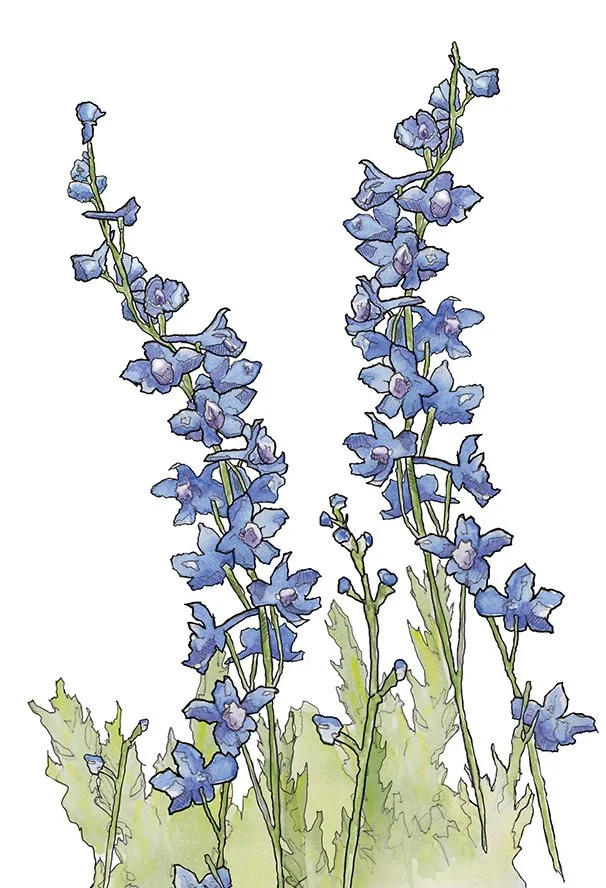
Delphinium illustration by karen blackerby logan

DELPHINIUMS

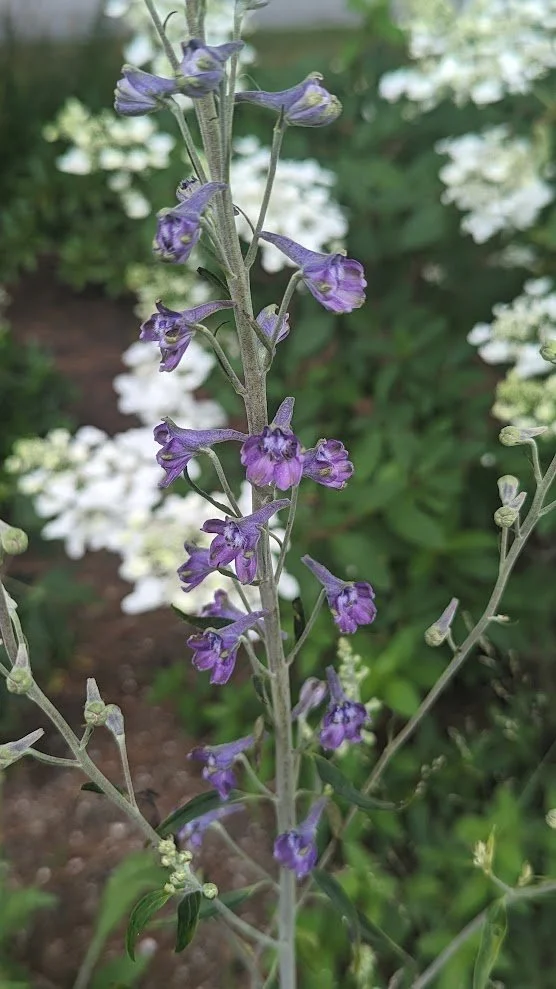
There are around 300 species of annual and perennial delphiniums. They typically bloom in early summer and, with proper care, often rebloom in late summer or early fall. While blue is the most common color, many hybrids offer shades of pink, lavender, red, white, and yellow, with both single and double blooms. We carry both compact and tall varieties and are growing two from seed this season.

Delphinium PG Gallagad

Delphinium Summer Nights

Delphinium PG Gallagad

*******************

GROWING DELPHINIUMS

  • Plant Delphiniums at the back of the bed in groups, where flower spikes can reach 2 to 6 feet tall.

  • Grow in fertile, well-drained soil in full sun to light shade, with shelter from strong winds.

  • Soil should not dry out. Water plants during the summer if rainfall is less than 1 inch per week.

  • Mulch helps retain moisture and keeps roots cool.

  • Care should include regular fertilization in spring when the plant begins to grow, and during the flowering period.

  • Deadhead the first blooms in early summer. Remove flower stalks when blooms are spent.

  • Taller varieties may require staking.

Delphinium Summer Nights

Delphinium Guardian Blue

DELPHINIUM VARITIES:

  • Summer Series - Summer Nights (Deep purple & light blue)

  • Blue Butterfly (we grow in 4-packs)

  • Q&S Series (Deep blue and grown in 4-packs)

Succession Gardening
[Plant Profile] Serviceberry
In PERENNIALS, APRIL, PLANT PROFILES Tags Delphiniums, perennials

POPPIES

April 10, 2026 Karen Logan

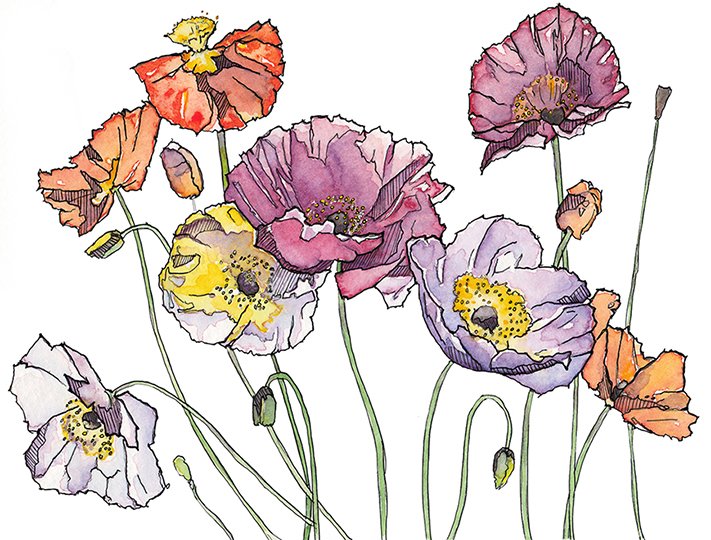
Iceland Poppies illustration by karen blackerby logan

POPPIES:

SPRING FAVORITE!

We love our poppies at Vineyard Gardens and grow a wide range of varieties for every garden. From true perennials to short-lived perennials and classic annuals, each has its own charm. Our annual poppies readily reseed, often returning year after year to create natural, evolving drifts of color.

We start our annual poppies from seed and offer a beautiful, carefully grown selection. Also grown from seed is a perennial variety that is among our favorite : the Spanish poppy, Papaver rupifragum ‘Double Tangerine Gem.’ This late-blooming beauty produces soft apricot flowers in late summer. Native to the mountains of Spain, it grows alongside Spanish lavender, bringing a touch of that wild, sun-soaked landscape into your garden.

Poppies like a rich, well drained soil in full sun. Deer Resistant!!

Iceland Poppy

Iceland Poppies

PAPAVER ORIENTALIS/ORIENTAL POPPIES

The most well-known perennial poppies are the Oriental poppies. They are long-lived, resilient plants that make a bold seasonal statement. They bloom in late spring to early summer, go dormant in the heat of midsummer, and return the following year even larger and more impressive.

Oriental poppies are celebrated for their dramatic, dinner-plate–sized blooms. The classic red with a dark, inky center is perhaps the most iconic. This year, we’re offering Crimson Red, Orange Red, and ‘Royal Wedding,’ a striking white variety with a black center. We also have ‘Turkenlouis,’ with its vibrant red, ruffled petals, and ‘Princess Victoria Louise,’ a beautiful soft salmon. Oriental poppies bring true drama to the garden.

Make sure to mark the spot so that you don’t disturb the sleeping poppy!

Oriental poppies photo by keith kurman

Oriental poppies

PAPAVER NUDICAULE/ICELAND POPPIES

Icelandic poppies, Papaver nudicaule, their name meaning “bare stems”, are another perennial type, though typically shorter-lived than Oriental poppies. They are truly stunning, with delicate, crepe paper–like blooms held on slender, one-foot stems that seem to float above the foliage. Plant two or three in a pot for a soft, airy display that lasts through spring and into early summer.

We carry Iceland poppies in both the Champagne Series (individual colors) and the Wonderland Series (a cheerful mix). The Champagne Series is available in scarlet, pink, yellow, orange, and red. While hardy, these are considered short-lived perennials. They are native to subpolar regions of Asia and North America, bringing a cool-climate elegance to the garden.

Iceland Poppies are blooming now!

Iceland Poppy

Iceland poppy

Iceland poppies

ANNUAL POPPIES

Papaver rhoeas, Papaver commutatum, Papaver paeoniflorus, Papaver somniferum

The great reseeders of the poppy world are the annual poppies. We grow these from seed, starting them in early to mid-February, and offer them in packs and 2” pots.

After their spring to early summer bloom, annual poppies continue to shine with their sculptural seed pods, extending the season into summer and fall. As the pods ripen, they scatter seeds into the surrounding soil, and new seedlings emerge the following year. In many sunny gardens, annual poppies happily naturalize, creating an effortless, ever-evolving display year after year.

This year we are growing:

  • Shirley Poppies

  • Papaver rhoeas, including Double Choice Mix

  • Select Seed, White Bridal Veil

  • We are growing the peony flowered poppy in Lauren’s Grape, Hungarian Blue and White Cloud.

  • Ladybird Poppy, Papaver commutatum, a red flower with a black pattern at the base of each petal. It is a prolific bloomer.

  • Papaver somniferum, in Imperial Pink and The Giant with a red flower.

    Ready to be planted now!

    **************************************

GROWING & CARE

  • Plant your poppies in a full sun garden with well drained soil.

  • They have beautiful seed pods that extend the season beyond bloom.

  • The annual poppies can be dead headed to extend bloom but at some point let the beautiful seed pods develop and let them ripen on the plant.

  • Poppies will reseed and you may have lots of little poppy seedlings for years to come.

  • If they are happy, they will colonize in your garden. It is wonderful when plants colonize! Other plants do this too!

Come to Vineyard Gardens to find out what other plants reseed and colonize in your garden!

In PERENNIALS, GARDEN TIPS, SPRING PLANTS, APRIL, PLANT PROFILES Tags Iceland Poppies, spring perennials, Deer resistant plants, summer blooms, Oriental poppies, annual poppies
Comment

ASPARAGUS

March 28, 2026 Karen Logan

ASPARAGUS

“There are a few perennial vegetables which actually are some of the easiest ones to grow. My all-time favorite is asparagus which can live for 20 or more years. Asparagus continually get bigger and more productive with just a little bit of care. The most important way to care for them is to keep the weeds out in order for them to thrive. They are one of the first vegetables to come up every spring and are absolutely delicious and healthy.” -

Chuck Wiley, founder of Vineyard Gardens Landscaping

Bare root asparagus

GROWING ASPARAGUS

Asparagus are a long lived perennial and should be planted in a dedicated bed.

  • Asparagus requires well drained fertile soil and can not tolerate wet feet.

  • Ensure planting site is well weeded.

  • Plant in full sun.

  • An excellent weed killing technique is to cover with cardboard 8 weeks prior to planting.

  • Make an 8” deep trench with a 4” ridge and loose soil down the middle.

  • Plant one bare root asparagus every 1’ between plants and 3’ between rows.

  • Splay the long roots down the sides of the ridge.

  • Water well to establish.

  • Top dress asparagus bed with plenty of premium compost every fall.

  • Since the roots are deep, you can hoe out weeds to about 3” deep as long as you do it before March 15th.

HARVESTING

Plants need to establish for 2 or 3 seasons before their first harvest, then they have abundant yields.

  • In the third year, harvest tender spring shoots at about 4.5”.

  • Do not harvest until shoots are pencil thick.

ONCE BARE ROOT ASPARAGUS IS AVAILABLE THERE IS A SHORT PLANTING WINDOW!

In PERENNIALS, SPRING PLANTS, VEGETABLE GARDENS, MARCH, PLANT PROFILES Tags asparagus, bare root asparagus, growing asparagus, harvesting asparagus, Jersey Giant Asparagus, Purple Passion Asparagus
Comment

HELLEBORE

March 13, 2026 Karen Logan

HELLEBORES

LENTEN ROSE

*********************

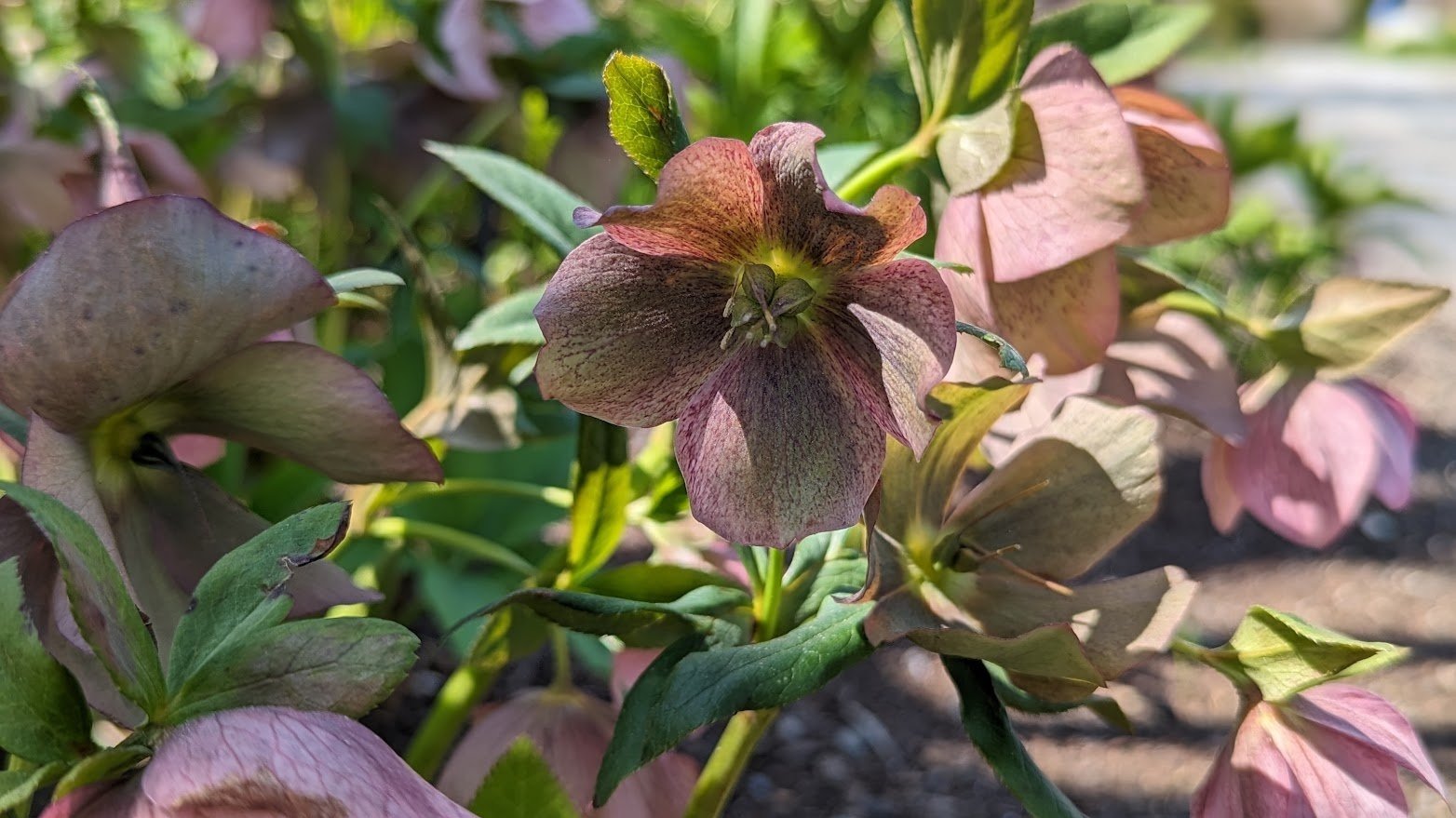
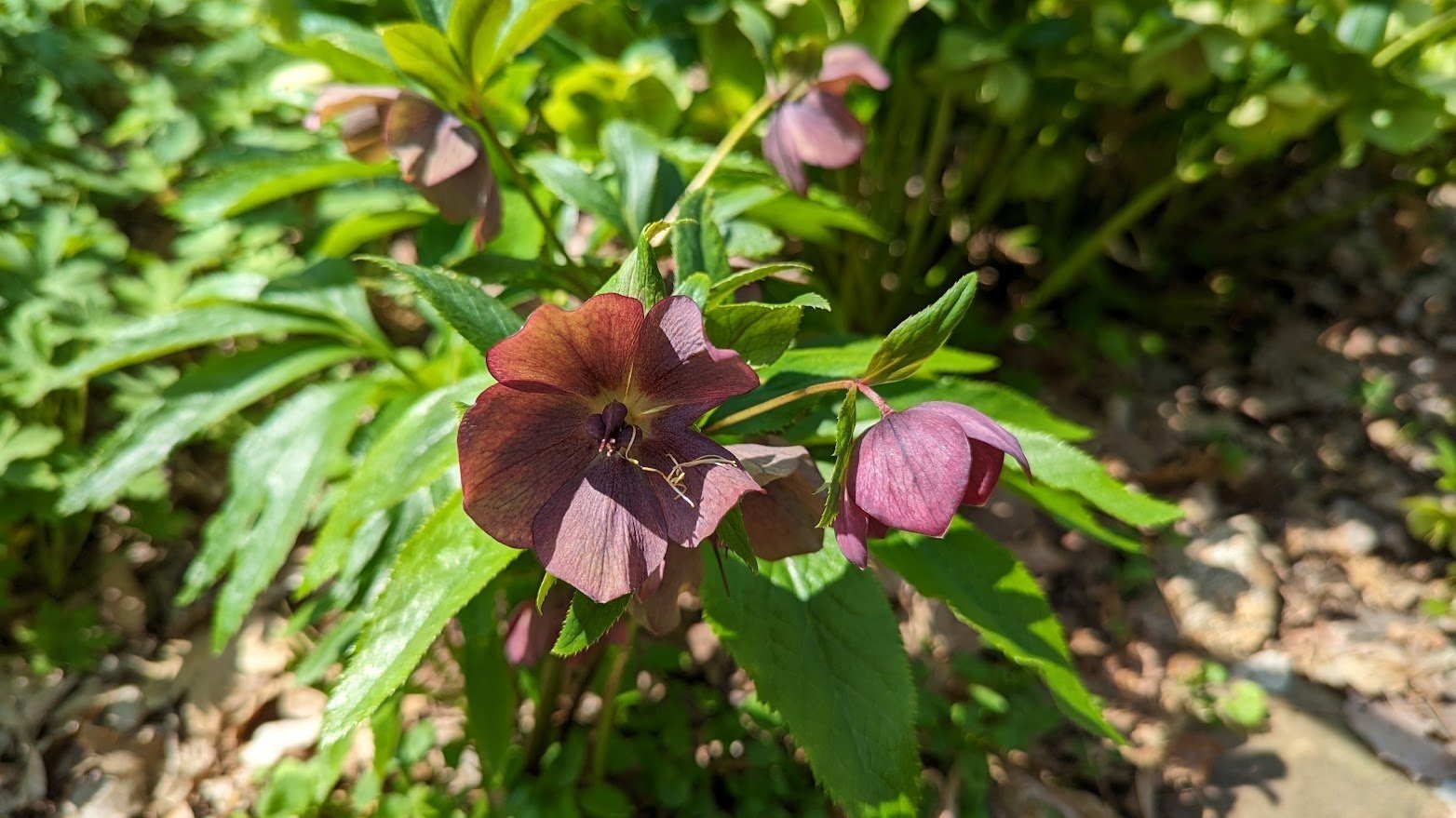
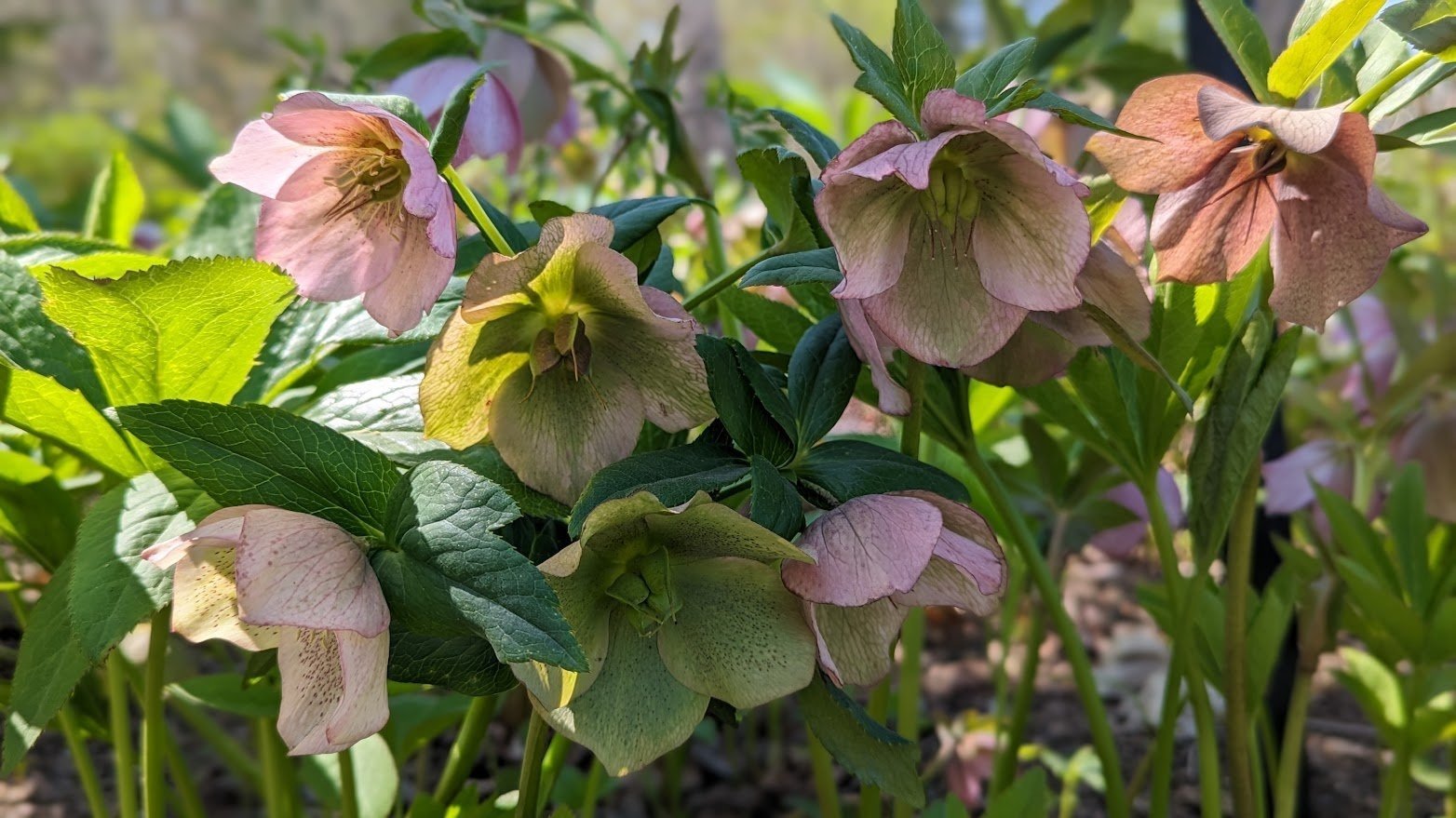
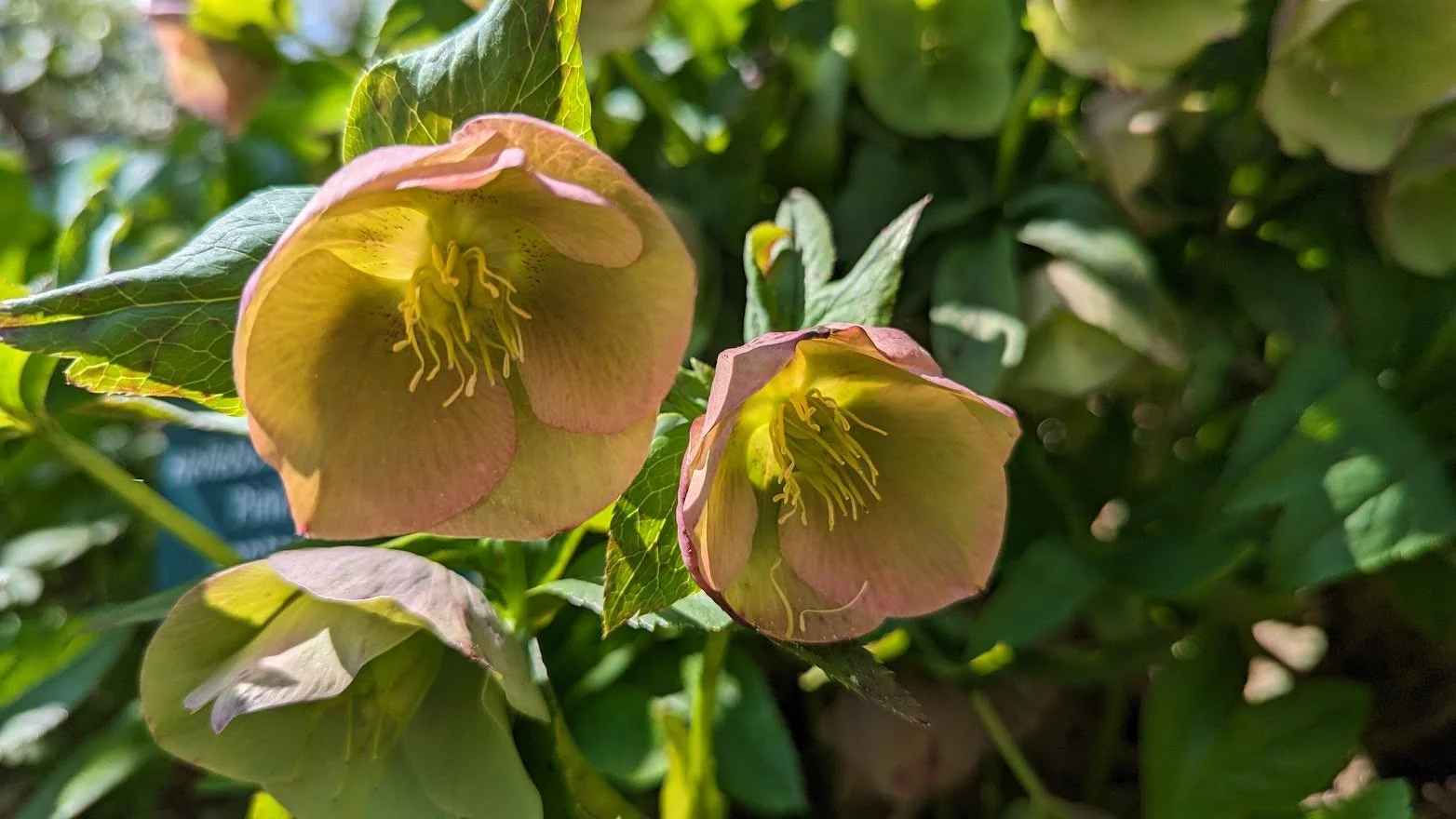
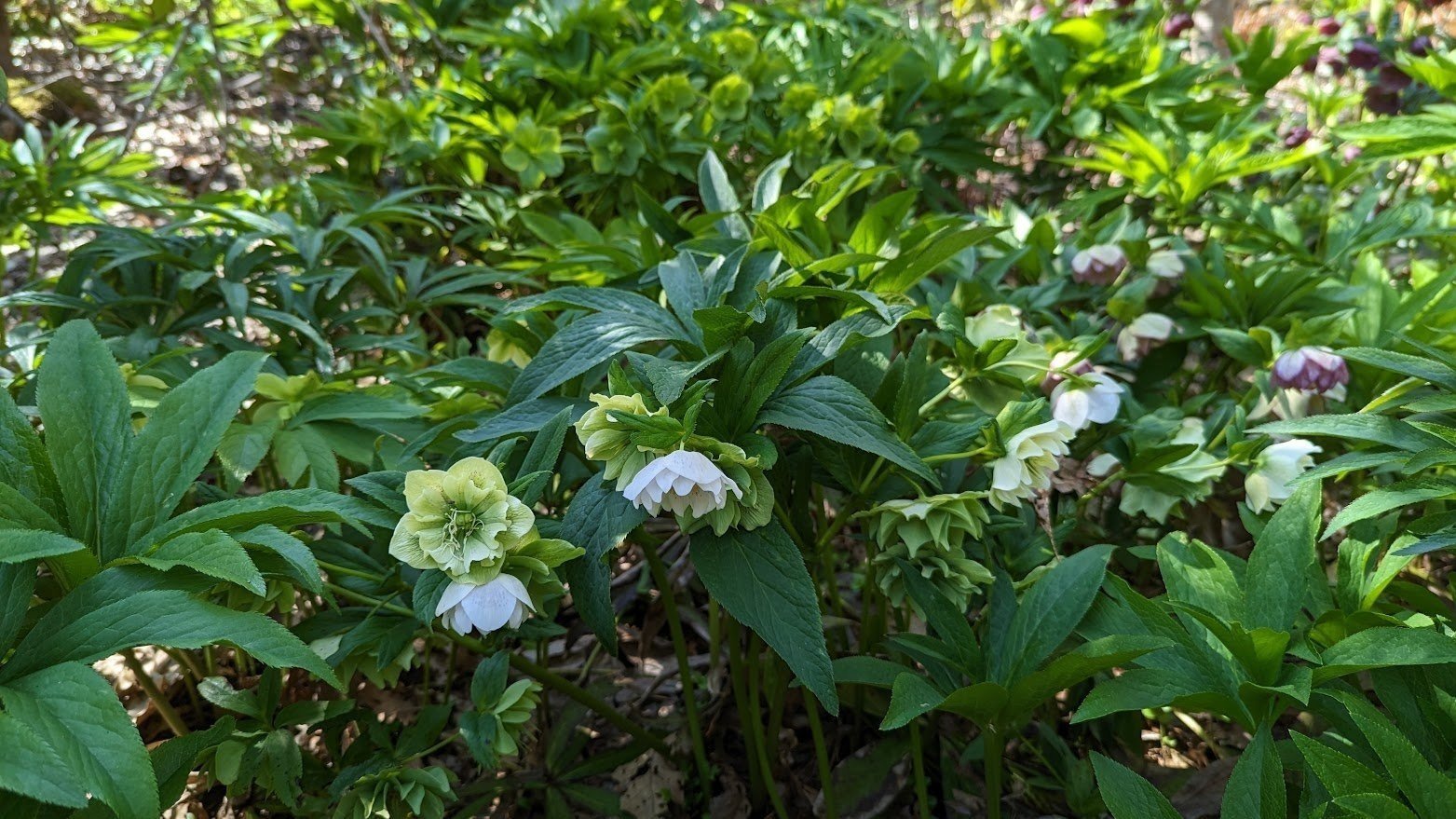
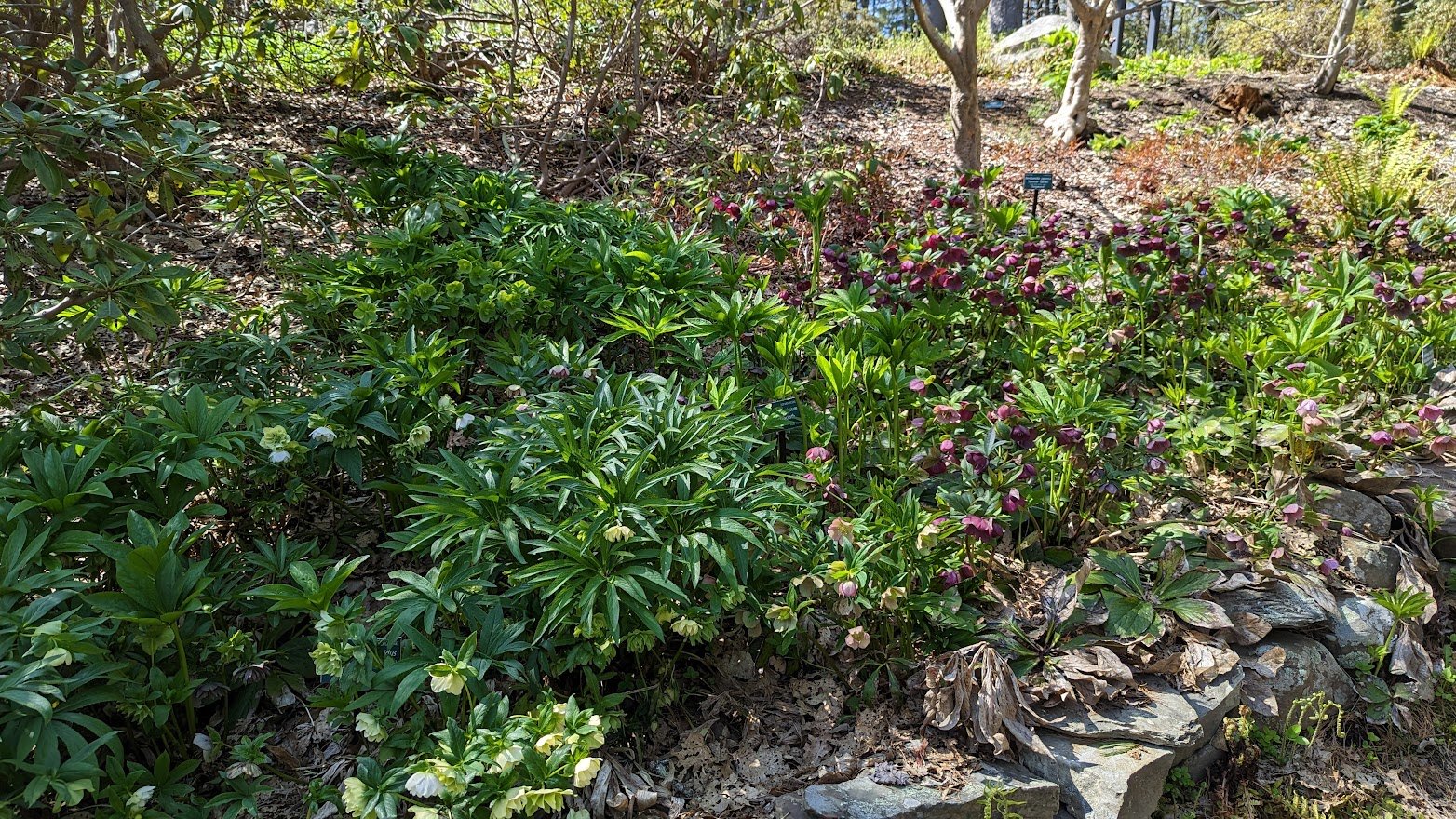
On a walk through Coastal Maine Botanical Garden last year at the beginning of May, one of the many surprises I stumbled upon were the enormous array of Hellebores dappled throughout the shade gardens. I was mesmerized by their range of colors from deep red to shades of pink and white. In the shade of the Giles Rhododendron and Perennial Garden, swaths of Hellebores were groundcover for the Rhododendrons and Azaleas. I have always been in awe of Hellebore’s unique flower structure and evergreen foliage but witnessing it in these numbers was just glorious.

Hellebores awaken in mid April when they begin to put on a show with their abundant blooms. Their flowers last for several weeks and once the petals have faded, the sepals, which look like a flower, remain attractive for several months. The sturdy evergreen foliage is appealing well into the winter months. With all their different stages they are the plant that keeps on giving from spring to winter.

Hellebores are perfect in woodland gardens and in shady areas under deciduous trees.

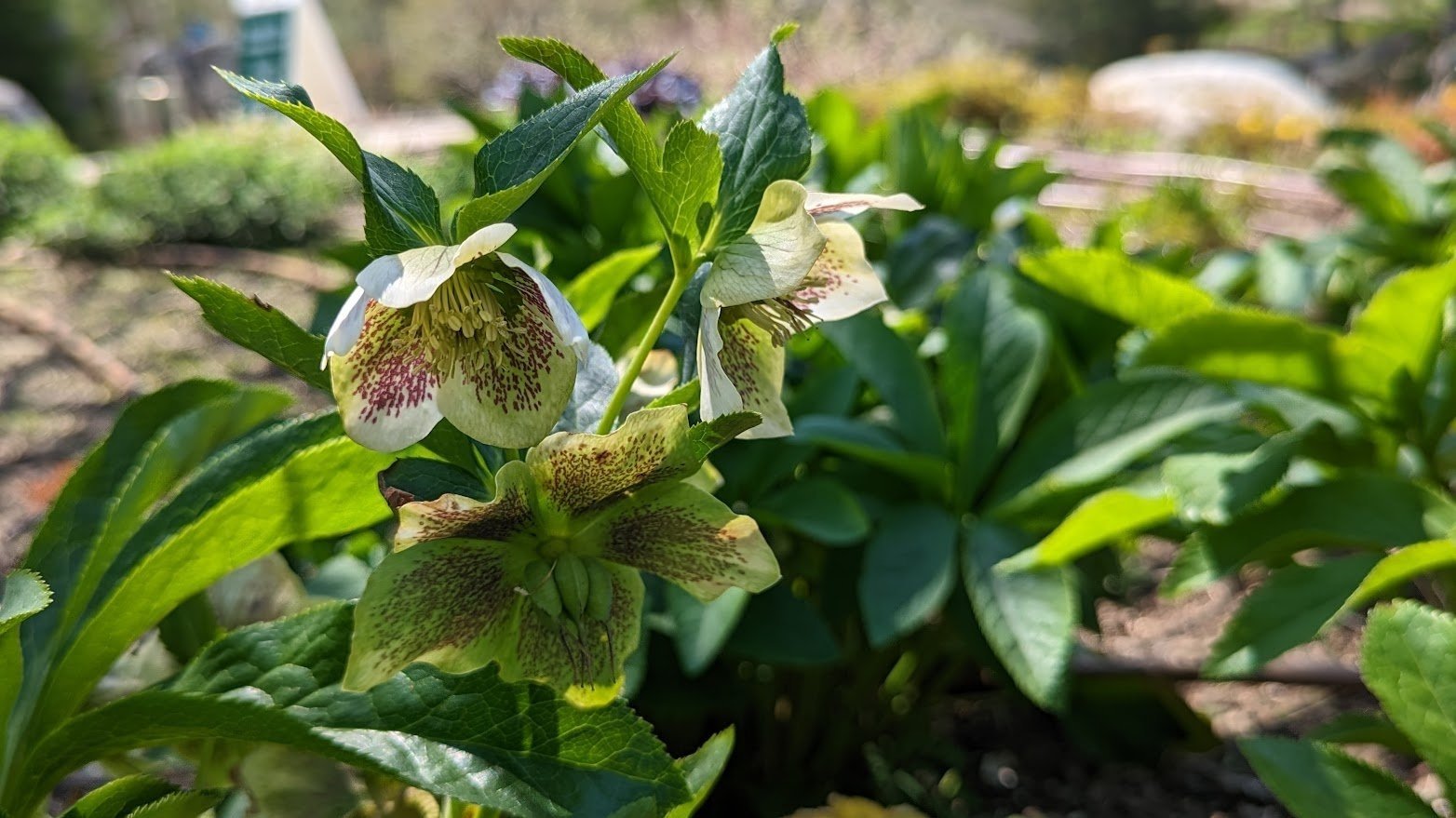
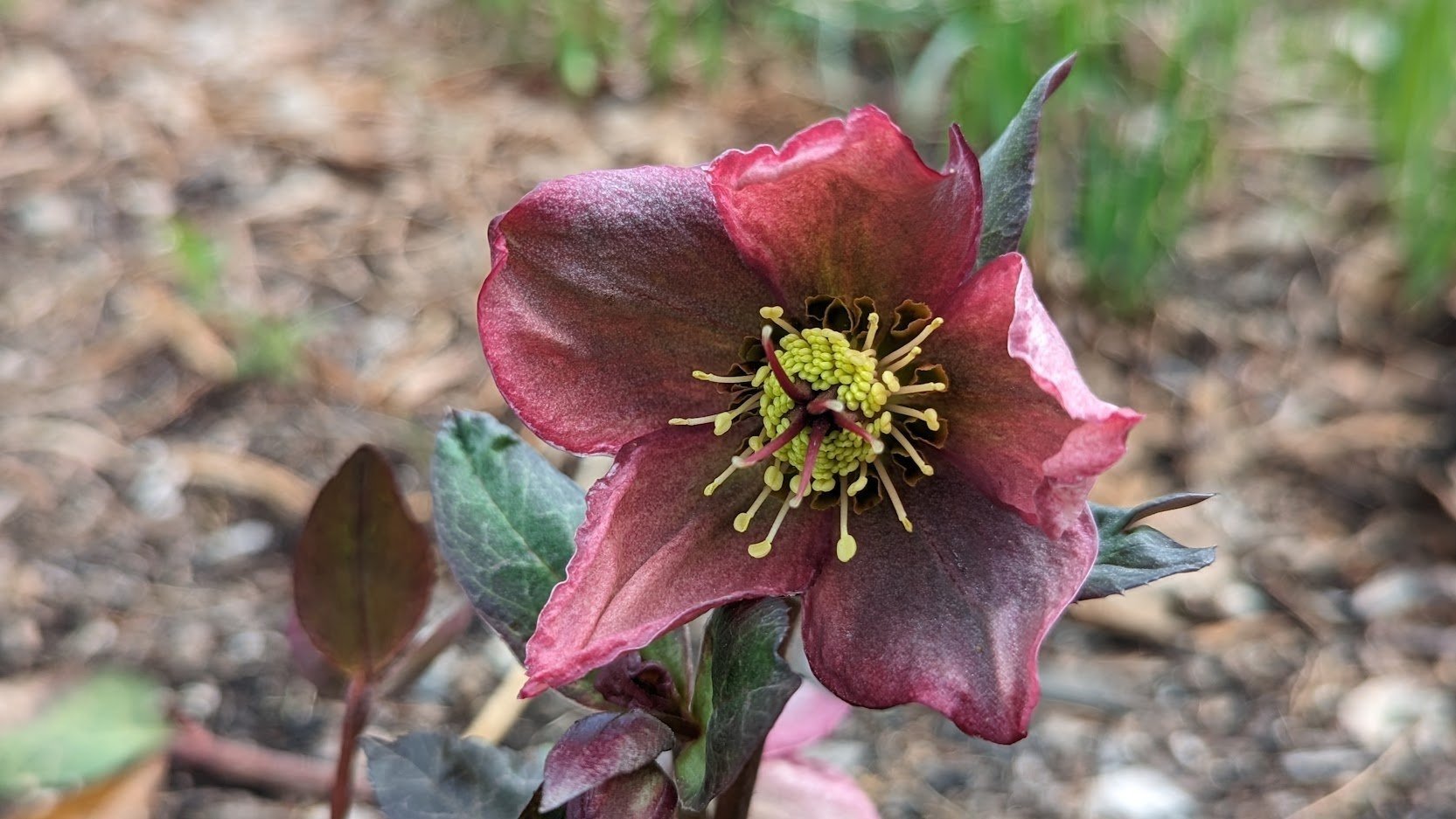
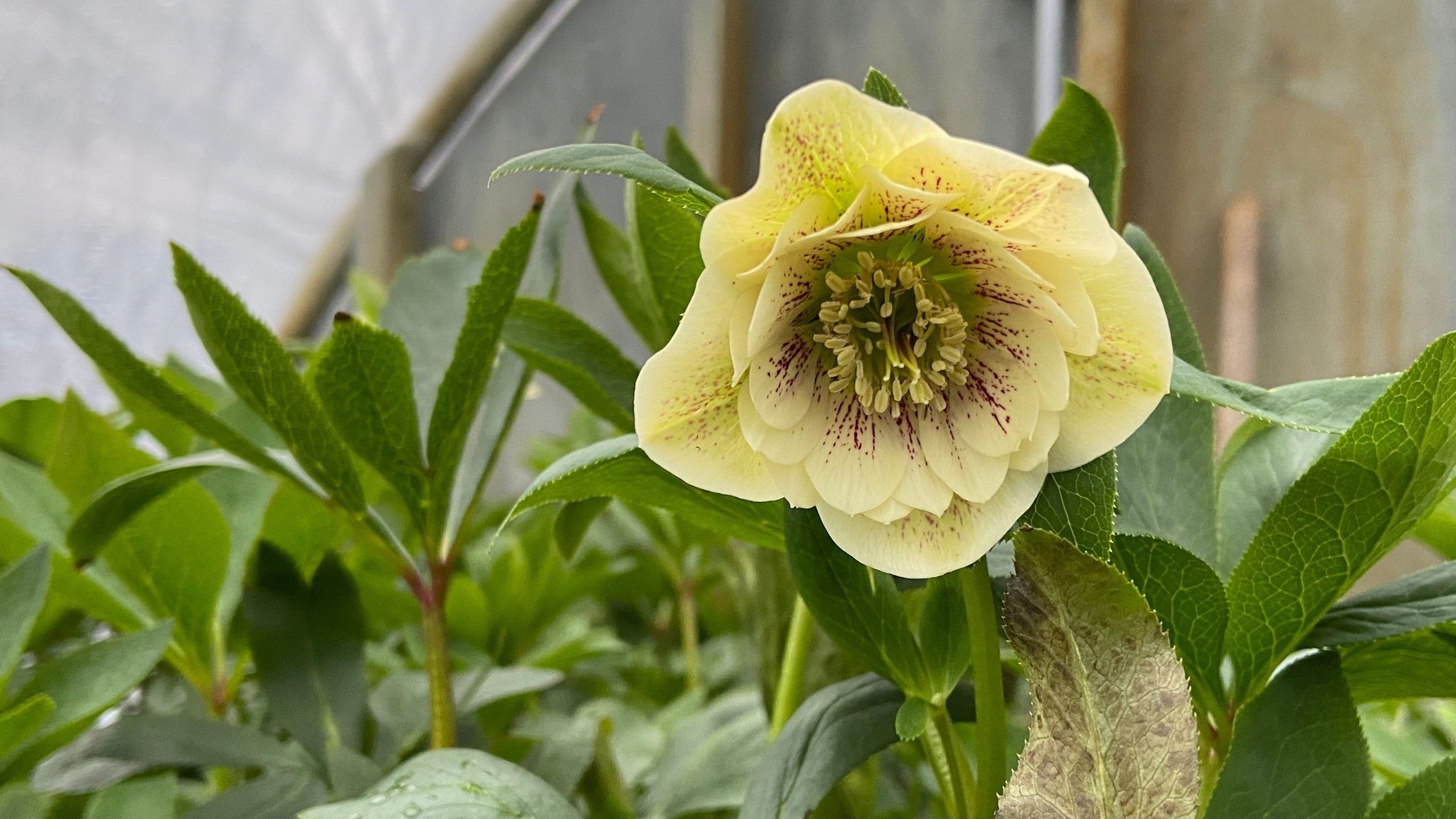
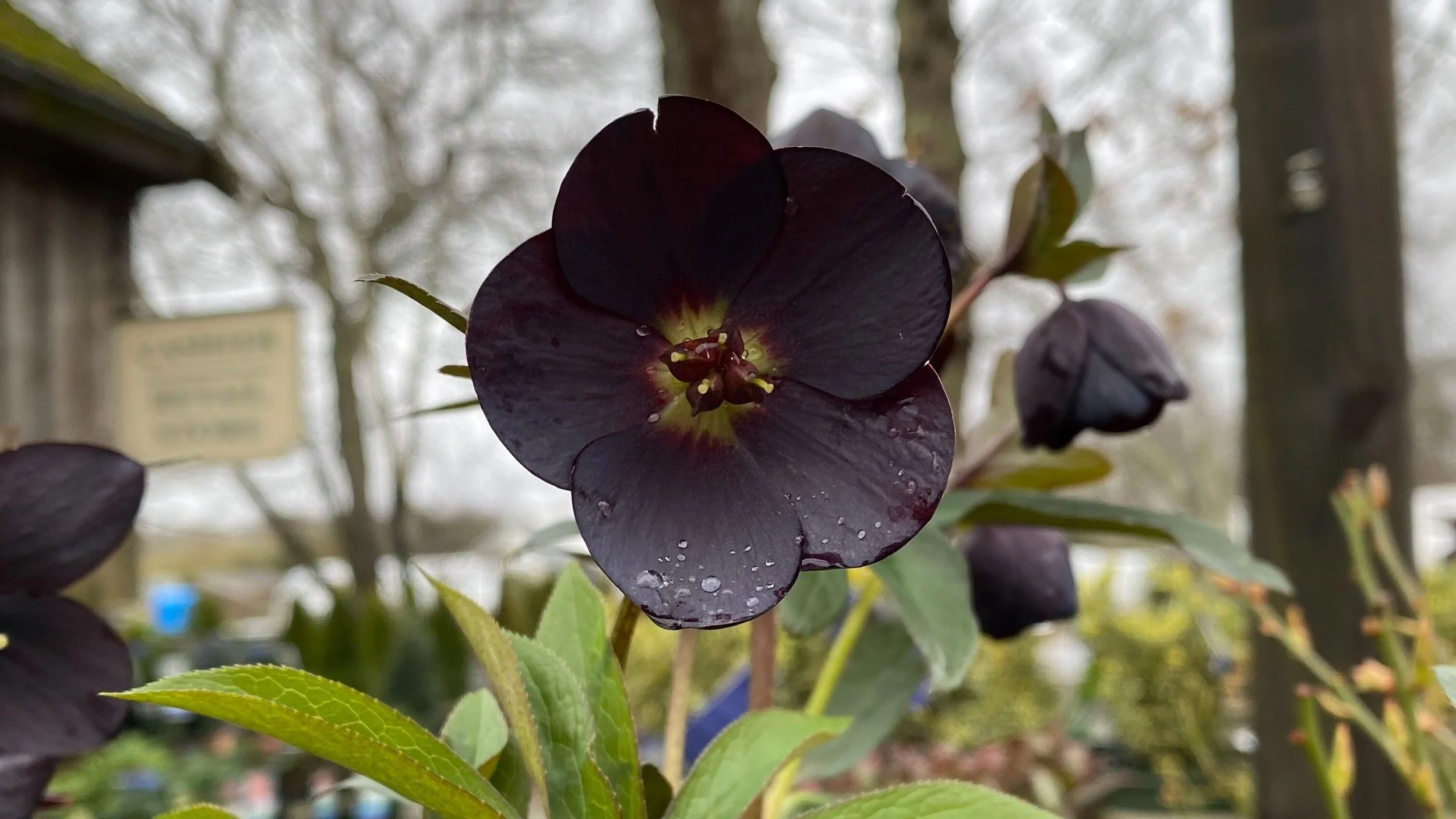
Helebore at Maine Coastal Botanical Garden

*********************

GROWING CONDITIONS & CARE

  • Easy to grow

  • 12 x 24” H. Spreads over time

  • Drought tolerant but thrives in slightly moist conditions

  • Sensitive to poor drainage

  • Cold hardy and tough

  • Rabbit and deer resistant

  • Perfect along shaded borders and woodland gardens

  • Beautiful when planted under deciduous trees as a ground cover

  • After a long winter, the large evergreen leaves look flattened and tattered. Remove the worst of these before the flower stalks begin to grow. Do not remove leaves prior to that or may harm plant.

PXL_20230510_182322269.PORTRAIT.jpg
PXL_20230510_184221067.jpg
PXL_20230510_182314019.PORTRAIT.jpg
PXL_20230510_162755129.PORTRAIT.jpg
Hellebore
Hellebore
U3fyPpqQ.jpg
Hellebore
Hellebore
PXL_20230510_184319741.jpg
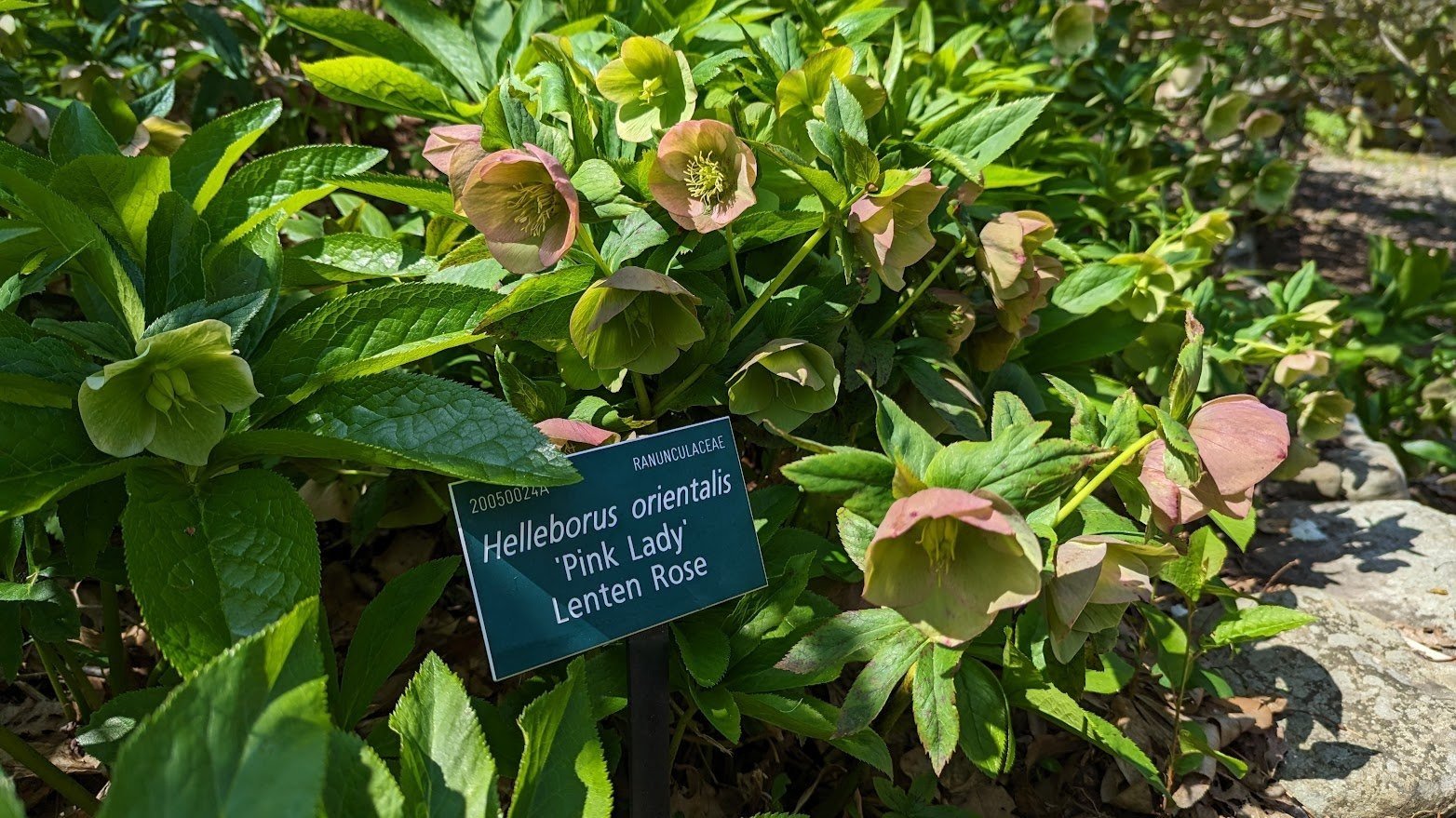
Helleborus orientalis 'Pink Lady' Lenten Rose
Helleborus x hybridus
PXL_20230510_184501021.jpg
PXL_20230510_182322269.PORTRAIT.jpg PXL_20230510_184221067.jpg PXL_20230510_182314019.PORTRAIT.jpg PXL_20230510_162755129.PORTRAIT.jpg Hellebore U3fyPpqQ.jpg Hellebore PXL_20230510_184319741.jpg Helleborus orientalis 'Pink Lady' Lenten Rose Helleborus x hybridus PXL_20230510_184501021.jpg

*********************

HELLEBORES AVAILABLE AT VINEYARD GARDEN

  • Hellebore Ice N' Roses® Bianco (Monrovia)

  • Hellebore Ice N' Roses® Red (Monrovia)

  • HelleboreIce N' Roses® Rosado (Monrovia)

  • Helleborus x iburgensis Ice N' Roses® Merlot Hellebore (Monrovia)

  • Hellebore Ice N' Roses® Rose (Monrovia)

  • Helleborus Paris in Pink (Walter’s Garden)

  • Helleborus Rio Carnival (Walter’s Garden)

  • Helleborus Romantic Getaway (Walter’s Garden)

  • Helleborus Maid of Honor (Walter’s Garden)

  • Helleborus Wedding Bells (Walter’s Garden)

  • Helleborus Spanish Flare (Walter’s Garden)

  • Helleborus New York Night (Walter’s Garden)

  • Helleborus Rome in Red (Walter’s Garden)

  • Helleborus Snowbells (Walter’s Garden)

  • Helleborus French Kiss (Walter’s Garden)

  • Helleborus Sandy Shores (Walter’s Garden)

  • Helleborus Ivory Prince (Walter’s Garden)

  • Helleborus Irish Luck (Walter’s Garden)

A hardy, deer resistant perennial with evergreen foliage, long-blooming flowers and multi seasonal interest!

*********************

MARCH GARDEN TIPS
EARLY SPRING COLOR
In MARCH, DEER RESISTANT, PERENNIALS, PLANT PROFILES Tags perennial plant, Hellebore
Comment

PERENNIALS FOR SHADE

July 12, 2024 Karen Logan

Gorgeous combination of Thalictrum ‘Elin,’ Aquilegia, Euphorbia and the leaf and seed pod of Paeonia delavayi. The glowing spikes on the right are from a bedding pocket of a pale yellow Digitalis [photo by Andrew Wiley]

PERENNIALS

FOR SHADE

******************************************

SUMMER BLOOMING PERENNIALS FOR SHADE

Even if your yard is shady, you can still have beautiful flowers and foliage! If your yard needs more sun but you don’t want to cut down trees you can limb up or thin out a few trees to let in more sun. On the other hand, If you have a very sunny garden and want to grow some of these wonderful shade perennials, plant a few small trees or large shrubs in the beds. Not only will they provide a little shade but height and size will add interest to perennial beds.

Alchemilla

Anemone

Asarum

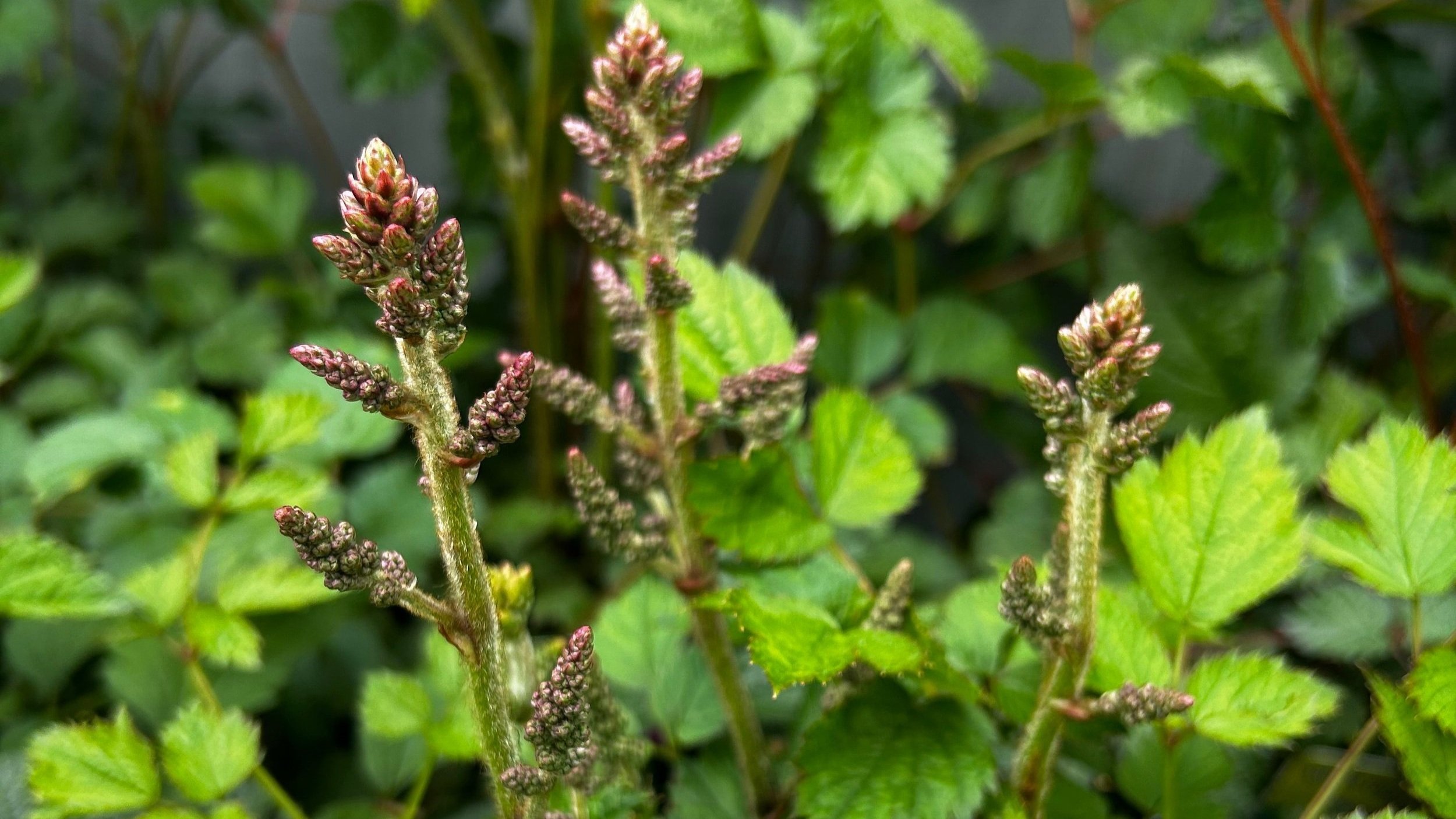
Astilbe

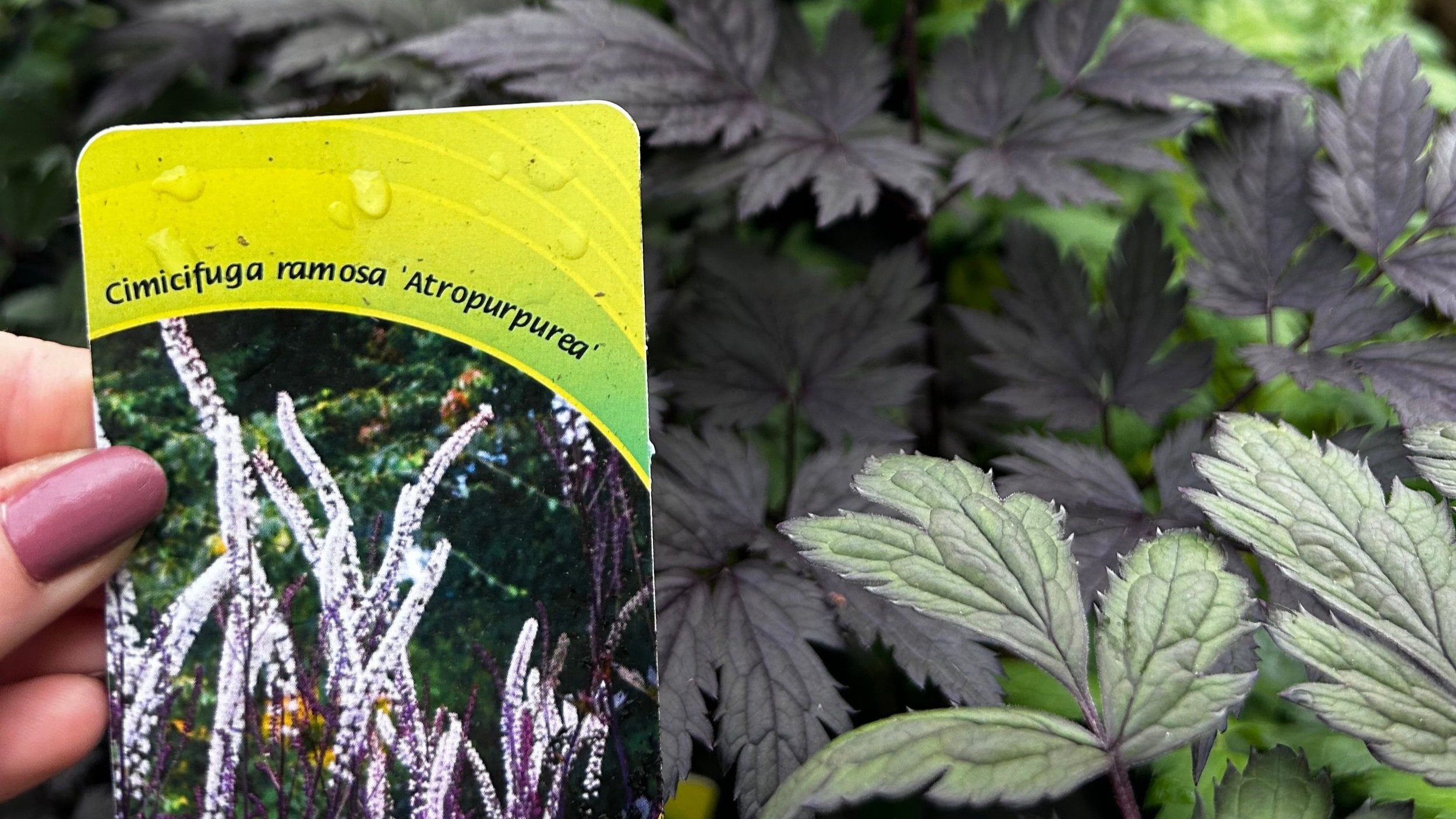
Cimicifuga

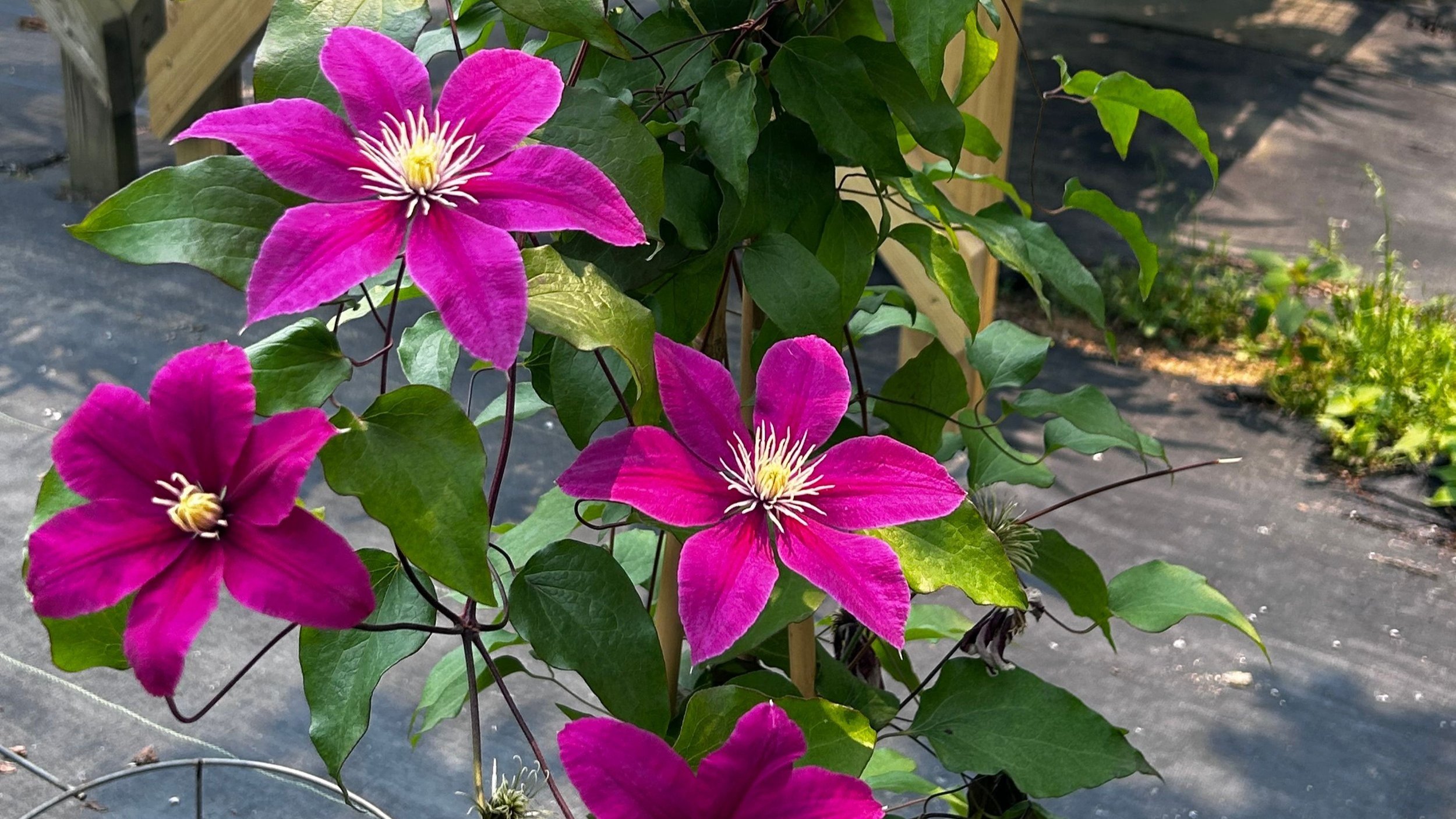
Clematis

Dicentra

Epimedium

Euphorbia

Ferns

 Foxglove

Galium

Ferns, Heuchera & Columbines

Geraniums (perennial)

Hackonechloa

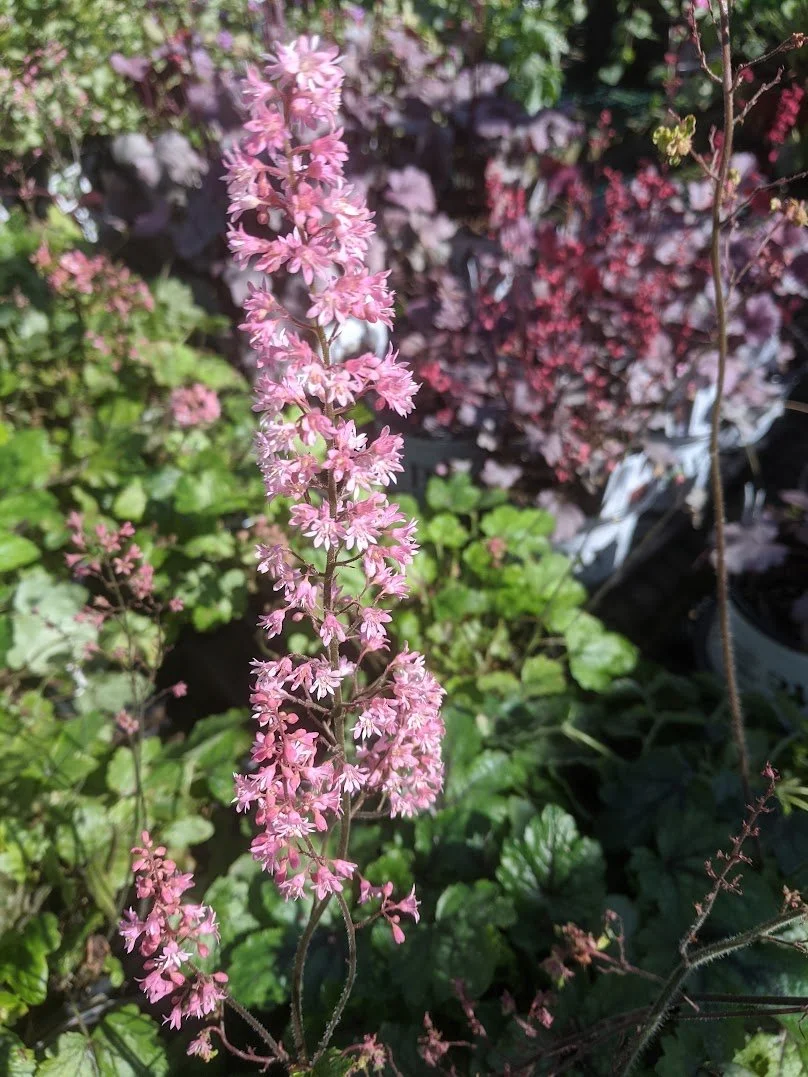
Heucheras

Hostas

Ligularia

Pachyhsandra

Polygonatum

Rodgersia

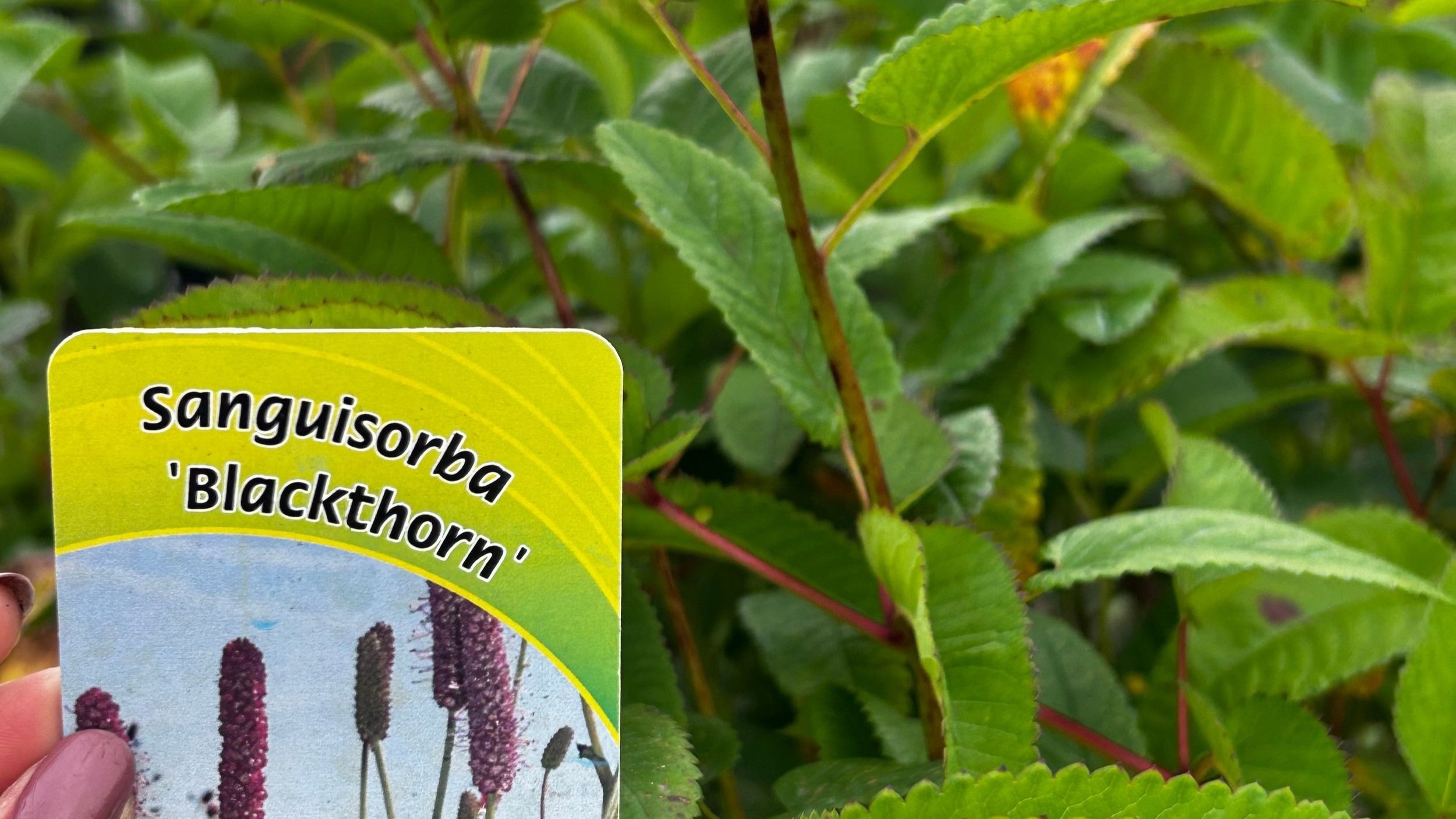
Sanguisorba

Thalictrum

Vinca

**************************************

Perennials that thrive in shade often do quite well with more sun, as long as they get enough water. The reverse does not apply. Perennials that need sun often grow long and leggy in the shade. Plants that evolved in shade, usually in the understory of other plants, often have larger leaves to capture as much sun as possible. Some good examples are Rodgersias, Hostas, Astilboides and many Heucheras, like the popular Autumn Bride. These plants usually like a rich moist but well drained soil.

**************************************

Hosta
Hosta
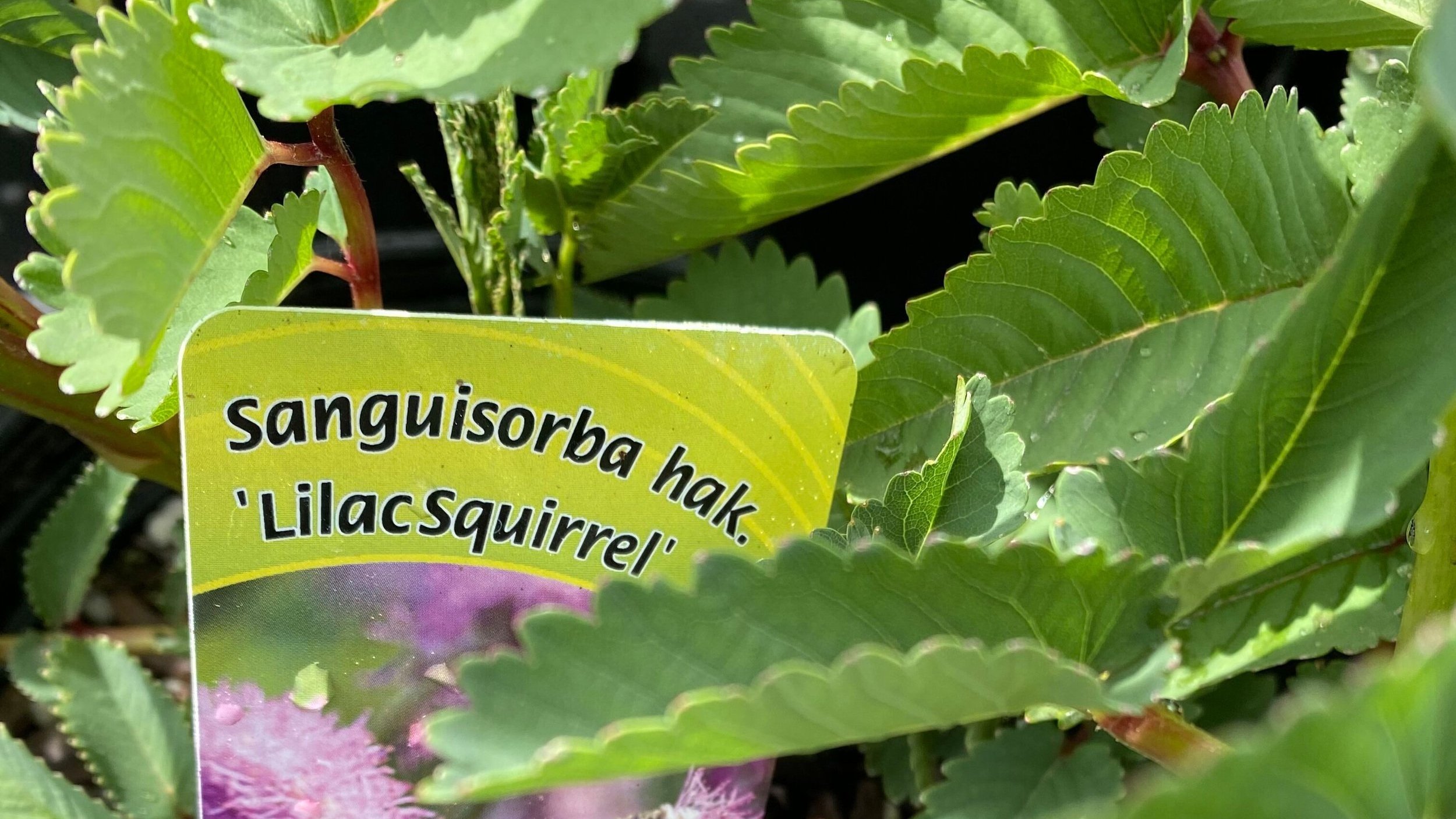
Sanguisorba ‘Lilac Squirrel’
Astilbe
Astilbe
Alchemilla, Lady's Mantle
Astilbe Pumila
Astilbe Pumila
cimicifuga+atropurpurea.jpg
Anenome
Anenome
Clematis Boulevard Acropolis
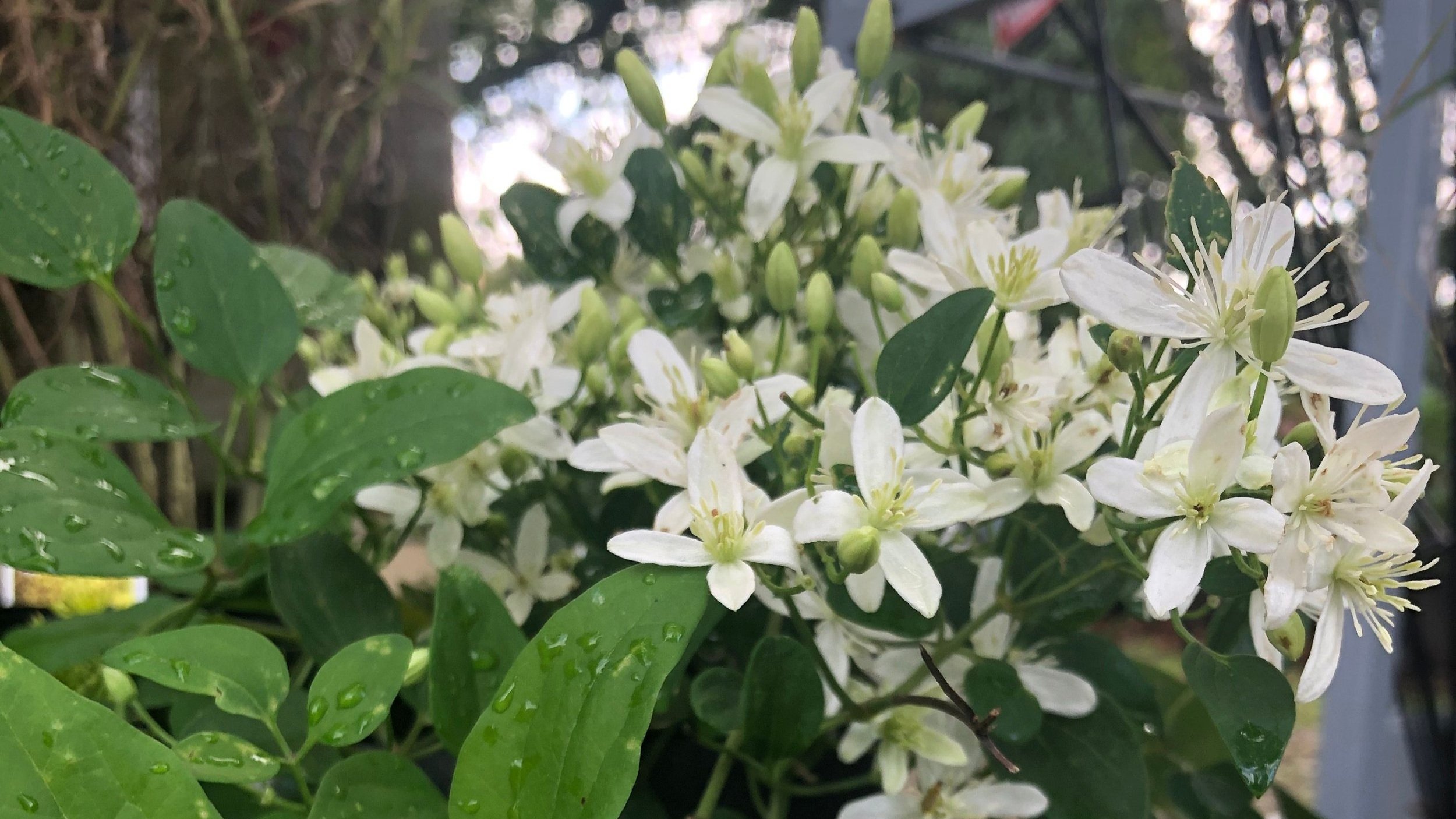
Clematis Sweet Autumn
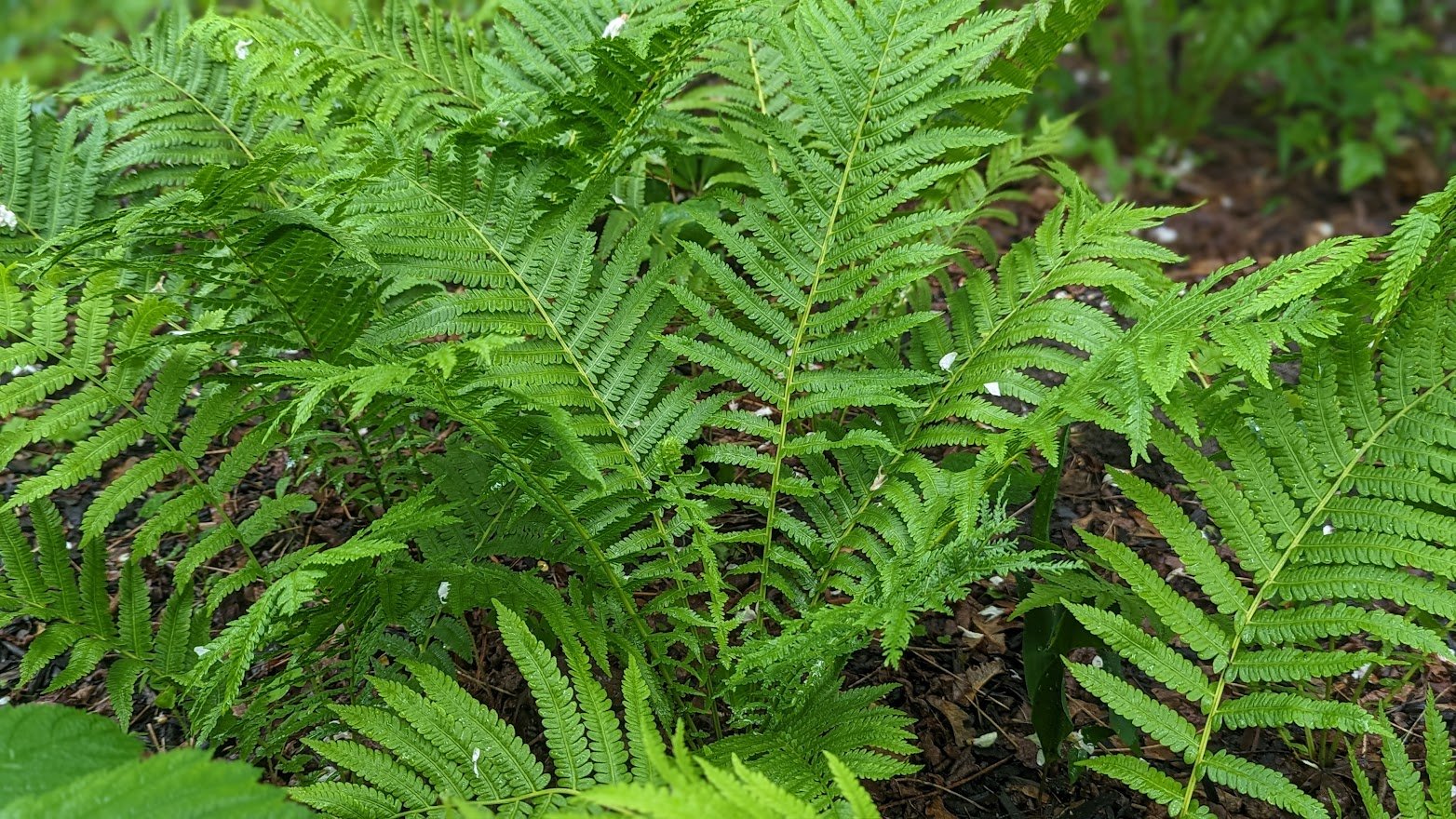
Ferns
Ferns
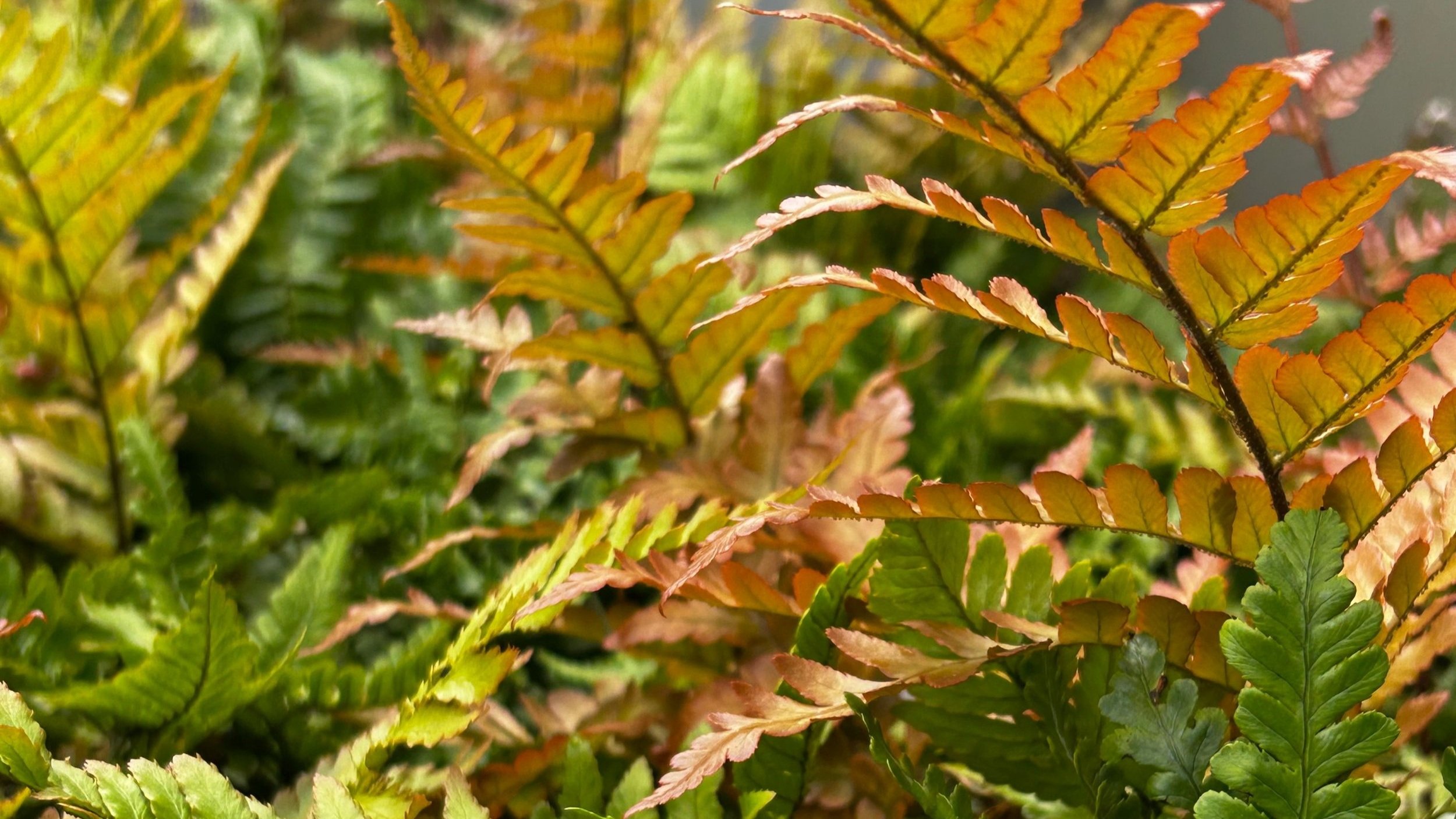
Athyrium Brilliance
Athyrium Brilliance
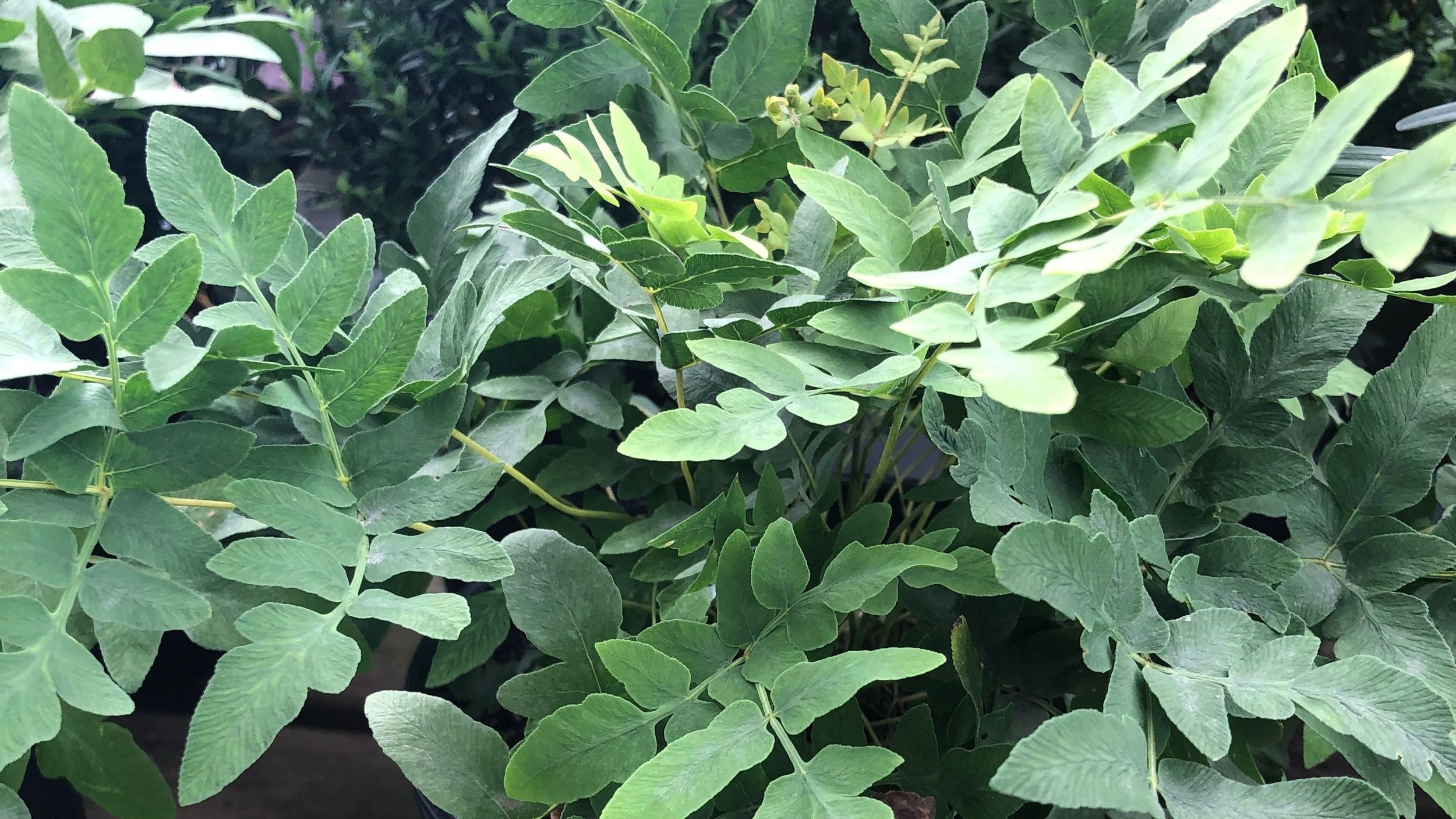
Osmunda regalis
Osmunda regalis
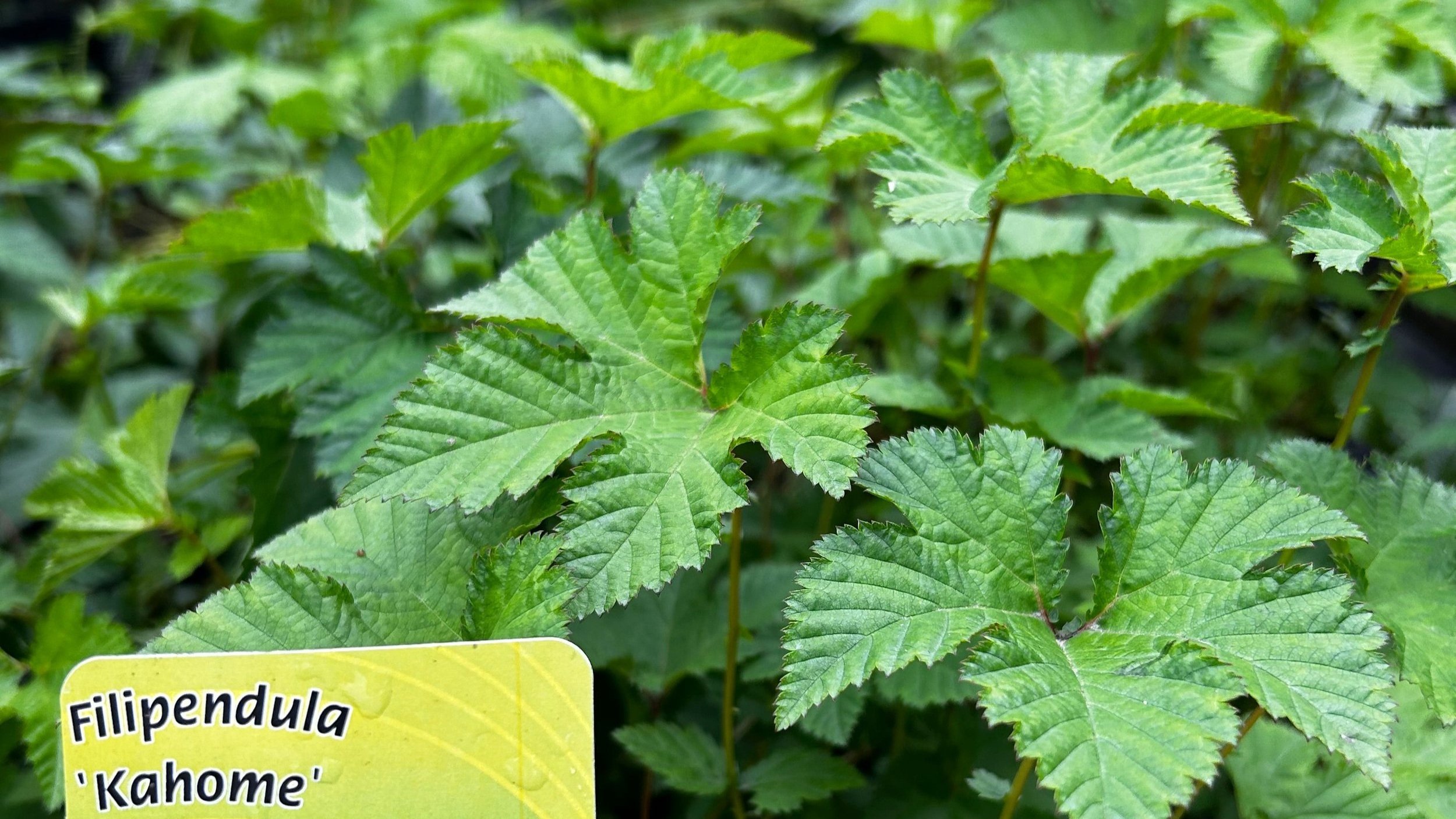
Filipendula Kahome
Filipendula Kahome
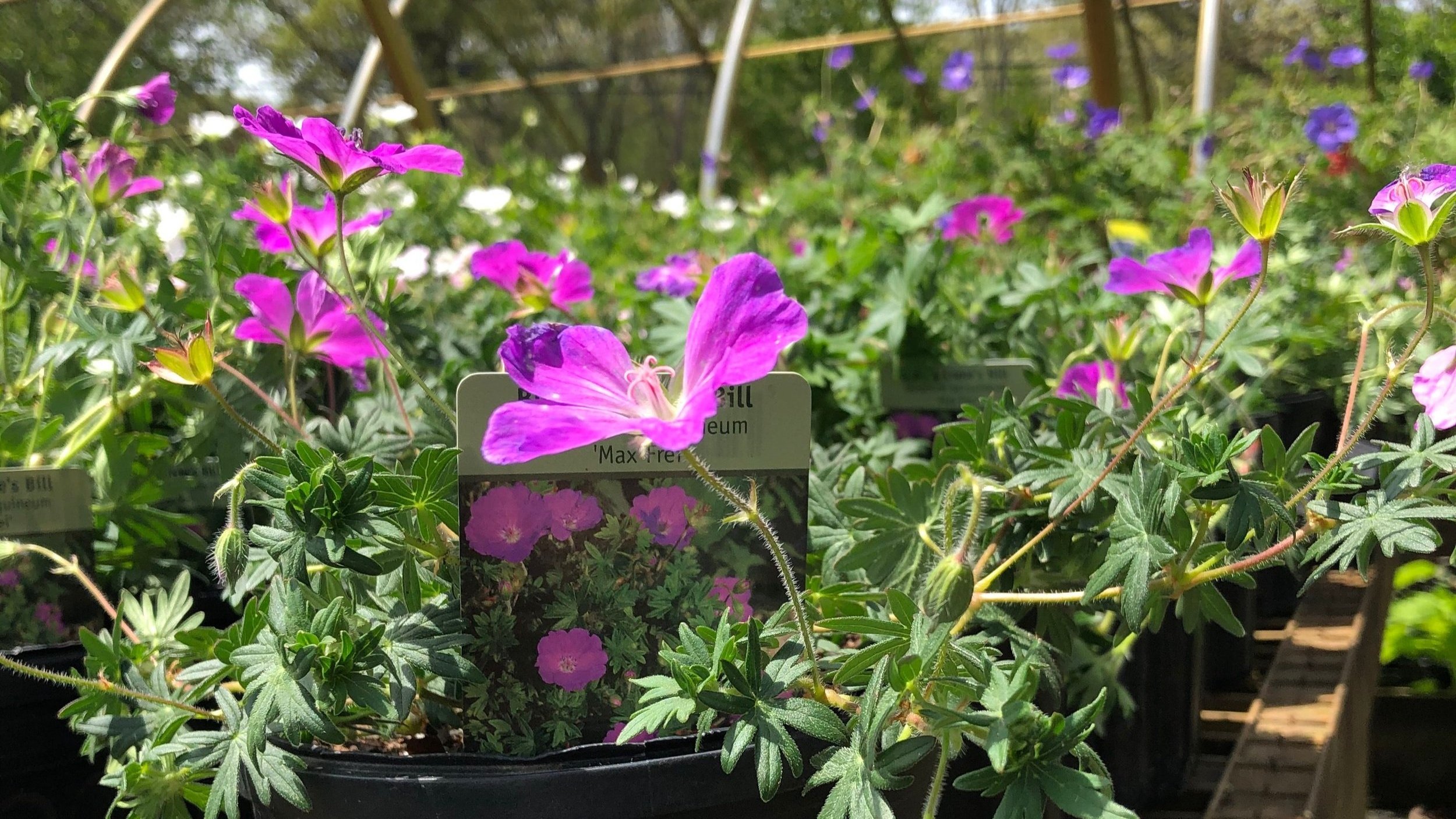
Geranium Max Frei
Geranium Max Frei
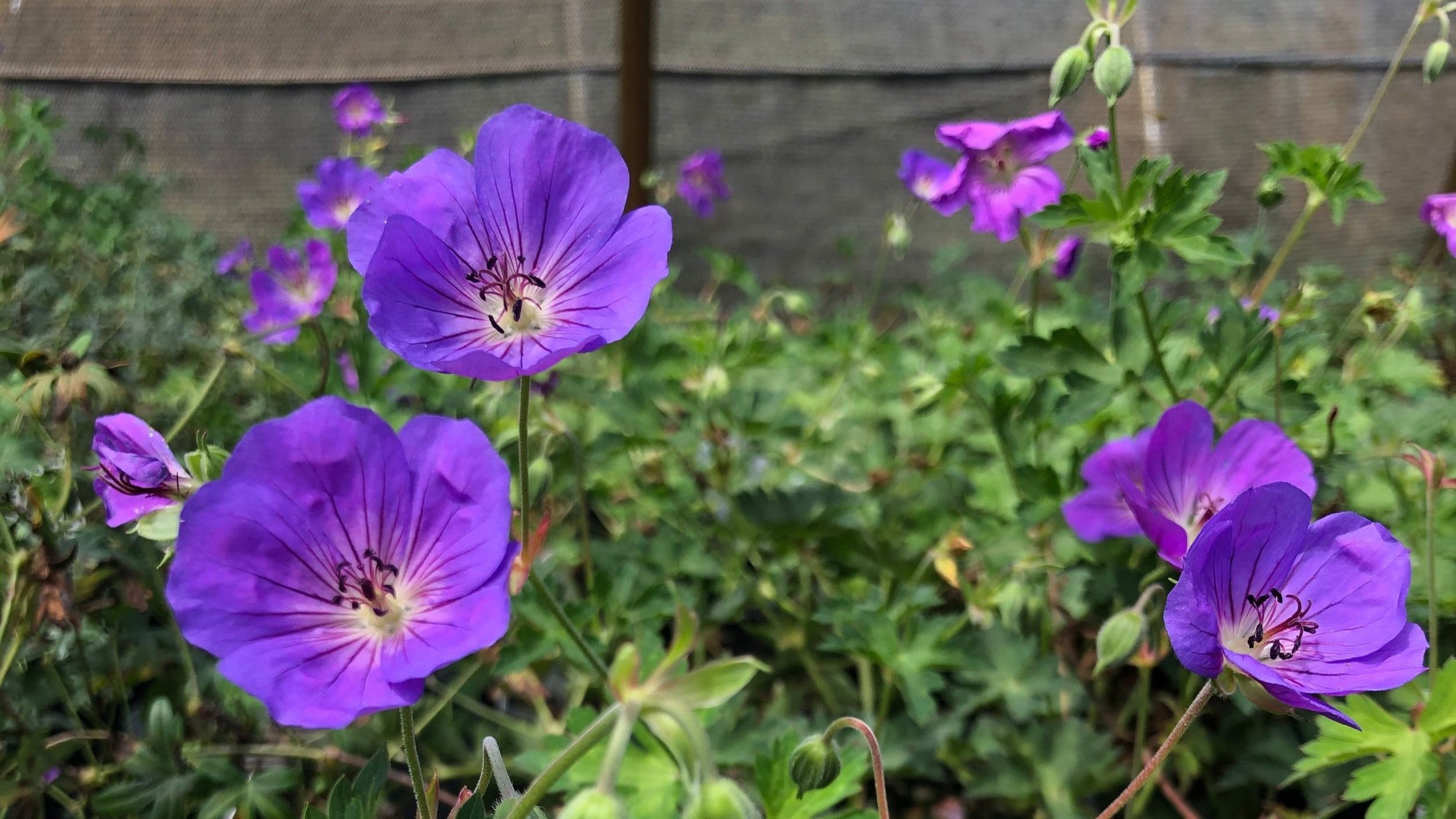
Geranium Rozanne
Geranium Rozanne
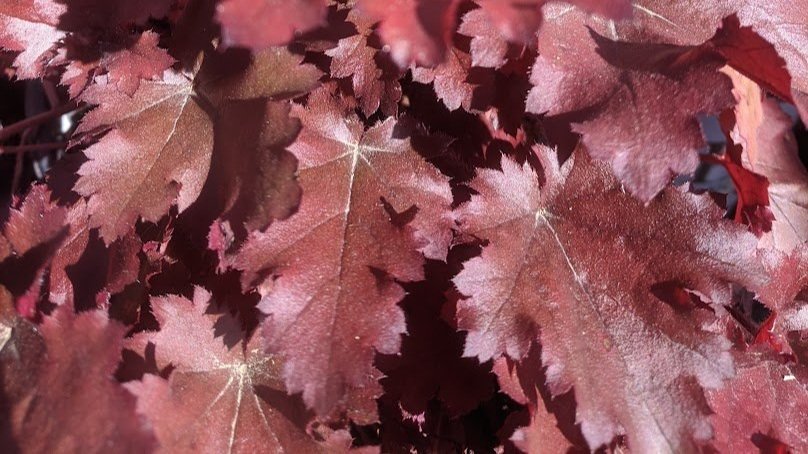
Heuchera Dolce Cherry Truffles
Heuchera Berry Smoothie
Heuchera Primo Wild Rose
Heuchera Snow Angel
Heuchera Snow Angel
Hosta Frech Fries
Hosta Frech Fries
Lilac+Squirrel.jpg
sanguisorba+black+thorn.jpg
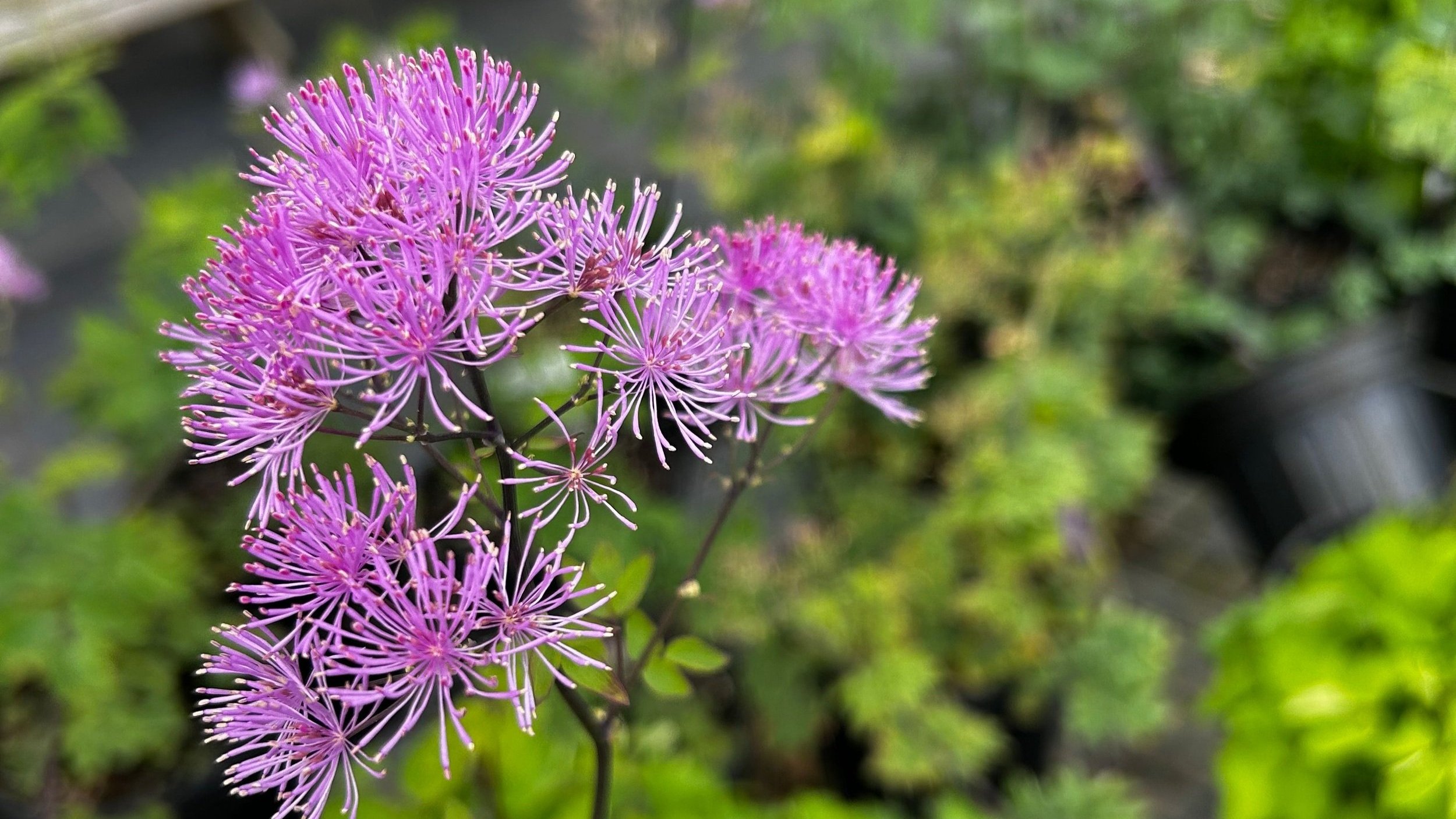
Thalictrum Black Stockings
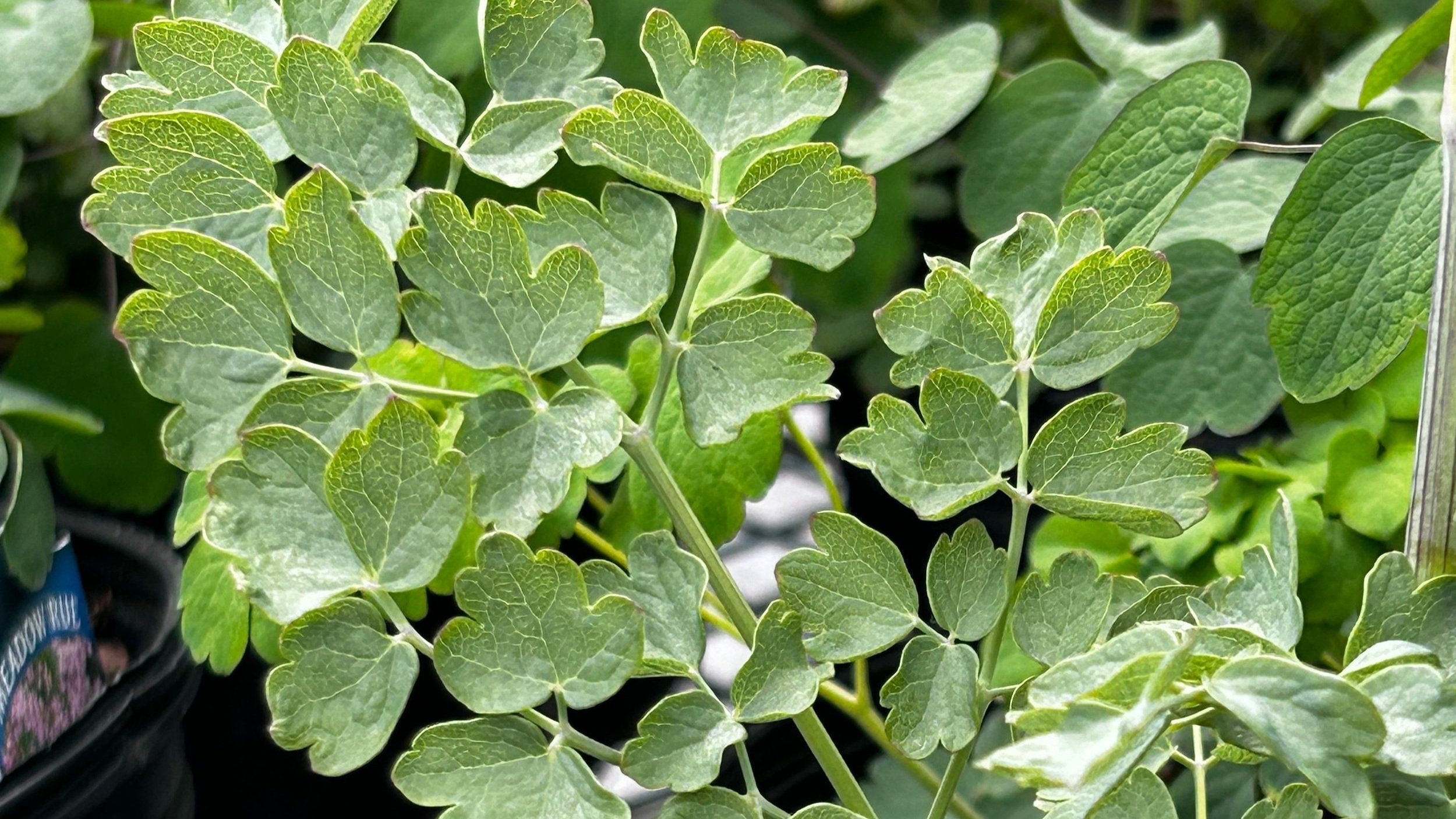
Thalictrum flavum glaucum
Euphorbia
Euphorbia
Foamflower
Foamflower
Hosta Sanguisorba ‘Lilac Squirrel’ Astilbe Alchemilla, Lady's Mantle Astilbe Pumila cimicifuga+atropurpurea.jpg Anenome Clematis Boulevard Acropolis Clematis Sweet Autumn Ferns Athyrium Brilliance Osmunda regalis Filipendula Kahome Geranium Max Frei Geranium Rozanne Heuchera Dolce Cherry Truffles Heuchera Berry Smoothie Heuchera Primo Wild Rose Heuchera Snow Angel Hosta Frech Fries Lilac+Squirrel.jpg sanguisorba+black+thorn.jpg Thalictrum Black Stockings Thalictrum flavum glaucum Euphorbia Foamflower

DEER RESISTANT PERENNIALS FOR SHADE

Ferns, Thalictrum, Rodgersia, Bleeding Hearts and Heucheras are all good choices for summer blooming shade if deer are a problem in your garden. Astilbes can add color to shade beds with their plumed flowers available in many colors and sizes. Many Heucheras also called Coral Bells, can add color with their foliage which comes in reds, bronzes, deep purples and green. The Heucheras will bloom for 3-4 weeks in summer and their foliage will last all summer. Everblooming Bleeding Hearts start blooming in early summer and continues blooming until late summer. Unlike it’s cousin, Dicentra spectabilis, only blooms in spring and goes dormant in summer. It will thrive in partial shade and spread and is also deer resistant.

Bleeding Hearts

PERENNIALS GROUNDCOVERS FOR SHADE

Plant ground covers and fill up the spaces with plants instead of mulch! Perennial groundcovers thrive and spread in partial shade. Pachysandra is the most shade tolerant. Vinca minor, Asarum and Epimedium are all good choices as well.

Perennial Geraniums and Campanulas will bloom in partial shade. Geranium Rozanne is our best selling Geranium. Geranium sanguineum Album, with white flowers and Geranium cantabrigiense Karmina, with pink flowers and fabulous fall color, are also great plants. The peach leaved Campanula persicifolia comes in blue and in white, both tall and short. The Takion series is the more compact one. We also carry Campanula poscharskyana, Campanula portenschlagiana Blue magic and Campanula rotundifolia, all shorter wider plants that can handle more sun and thrive in walls and cracks in walks. This always indicates they don’t need rich soil. New this year is Campanula cocchlearifolia in both white and Blue. We grew these from seed which was seeded in June of 23

astilbe

plant profile

pollinator month

national wildlife federation

In GARDEN TIPS, PERENNIALS, JULY, GROUNDCOVERS, FIELD NOTES Tags summer blooms, summer blooming perennials, perennials, shade perennials
Comment

PERENNIAL GROUNDCOVERS

June 28, 2024 Karen Logan

Virginia Bluebells [photo by keith kurman]

PERENNIAL

GROUNDCOVERS

Low-growing, ground-hugging perennial plants are the best low-maintenance ground coverings. Groundcovers bring color, textural interest, plant food/shelter for insects and a great replacement for mulch. They can even be an alternative to lawns. Native groundcovers require no fertilizer and only supplemental watering. There are evergreen groundcovers that cover throughout the winter and help with erosion control. Some groundcovers thrive under canopy of shade others do well in full sun.

  • WOOD SPURGE (Euphorbia Robbiae): A deer-resistant evergreen groundcover that is spread stoloniferously. A vigorous spreader, blooming in spring on 18” tall stalks. They prefer a little afternoon shade.

  • PERSICARIA: A taller groundcover with late season flowers, spanning four months from July to October. A vigorous, stoloniferous spreader. We have available Alba, Amethyst Summer and Fat Domino.

  • SWEET WOODRUFF (Galium odoratum): Sweet Woodruff is a lovely plant that will spread like a groundcover in your garden. It has small white flowers in spring through early summer. It’s vigorous but not aggressive and can coexist nicely with bulbs that will come right up through it. They spread stoloniferously by sending out stolons or side shoots just beneath the soil surface. An ideal ground cover around shrubs and/or as a border accent in woodland gardens. It thrives in rich garden soil, in part to full shade.

  • HYPERICUMS CALCYNUM (St. John’s Wort): A ground cover with large yellow flowers. It can take partial shade but likes a little afternoon shade. With this groundcover more sun equals more flowers! Hypericums calcynum spreads stoloniferously (through underground stems). If it likes the spot, it will spread vigorously.  A pollinator magnet!

  • PACHYSANDRA: We carry the Japanese spurge, pachysandra terminalis. Our favorite is the native one, Pachysandra procumbens. Pachysandra is considered an evergreen groundcover.

  • VINCA: We carry Vinca minor Bowles, with the early summer blooming blue flowers and the white flowering Vinca minor. We also carry Illumination, a vinca cultivar with yellow variegated foliage and a blue flower.

  • EPIMEDIUM, BARRENWORT: A less common groundcover that thrives in shade. This year we have Sunny and Share, Ellen Willmot, Pink Champagne, Red Beauty and Nanum.

  • FERNS: Ferns can spread nicely like ground covers such as Matteuca struthiopteris (the Ostrich fern), Dennstaedtia punctiloba (Hay Scented Fern) and Onoclea sensibilis. Dennstaedtia punctiloba and Onoclea sensibilis are both hard to find. We don’t have either in stock right now.

  • GEUM: The native Geum is a good ground cover. Geum triflorum has beautiful seed pods.

  • THYME: Creeping and wooly thymes are ground covers we like to recommend for sun. Creeping thyme comes in white flowers (albiflorus), red flowers (coccineus) or pink chintz with pink flowers. We also carry creeping lemon and Elfin thyme.

  • LAURENTIA fluviatilis ‘BLUE STAR CREEPER’ and PRATIA: Two other interesting plants that spread like ground covers.

Wood Anenome Vestal
Wood Anenome Vestal
Sweet Wooodruff
Sweet Wooodruff
Sweet Woodruff and French Lavender
Virginia Bluebells
Virginia Bluebells
Fern
Fern
Fern
Fern
Epimedium new growth
Epimedium x Domino
Epimedium x Domino
Viinca, white flower
Pachysandra
Pachysandra
Bearberry (native)
Bearberry (native)
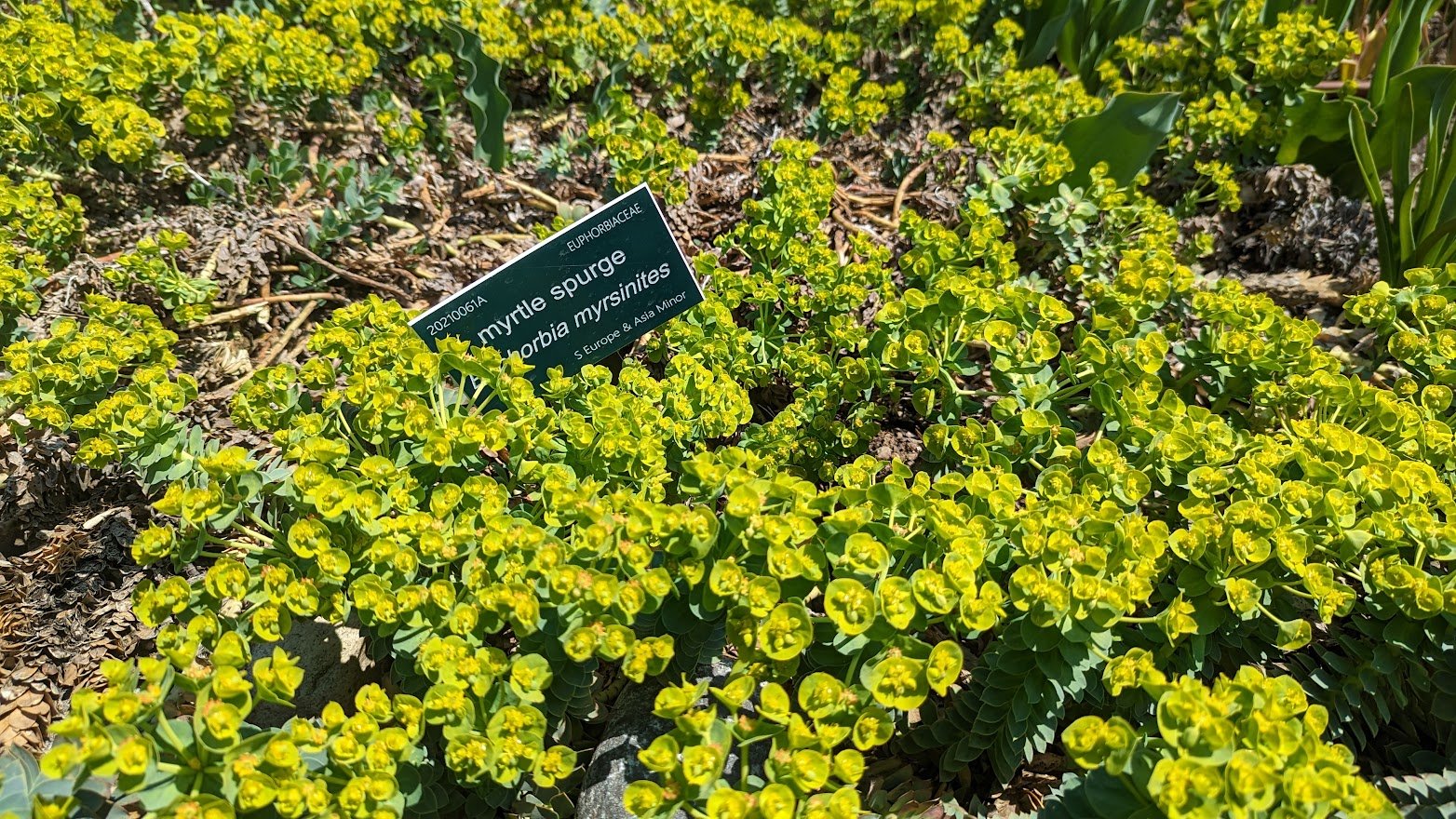
Myrtle Spurge
Myrtle Spurge
Brunnera macrophylla
Wild Strawberry (native)
Veronica Speedwell
Veronica Speedwell
Mayapple
Mayapple
Wood Anenome Vestal Sweet Wooodruff Sweet Woodruff and French Lavender Virginia Bluebells Fern Fern Epimedium new growth Epimedium x Domino Viinca, white flower Pachysandra Bearberry (native) Myrtle Spurge Brunnera macrophylla Wild Strawberry (native) Veronica Speedwell Mayapple

Gingers bloom in early spring. The flowers are hidden beneath the foliage, rarely seen and are pollinated by ants! They are grown for their foliage which spreads and in certain species is evergreen, like the europeum.

  • EUROPEAN GINGER (Asarum europeum): a spreading perennial ground cover with shiny rounded leaves.

In my opinion there isn’t a prettier flower than a Blue Bell. They spread and form large clumps with beautiful blue flowers in spring. They don’t bloom all summer so it’s a good idea to plant in combination with a later emerging and blooming perennial. The later blooming perennial will fill in the space nicely when the Virginia Blue Bells are past their bloom and dormant until the following spring.

  • MERTENSIA virginica ‘VIRGINIA BLUEBELLS’: They do best with a little afternoon shade.

Try planting ground covers at the base of your shrubs instead of mulching. Ground covers are very effective at keeping weeds out!

Virginia Bluebells

*****************

SUCCESSION GARDENING

Succession Gardening is a new concept in groundcovers where one plant replaces another one that is gone by in the same area. These ‘groundcovers’ may not spread stoloniferously but they will cover the ground where another plant has passed.

  • Alchemilla, Perennial Geraniums, Hostas, Euphorbia, Lupine, Rodgersia, Cimicifuga, Aruncus, ornamental rhubarb (Rheum), Bronze Fennel, (Foeniculum vulgare), Sanguisorba , Aconitum, Foxgloves and Thalictrum, can all be used as plants that emerge late and will cover up earlier blooming plants. They will grow up, over and fill in the space when early bloomers and cool weather annuals finish blooming and go dormant, like Virginia Bluebells (Mertensia virginica)or Bleeding heart (Dicentra spectabilis).

  • Enjoy the bulbs in spring and then cover up their foliage with Ladies Mantle(Alchemilla mollis) or Geranium sanguineum album.

  • Hostas are late to emerge and are also often planted in areas where you have early bloomers that don’t last all summer, like Trilliums, Shooting Stars(Dodecatheons) or bulbs like Crocus or Chionodoxa.

  • It may take larger plants such as Thalictrum to cover up larger bulb foliage like daffodils or Fall crocus (Colchicum). Even Cammasia foliage can be hidden away after it’s done blooming! The Thalictrum will come right through the messy bulb foliage and cover it right up. You don’t even have to cut it back.

This is an old concept that is being perfected at Great Dixter House and Gardens in England, where Andrew did an internship. This concept also serves to increase the biodiversity of the garden.

PXL_20240517_172236156.PORTRAIT.ORIGINAL.jpg
Geranium 'Cranesbill'
Foxglove Apricot
Foxglove Apricot
Foxgloves
Foxgloves
Lupine
Lupine
Lady's Mantle
Lady's Mantle
Hosta
Hosta
Hosta
Hosta
Thalictrum
Thalictrum
Cimicifuga Brunette
Cimicifuga Brunette
PXL_20240517_172236156.PORTRAIT.ORIGINAL.jpg Geranium 'Cranesbill' Foxglove Apricot Foxgloves Lupine Lady's Mantle Hosta Hosta Thalictrum Cimicifuga Brunette

native groundcovers

for beauty & biodiversity

ecological gardening

share your habitat

In PERENNIALS, EVERGREENS, GROUNDCOVERS, JUNE, FIELD NOTES Tags Sweet Woodruff, Epimedium, groundcover, creeping thyme, Blue star creeper, perennial groundcovers, evergreen groundcover, Geum, ferns, native groundcovers
Comment

SUMMER BLOOMING PERENNIALS

June 21, 2024 Karen Logan

Nepeta Walker’s Low & Fothergilla

************************************

JOIN US THIS SATURDAY MORNING

_______________

GARDEN

WORKSHOP

PLANTING FOR CLIMATE RESILIENCE

SATURDAY JUNE 22ND // 11:00AM // VINEYARD GARDENS NURSERY

We are very excited to welcome Andrea Berry, Executive Director of Wild Seed Project in Maine. She will share her knowledge about planting climate resilient habitats in northeast landscapes.

Scrub Oak Barren- Sandplain Grassland : Scrub oak, little bluestem, sweetfern,Northern blazing star, butterfly milkweed, wood lily & flax leaved aster. Illustration by karen blackerby logan

************************************

SUMMER BLOOMING

PERENNIALS

******************************************

SUMMER BLOOMING PERENNIALS AT THE NURSERY

* Salvia Purple Rain


* Nepeta Walkers Low


* Nepeta Prelude Blue

* Monarda


* Stachys

* Coreopsis Gold

Standard, Zagreb

& Uptick Red

* Filipendula Kahome

* Alchemilla mollis

Thriller

* Lobelia Queen

Victoria, Starship

Scarlet

* Clematis Boulevard

Acropolis & Nubia

* Hibiscus Ballet Slippers

Asclepias tuberosa Orange ‘Butterflyweed’

* Rudbeckia Herbstone

* Gaura Sparkle White

* Gaura Belleza Dark

Pink

* Rudbeckia Goldblitz

* Asclepias tuberosa

Orange & Hello Yellow

* Incarnata Ice Ballet

& Cinderella

* Kniphophea

* Thalictrum flavum

glaucum

* Thalictrum

rochebrunianum


* Thalictrum black

stockings


* Thalictrum elin

Clematis Boulevard Acropolis
Clematis Boulevard Nubia
nepeta%2Bblue%2Bprelude.jpg
nepeta%2Bwalkers%2Blow.jpg
coreopsis+moonbeam.jpg
coreopsis+uptick+cream+and+red.jpg
coreopsis+uptick+red.jpg
astilbe+pumila.jpg
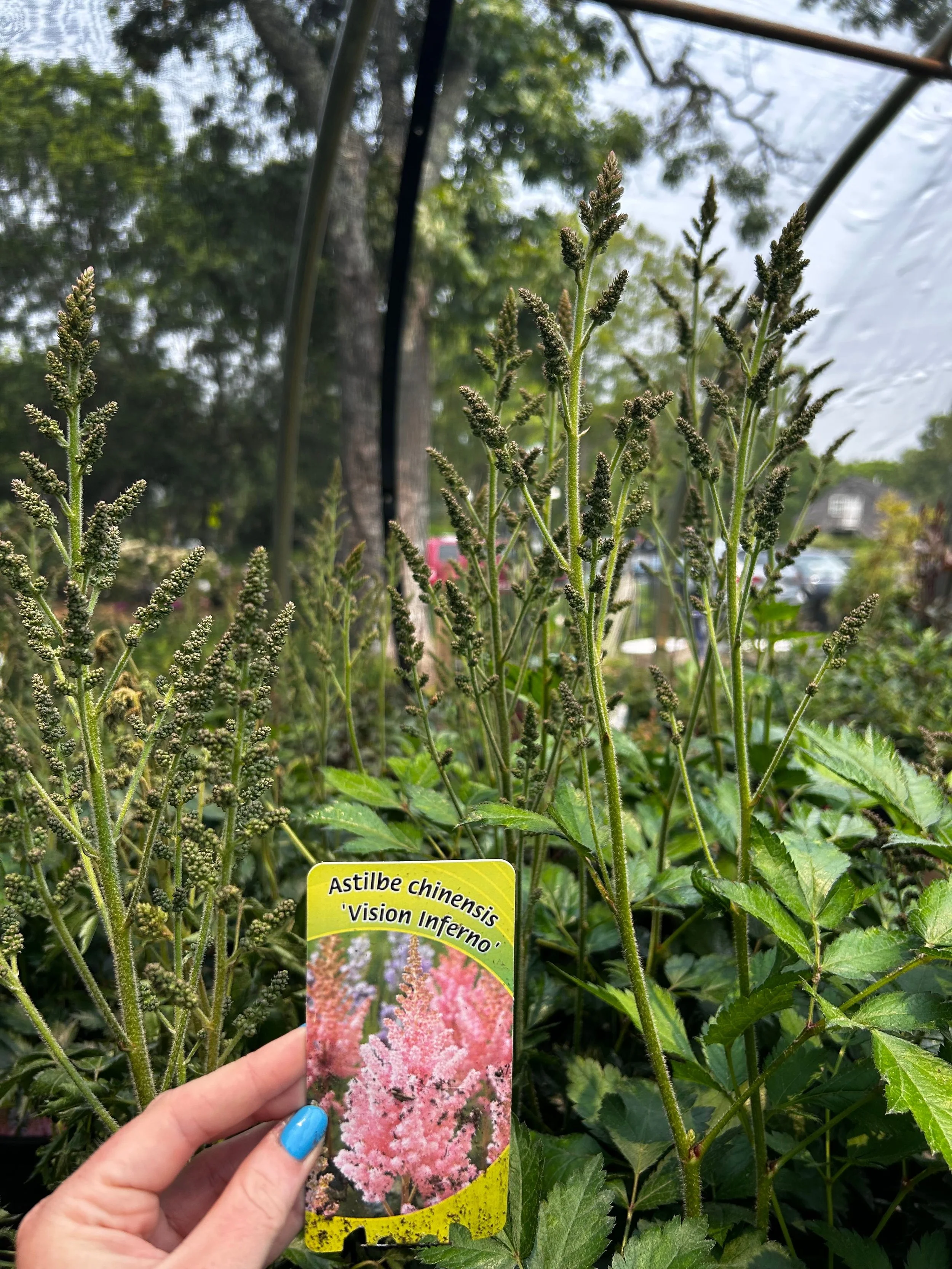
astilbe+vision+inferno.jpg
filipendula+kahome.jpg
hibiscus+valentines+crush.jpg
hibsicus+ballet+slippers.jpg
kniphophea+flamenco+mix.jpg
Lady%27s+Mantle%2C+alchemilla+thriller.jpg
lamium+shell+pink.jpg
lobelia+queen+victoria.jpg
monarda+leading+lady+razzle+berry.jpg
stachys+hummelo.jpg
Clematis Boulevard Acropolis Clematis Boulevard Nubia nepeta%2Bblue%2Bprelude.jpg nepeta%2Bwalkers%2Blow.jpg coreopsis+moonbeam.jpg coreopsis+uptick+cream+and+red.jpg coreopsis+uptick+red.jpg astilbe+pumila.jpg astilbe+vision+inferno.jpg filipendula+kahome.jpg hibiscus+valentines+crush.jpg hibsicus+ballet+slippers.jpg kniphophea+flamenco+mix.jpg Lady%27s+Mantle%2C+alchemilla+thriller.jpg lamium+shell+pink.jpg lobelia+queen+victoria.jpg monarda+leading+lady+razzle+berry.jpg stachys+hummelo.jpg

Lady’s Mantle

In GARDEN TIPS, JUNE, PERENNIALS, FIELD NOTES Tags summer blooms, summer blooming perennials, perennials
Comment

[PLANT PROFILE] AUTUMN CLIMBERS

August 2, 2023 Karen Logan

Scentsation Honeysuckle

AUTUMN CLIMBERS

Late season blooming vines brighten your autumn landscapes just as the summer flowers are waning.

*************************************

HONEYSUCKLE

These flowering vines are lush with often very fragrant flowers that are beloved by butterflies and hummingbirds.

Goldflame Honeysuckle

Scentsation Honeysuckle

Goldflame Honeysuckle

*************************************

WISTERIA

Wisteria is a high-climbing, long-lived vining plant with cascades of blue to purple flowers that look spectacular hanging from a pergola or archway. Wisteria only blooms on new wood so pruning is a secret to it’s success.

*************************************

CLEMATIS

  • Clematis viticellas are the smaller flowered clematis such as Roguchi and Betty Corning. They are both fragrant, very floriferous and excellent climbers attaching with tendrils .

  • Autumn Clematis is an evergreen woody high-climbing vine with late-season blossoms and wonderfully fragrant blooms!

    Clematis like their roots in the shade and the vining part in the sun. Pruning in spring results in more stems coming from the crown of the plant.

Sweet Autumn Clematis

Varieties available

———————————

paniculata


Roguchi


Betty Corning


Robert Brydon

Sweet Summer Love


Rouge Cardinal


Diamond Ball


Pink Mist

Roguchi Clematis

Clematis Rooguchi seed pod
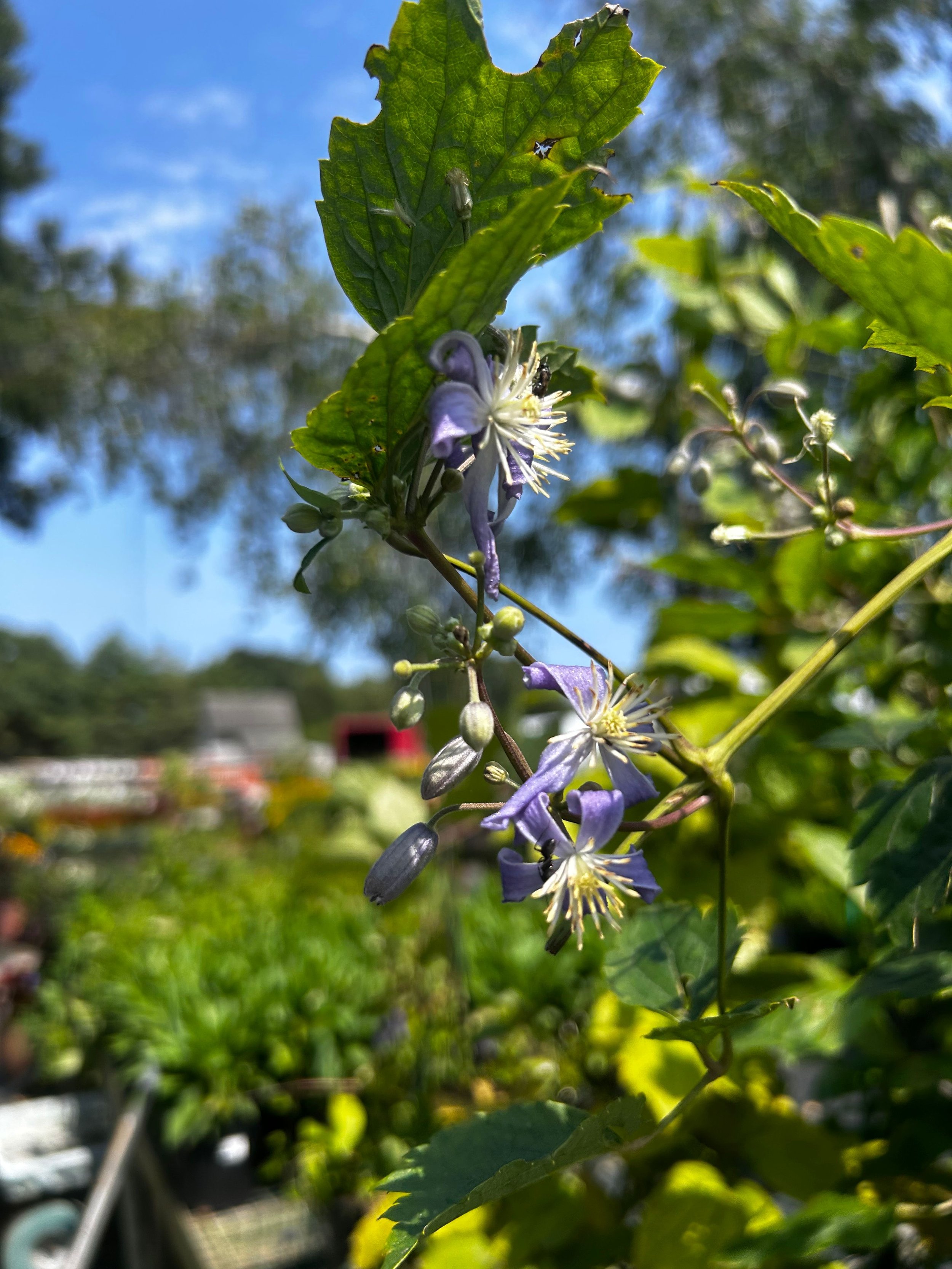
Roguchi Clematis

Clematis Mrs. Robert Brydor
*************************************

honeysuckles in bloom

monrovia

backyard vines with fall flair

birds & blooms

growing vertical with vines

wild seed project

In AUGUST, PERENNIALS, VINES, PLANT PROFILES
Comment

[PLANT PROFILE] FILIPENDULA

July 11, 2023 Karen Logan

Filipendula ‘Queen of the Praire’ and Filipendula ‘Dwarf Meadowsweet’

FILIPENDULA

******************************************

Filipendula is a native perennial to the northeast. It is a great foliage plant that is valued for both its leaves and its flowers. Most filipendulas grow in average, medium to wet, well-drained soil in full sun to part shade.

Filipendula ‘Kahome’ (front) & Filipendula ‘Queen of the Prarie’ (back)

******************************************

Filipendula Varieties

__________________________

Filipendula rubra Venusta Magnifica ‘Queen of the Prarie’

Astilbe-like, wide panicles of tiny, fragrant, pale pink flowers that bloom in early to mid summer.

USES:

Borders (rear), cottage gardens, native plant gardens, wild/naturalized areas, wet meadows or moist areas along streams or ponds.

  • This is a large plant for large gardens.

  • Can be spectacular, particularly when massed.

  • Great for naturalizing in moist meadows.

    **A highlight of midsummer!**

Filipendula rubra

Filipendula rubra

Venusta Magnifica

‘Queen of the Prarie’

____________

* Grows up to 8’ tall

(usually shorter)

* Pale Pink blooms June-

Aug

* Full sun to part shade

* Medium to wet soil

* Native to moist soils but will

do well in average or dry

soils.

Filipendula rubra

__________________________

Filipendula ‘Kahome’ (Dwarf Meadowsweet)

An upright, clump-forming perennial that typically grows only 8-12” tall and features branched, terminal, Astilbe-like panicles of tiny, fragrant, rosy pink flowers in summer.

USES:

Border fronts, cottage gardens, wild/naturalized areas, wet meadows or moist areas along streams or ponds. Dwarf size facilitates massing this plant as a ground cover.

filipendula ‘Kahome’

Meadowsweet

____________

* 8-12” tall

* Blooms June to July

* Full sun to part shade

* Medium to wet soil

******************************************

Benefits

Attracts butterflies, pollinators and is deer resistant !

******************************************

JULY

GARDEN TIPS

PERENNIALS

FOR SHADE

In JULY, GROUNDCOVERS, NATIVE PLANTS, PERENNIALS, PLANT PROFILES Tags groundcovers, shade perennials, native perennials, filipendula, meadowsweet, wet soil perennials
Comment

[PLANT PROFILE] SWEET WOODRUFF

May 11, 2022 Karen Logan

Sweet Woodruff

SWEET WOODRUFF

(Galium odoratum)

Sweet Woodruff is a lovely plant that will spread like a ground cover in your garden. It has small white flowers in spring through early summer. It’s vigorous but not aggressive and can coexist nicely with bulbs that will come right up through it. They spread stoloniferously by sending out stolons or side shoots just beneath the soil surface.

Sweet Woodruff

WHERE TO PLANT SWEET WOODRUFF

  • An ideal ground cover. Plant as a ground cover around shrubs.

  • A wonderful border accent in woodland gardens.

  • It thrives in rich garden soil, in part to full shade.

OTHER GROUNDCOVERS

  • Other ground covers that do well in shade include the more common evergreen pachysandra and Vinca minor, Periwinkle.

  • Pachysandra: We carry the Japanese spurge, pachysandra terminalis. Our favorite is the native one, Pachysandra procumbens.

  • Vinca: We carry Vinca minor Bowles, with the early summer blooming blue flowers and the white flowering Vinca minor. We also carry Illumination, a vinca cultivar with yellow variegated foliage and a blue flower.

  • Epimedium, barrenwort: Another less common groundcover that thrives in shade is Epimedium. Epimedium Spine Tingler is a cultivar that is available now. This year we also have Frohnleiten, Rubrum, Sulphureum, Niveum, Pink Champagne, Domino and Amber Queen, which won the RHA (Royal Horticultural Award) of Merit.

  • Ferns: Ferns can spread nicely like ground covers such as Matteuca struthiopteris (the Ostrich fern), Dennstaedtia punctiloba (Hay Scented Fern) and Onoclea sensibilis. Dennstaedtia punctiloba and Onoclea sensibilis are both hard to find. We don’t have either in stock right now.

  • Geum: The native Geum has been mentioned as a good ground cover. Geum triflorum has beautiful seed pods.

  • Thyme: Creeping and wooly thymes are ground covers we like to recommend for sun. Creeping thyme comes in white flowers (albiflorus), red flowers (coccineus) or pink chintz with pink flowers. We also carry creeping lemon and Elfin thyme.

  • Laurentia fluviatilis, Blue Star Creeper and Pratia: Two other interesting plants that spread like ground covers.

    And there are plenty more! 

Try planting ground covers at the base of your shrubs instead of mulching. Ground covers are very effective at keeping weeds out!

Pachysandra

Sweet Woodruff and French Lavender

Pachysandra

Epimedium Spine Tingler

Epimedium x Domino

Epimedium new growth

Viinca, white flower

GARDEN TIPS

MAY

PLANT PROFILE

CREEPING PHLOX

In PERENNIALS, EVERGREENS, GROUNDCOVERS, MAY, PLANT PROFILES Tags Sweet Woodruff, Epimedium, groundcover, creeping thyme, Blue star creeper, perennial groundcovers, evergreen groundcover, Geum, ferns
Comment

484 State Rd. West Tisbury, MA 02575

Mon - Sat : 8am - 5pm / Sun : 9am-3pm

(508) 693.8512