• Home
  • ABOUT
    • FALL CHECKLIST
    • PROJECTS
    • Landscape Teams
    • LANDSCAPE DESIGN
    • LANDSCAPE CONSTRUCTION
    • LANDSCAPE MAINTENANCE
    • Nursery
    • SALES & DISCOUNTS
    • BULK MATERIAL
    • PLANT PROFILES
  • FIELD NOTES
  • EVENTS
  • TESTIMONIALS
  • Careers
  • Contact
Menu

Vineyard Gardens

484 State Road
West Tisbury, MA, 02575
508.693.8512
Landscaping & Garden Center

Your Custom Text Here

Vineyard Gardens

  • Home
  • ABOUT
  • LANDSCAPING
    • FALL CHECKLIST
    • PROJECTS
    • Landscape Teams
    • LANDSCAPE DESIGN
    • LANDSCAPE CONSTRUCTION
    • LANDSCAPE MAINTENANCE
  • NURSERY
    • Nursery
    • SALES & DISCOUNTS
    • BULK MATERIAL
    • PLANT PROFILES
  • FIELD NOTES
  • EVENTS
  • TESTIMONIALS
  • Careers
  • Contact

EVERGREENS FOR SCREENING

September 22, 2026 Karen Logan

Thuja plicata (Western Red Cedar)

EVERGREENS

FOR SCREENING, BEAUTY AND FUNCTION

Evergreens retain their foliage for a full year or more and are classified as either conifers or broadleaf evergreens. Conifers belong to the phylum gymnosperms which are plants that bear cones instead of flowers as reproductive structures. Their leaves are called needles or scales and are adaptations for survival in tough windy drought conditions, like on top of mountains. While broadleaf evergreens belong to the phylum Angiosperms (flowering plants) and produce flowers and seeds. Both conifers and broadleaf evergreens are a wonderful and highly functional asset to your landscape, especially when privacy is a goal.

Screening is one of the most requested landscape functions.

This can seem like a very simple request however from the grower’s perspective it is much more complex and dependent on budget and environment.

Layered screening with large Thuja plicatas that give wonderful privacy

BUDGET & TIMELINE

How much you have to spend on screening directly correlates to the amount of time it will take to achieve your end goal. The bigger the tree, shrub, or grass, the more expensive it is and the more labor intensive it is to install. Large transplants can take a couple of years to re-establish their root systems.However, faster growing plants are not always an ideal option. A fast growing plant can be weak wooded, susceptible to high winds or winter ice damage, or prone to outgrowing their space entirely. The most economical and resilient strategy is to start your screening "vision" with smaller plants that can quickly establish themselves backed by slower-growing structural evergreens.

ENVIRONMENT & MICROCLIMATE

The Island may be small but it is remarkably diverse in terrain and habitats. What would work for a screen in Vineyard Haven will not necessarily work for screening in Chilmark. Soil types, sun exposure, and local wildlife play massive roles in plant decisions.

  • Deer Pressure: High up-island deer populations require careful plant selection.

  • Soil Variations: Sandy coastal soils dry out quickly (Oak Bluffs), while low-lying clay soils can trap moisture and cause poor drainage that slowly stresses root systems.

  • Water Compatibility: Matching the plant to the soil moisture is critical. Planting a drought-loving juniper in a damp, heavy clay area, for instance, sets it up for failure.

It helps to remember that what you see above ground is only half of the plant, what goes on below is perhaps even more important.

Thuja plicata Virginian

Thuja plicata Green Giant

Thuja plicata Fluffy

Conifers

  • Picea abies (Norway Spruce): A reliable, fast growing evergreen averaging about 13 inches per year! It adapts wonderfully to island growing conditions and tolerates acidic, loamy, sandy, well-drained, and even clay soils.

  • Cupressocyparis leylandii (Leyland Cypress): A powerhouse screen growing at least 24 inches per year. It handles island conditions well, though it should be avoided directly on the waterfront where heavy salt spray and high winds can cause irreversible damage.

  • Pinus strobus (Eastern White Pine): A classic native beauty that prefers acidic, moist, well-drained soil and adds a soft texture while growing at least 24 inches a year.

  • Thuja plicata 'Green Giant' (Western Arborvitae): We have been carrying this cultivar for years. This specific variety can get up to 60' tall! Many use arborvitae as screening for privacy on their properties, as well as a windbreaker. We have them in several sizes.

  • Thuja plicata 'Virginian' (Virginian Arborvitae): A smaller newer cultivar growing 15' tall x 6' wide in ten years(with a steady 1-to-2-foot annual growth rate). It is known to be deer-resistant and compact for tight screening needs. We offer three different sizes up to 9 feet.

**********
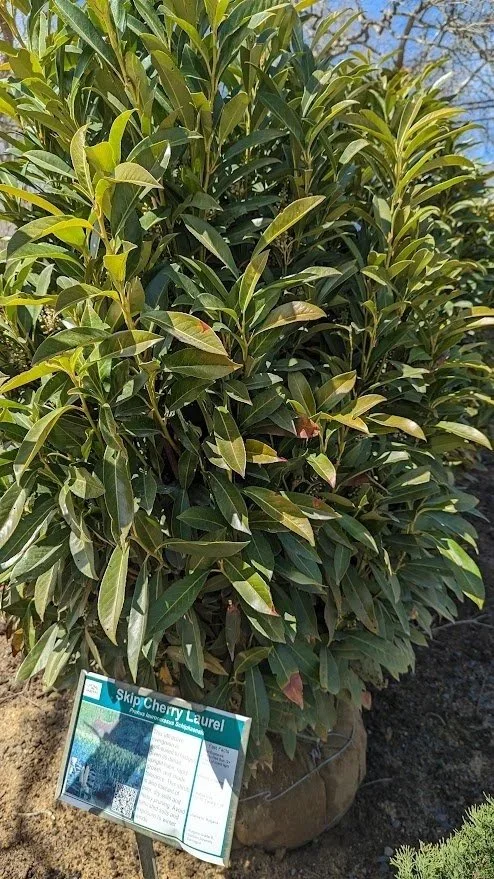
Broadleaf Evergreens

Broadleaf evergreens make magnificent, texturally rich privacy screens, and they excel in areas with partial shade.

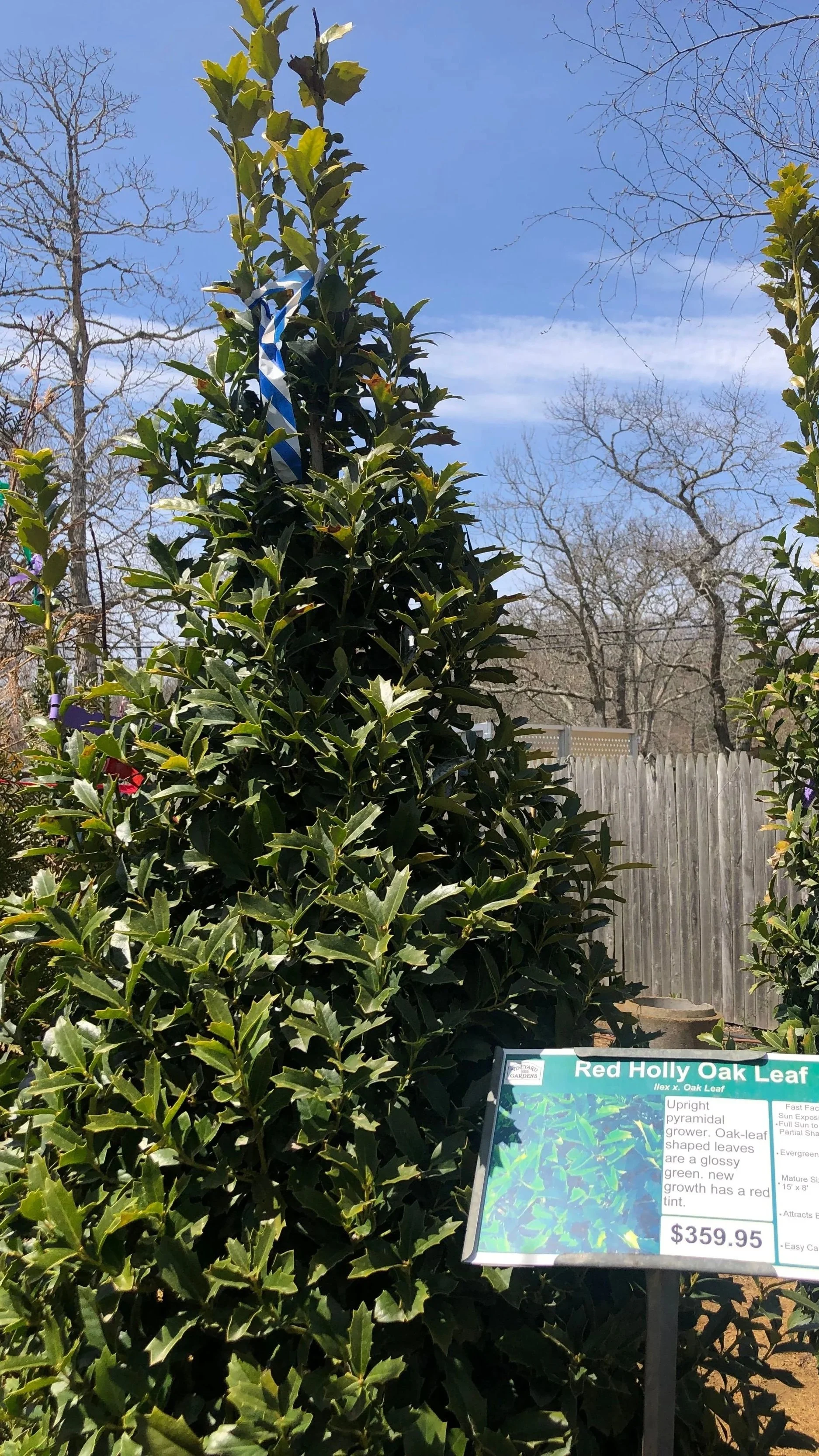
  • Hollies (Ilex): Tough, glossy, and brilliant for privacy and winter color.

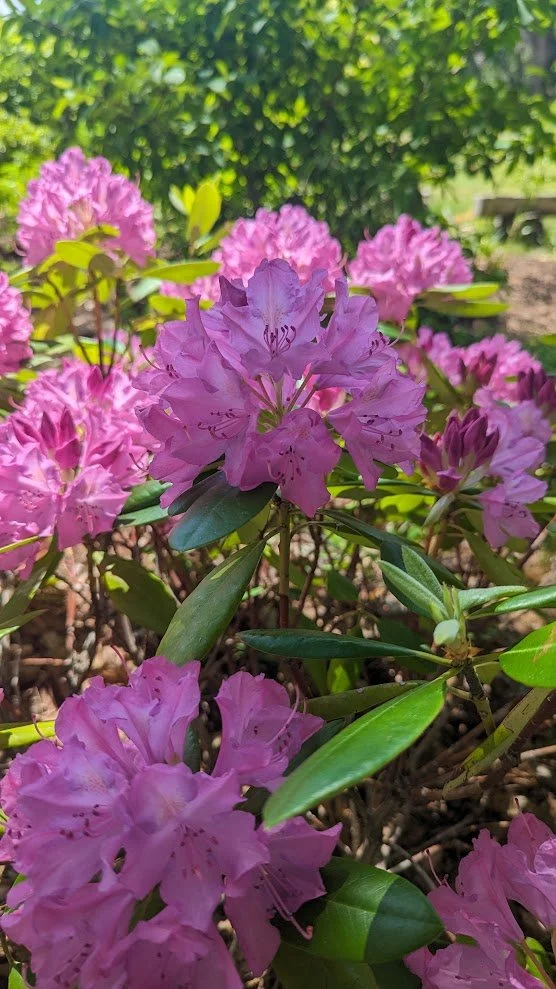
  • Rhododendrons: Offer lush foliage, stunning spring blooms, and year-round structure.

  • Cherry Laurels: Dense, fast-establishing, and classic.

  • Andromedas (Pieris): Provide early spring blooms and delicate, year-round foliage.

    **********

Chamaecyparis lawsoniana ‘Pinpoint Blue’

Chamaecyparis pis. ‘Gold mop’

Chamaecyparis pisifera Baby Blue

The Benefits of Evergreens

  • Year-Round Interest: Gives the landscaper structure year round and stays green even through the dead of winter.

  • Privacy & Windbreaks: Block unwanted views and buffer cold seasonal winds.

  • Wildlife Habitat: Offer critical shelter and nesting sites for birds and small mammals.

  • Resilience: Exceptionally drought-resistant once their root systems are established.

  • Climate Suitability: Perfectly adapted to Martha’s Vineyard's climate zone (traditionally zone 7A, with many varieties proving even hardier)

Juniper Blue Star

Juniperus Blue Pacific

Juniperus procumbens Nana

Juniperus chinensis Blue Point

Stop by Vineyard Gardens to find the perfect evergreens for your screening project and let our team help you create privacy that lasts for generations!
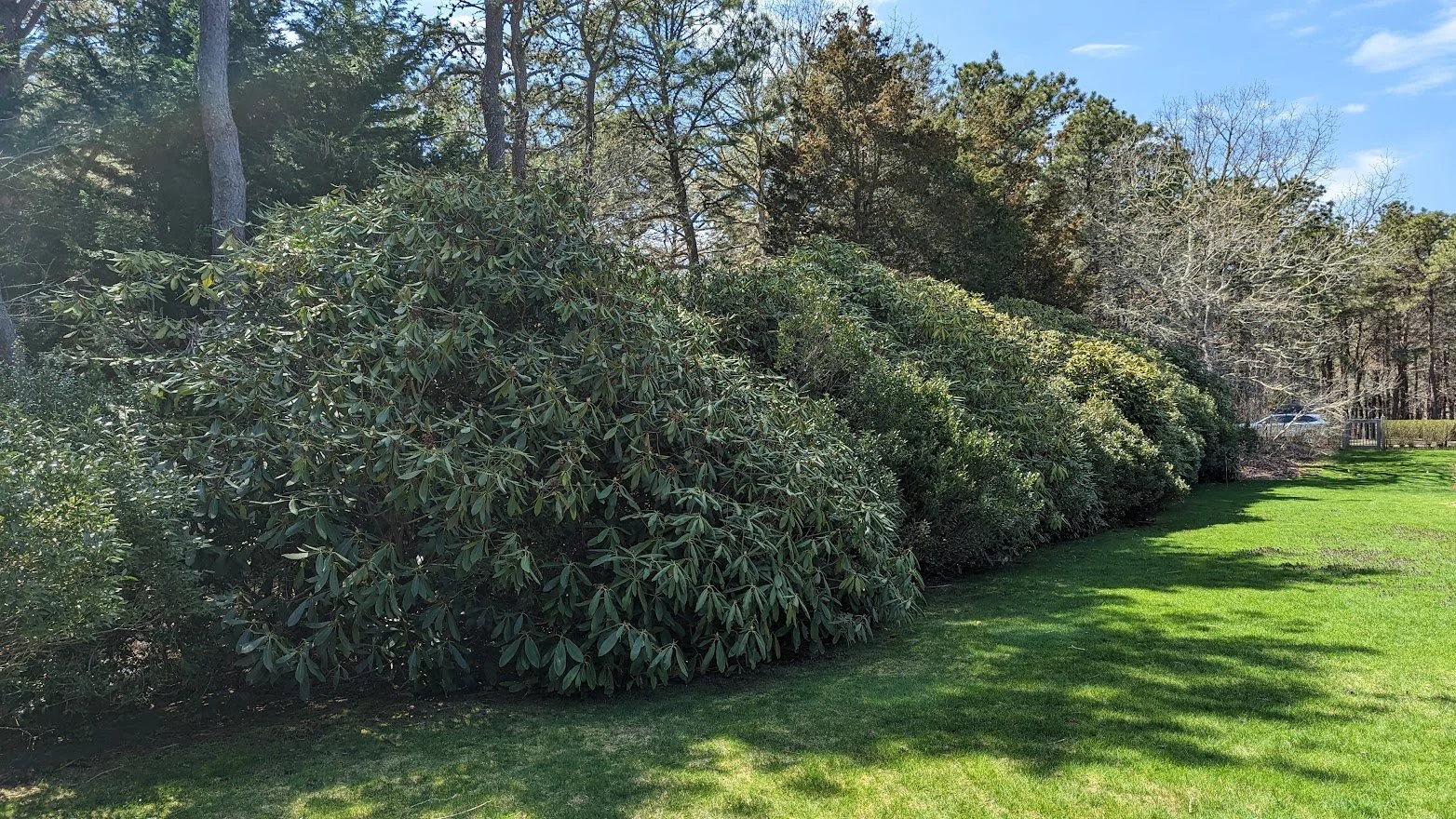
Rhododendron screening

WOODLAND RETREAT SCREENING
SCREENING FOR NATURAL PRIVACY
ODE TO AUTUMN
In SEPTEMBER, FALL PLANTS, EVERGREENS, FIELD NOTES Tags evergreen screening, thuja plicata, leland cypress, Eastern White Pine, broad leaf evergreens, rhododendrons
Comment

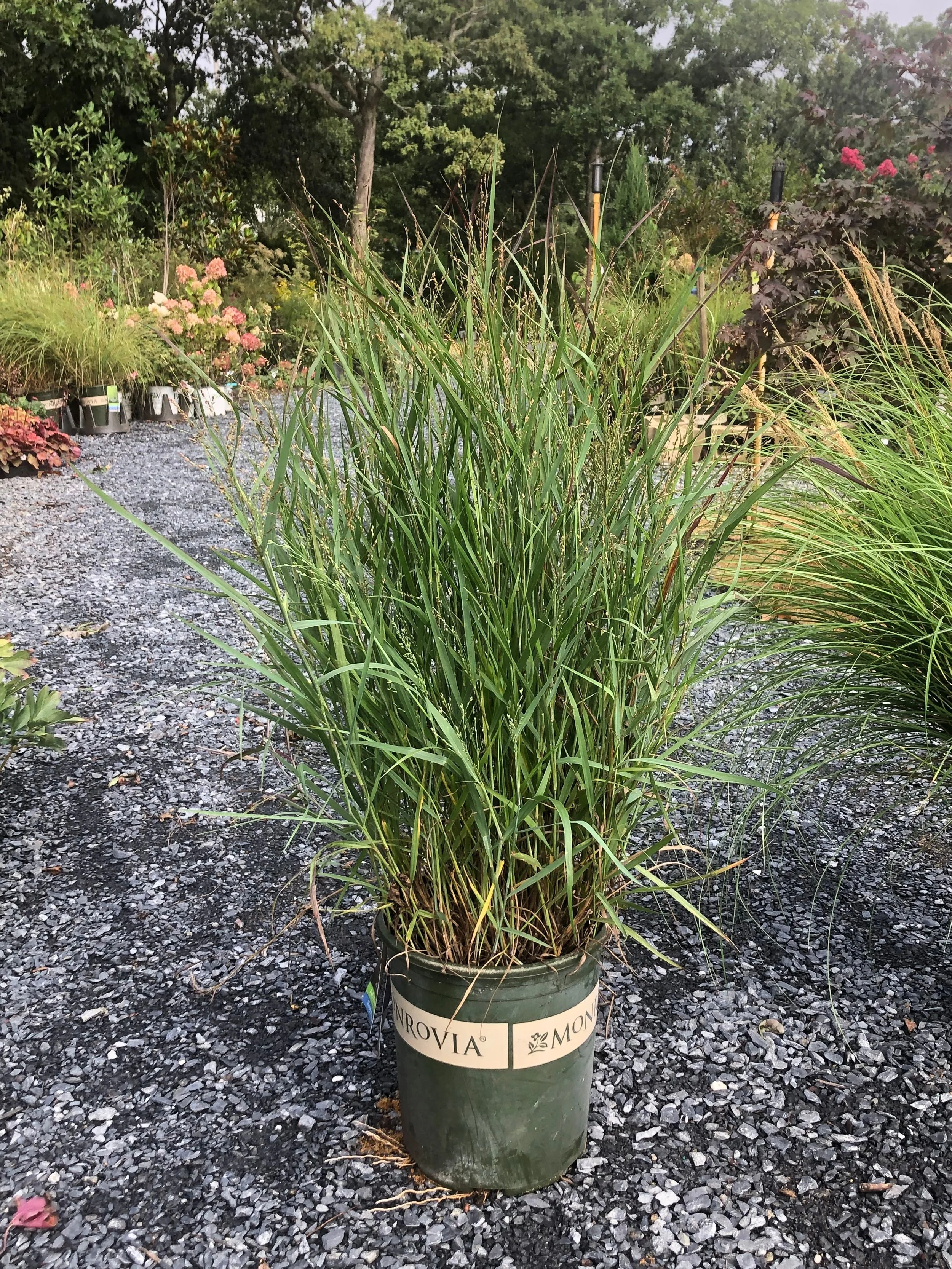
PANICUM (SWITCHGRASS)

September 21, 2026 Karen Logan

Panicum ‘Heavy Metal’

PANICUM

Panicum virgatum (Switchgrass) is native to Martha's Vineyard and the New England region. It is a quintessential North American warm-season grass that thrives locally in coastal plain environments, fields, and woodland edges.

Switchgrass serves many purposes in the landscape, adding height and texture, as well as giving a natural feel in ecological restoration projects. Easily grown in average to wet soils in full sun to part shade, this clump-forming grass typically stands 3 to 6 feet tall and spreads through rhizomes. Once established, it is remarkably low-maintenance, thriving in hot sun and tolerating drought without requiring rich soil.

Seasonal Interest & Wildlife Value

  • Summer & Fall: Bright green leaves line the stems throughout the growing season before turning a brilliant yellow in the fall. In mid-to-late summer, it features finely-textured, pink-tinged, panicles that mature into delicate red seed heads.

  • Winter: The seed plumes stay through winter and are a good food source for birds. The dense habit provides crucial winter cover for small mammals.

  • Ecological Role: Switchgrass acts as an important native host plant for butterflies such as the tawny edge skipper and Delaware skipper.

Popular Panicum Cultivars

  • Panicum virgatum 'Cloud Nine' (Switchgrass): One of the tallest varieties available, featuring upright bluish foliage with rose-colored seed panicles that transition to rich golden shades in autumn. It provides ideal wildlife habitat and food for songbirds.

  • Panicum virgatum 'Shenandoah' (Red Switchgrass): A stunning red switchgrass with upright foliage that becomes red-tinted during the growing season culminating in a dazzling red-leaved show in fall. It is exceptionally drought-tolerant and easy to maintain.

  • Panicum virgatum 'Heavy Metal' (Blue Switchgrass): Features a strictly upright habit with metallic-blue foliage. Airy, pink-tinted blooms appear in July, highlighting the steely blue leaves, and beautiful when planted in masses.

Panicum ‘Heavy Metal’

Panicum ‘Dewey Blue’

Panicum

In SEPTEMBER, FALL PLANTS, GRASSES, PLANT PROFILES, NATIVE PLANTS Tags grasses, fall color, Switch grass, Panicum virgatum, native grass
Comment

ODE TO AUTUMN

September 21, 2026 Karen Logan

A Season

of Transitions

by karen blackerby logan

What a glorious time of year, a season for the senses. The mysteries and magic in nature are in their transition states, quietly entering new phases of life. The meadow is dancing with asters and goldenrods. Birds and bees are singing and buzzing their way from flower to flower and seed to seed. Squirrels and chipmunks are busily searching for as many acorns as possible preparing for winter. The sound of the first fallen leaves crunching underfoot. Maples and oaks will soon brighten the canopy with vibrant oranges, reds and yellows. And as I am writing, I am experiencing one of the most miraculous transitions; a monarch chrysalis in her final stage of transformation. I think it will be minutes until the monarch emerges, now visible through the transparent chrysalis. The ‘super’ monarch that emerges this time of year will be preparing for her great migration south to Michoacan, Mexico.

Autumn is truly an atmospheric time of year, teetering between life and death.  As you walk through your garden you may have the urge to cut back plants and rake up the leaves, but in each of those seed pods a meal is to be had or a home to be occupied.  Seed pods of echinaceas, sunflowers and many other flowers are a valuable food source for wildlife during the long winter months ahead. Long pithy stemmed flowers like Joe-Pye Weed are homes to native bees. Not only is this necessary for wildlife, they can also be an ornamental part of your landscape during winter. The various shapes and shades of brown bring texture to your garden. Letting leaves and organic matter decompose in your garden bed helps regenerate the soil, insulates roots, stores carbon and protects habitats through the winter months. Many species of moths and butterflies pupate and overwinter in our leaves and emerge in spring, like the Luna Moth.

New England Asters & Goldenrod

Black Swallowtail catepillar

Monarch chrysalis in final stage

newly emerged monarch

At Vineyard Gardens, the same bustling and excitement is happening. We’re soaking up the remaining warmth of summer days and enjoying cool nights, knowing this is the best time to plant trees, bushes and perennials so they can set root before the ground freezes over. We’re excited about the upcoming Harvest Festival to celebrate another wonderful season on Martha’s Vineyard. We have incredible sales going on to give you some incentive to fill any holes in your garden in anticipation for next year.  

Ornamental peppers

Mums

As I walk through my garden, holes are becoming more evident as the early and mid-summer perennials have faded away. I contemplate what to grow there. What will be a colorful and beneficial addition for our native species during this transition time? How about some late blooming flowers that give a flash of hope as we head into winter? Or a bush or tree that transitions to that brilliant autumn glow of dazzling ambers, reds and yellows? It is too late now to plant annual season extenders, which should have been planted a month or so ago, but I am reminded to think ahead in early summer about the autumn garden. Planted early enough though, Dalhias, Salvias and grasses are wonderful season extenders, adding color, texture and movement to your landscape. 

Shrubs help create the bones and structure of the garden. They are aesthetically valuable, providing blooms at more than one level, as well as offering height that contributes to layering. Shrubs are also extremely beneficial as a habitat and food for wildlife. Native shrubs, like Viburnums, Buttonbush and Winterberry provide berries, seeds and protection throughout the winter months. Crape Myrtles (Lagerstroemia indica), offer taller blooms and beautiful exfoliating bark. Panicle hydrangeas are starting to fade from white to pink, and many are still blooming profusely. Hydrangea macrophyllas are reaching the end of their summer show but are transitioning to a burgundy color to match the fall pallette. Oak Leaf Hydrangea flowers have faded to burnt copper and compliment the bright yellow Helianthus Lemon Queen that can reach over six feet tall. The berries on Hollies are ripening and their evergreen leaves add structure within the winter garden. 

Winterberry

Panicle Hydrangeas

Clerodendrum trichotomum

Late season spent flowers of Hydrangea macrophylla

Buttonbush

Hollies

A great option for autumn color in your garden is to add potted plants. Potted grasses will bring some height and texture. Mums, gourds and pumpkins near the front of your garden bed will add color and enhance the autumnal season palette. Place Brugmansia, Angels Trumpet, a wonderfully fragrant tropical plant, in a pot on your patio, and its nighttime fragrance will fill the fall air. 

As summer fades, there is a lingering warmth and some colorful life that is still at its peak. Colchium, Autumn Crocus, emerges and is that bit of pink hope reminding us of summer blooms.  African Blue Basil is particularly gorgeous this time of year with its purple hues and abundant blooms, a magnet for pollinators. This is the time of year that Pineapple Sage (Salvia elegans), with its red flower spikes, and Mexican sage (Salvia leucantha) are putting on their best show. Salvia guaranitica and uliginosa’s blue tubular flowers contrast the toned down hues of the autumn landscape. Grasses are very showy and sway to the rhythm of the wind. Purple, pink and white asters and yellow goldenrods vibrate in meadows, helping monarchs find their way south. 

I just love this time of year, lightly bundled up walking through orchards, the smell of ripening and decaying apples and pumpkins perfuming the air, shrubs and trees transitioning into their autumn fashion, the pace of life begins to slow and a moment for reflection is found. This transition between the bright excitement of summer and the dark quiet calm of winter captivates my nostalgic heart. As I finish writing this ode to autumn, my monarch has emerged and is ready for her next phase.

Colchium

Goldenrod & Asters

Brugmansia, Angels Trumpet

Harvest vignette

Salvia guaranitica

Goldenrod and newly emerged Monarch

In SEPTEMBER, FALL PLANTS, FIELD NOTES Tags Autumn colors, autumn transitions, fall gardens, fall colors, colchium, asters, goldenrod, natures cycles
Comment

LOBELIA

September 16, 2026 Karen Logan

Lobelia cardinalis [illustrated by karen blackerby logan]

LOBELIA

Plant Detective: The Secret World of Cardinal Flowers

by karen blackerby logan

There is nothing quite like sitting quietly in the garden with a sketchbook, playing plant detective and watching nature unfold it’s quiet magic. Lately, I’ve been completely captivated by our native Cardinal Flower (Lobelia cardinalis). Watching it through a biomimicry lens, studying how its physical structures, evolutionary strategies, and relationships with pollinators weave together, has provided me with profound insight into a beautiful evolutionary mutualism.

While I was out observing and drawing, a ruby-throated hummingbird came by for a visit, giving me a front-row seat to one of nature's magical partnerships in action.

sketchbook entry about cardinal flowers [karen blackerby logan]

Cardinal Flower and Hummingbird Mutualism

If you look closely at a Cardinal Flower, the details of its design tells a story of co-evolution.

Hummingbirds have exceptional vision for red, unlike bees, which generally cannot see the red color spectrum and lack the physical aspects to access deep nectar. The flower's red, deep tubular structure is a beacon, perfectly matched for the Ruby-Throated Hummingbird's vision and long, slender beaks.

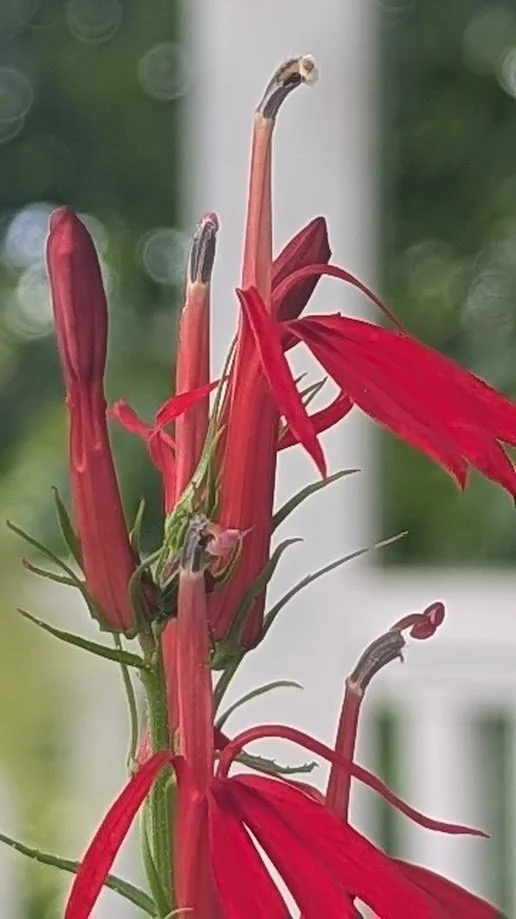
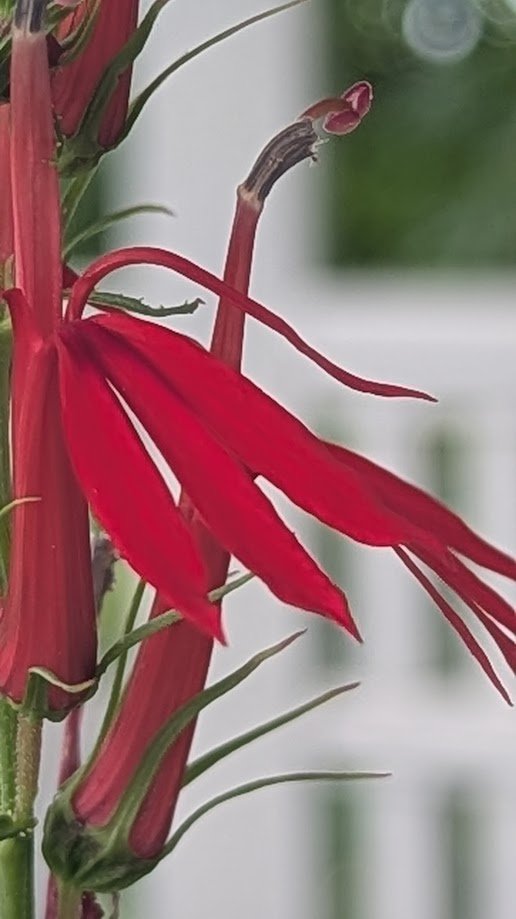
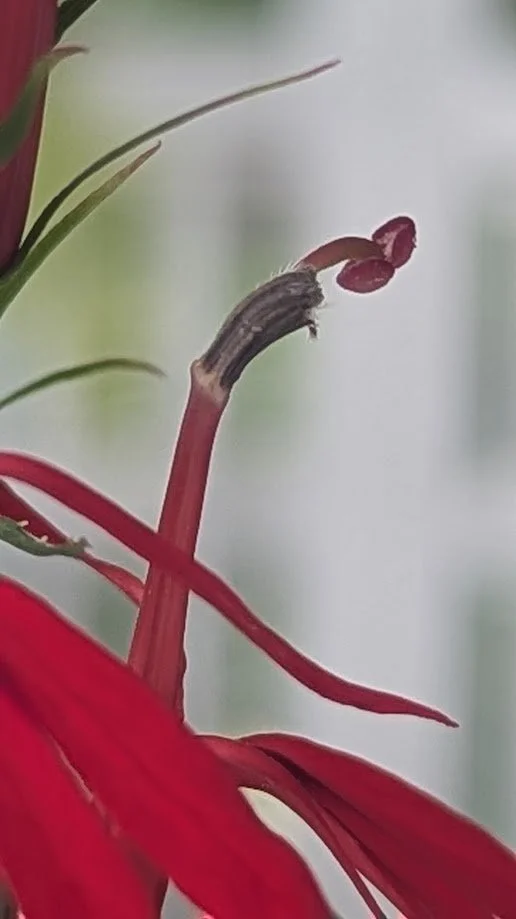
Even more fascinating is the engineering inside the stamen tube. The Cardinal Flower features a hollow angled, stamen tube with brush-like anthers at the tip, safely holding the female stigma inside until the timing is right. When a hummingbird dips its beak in for a drink of nectar, its forehead makes direct contact with this angled brush tube coated in pollen. The pollen precisely transfers onto the bird's forehead, ready to be carried off to pollinate the next flower.

Detail of male phase (upper) and female phase (lower) [image credit: karen blackerby logan]

Detail female phase and petal arrangement [image credit: karen blackerby logan]

Close up of female phase [image credit: karen blackerby logan]

Pollination Strategy

Cardinal Flowers bloom in vertical spires, opening sequentially from the bottom up. Because hummingbirds naturally forage in this same upward direction (where the lower blooms offer the most nectar), self-pollination is prevented.

Each individual flower goes through two distinct phases:

The Male Phase: When the lower blooms first open up, the pollen is available on the anthers, while the female stigma is tucked away in the hollow fused stamen tube .

The Female Phase: As the season progresses and the hummingbirds work their way up the stalk, the older lower blooms age and the pollen phase is complete. The stigmas finally push their way through and open up, ready to catch fresh pollen brought by another hummingbird from a different Cardinal Flower.

The petals are designed for this partnership as well. The two side petals curl back while the lower three cleft petals droop into a funnel-like bullseye for the hummingbird to swoop in. In contrast, the Great Blue Lobelia’s (Lobelia siphilitica) "landing pad" lower petal evolved specifically to invite heavy-bodied native bees to land on.

This evolutionary split between the Cardinal Flower and the Great Blue Lobelia is a great lesson in resource sharing and pollination efficiency, allowing each plant to optimize its own unique pollinator specialist.

Lobelia Starship Deep Rose & Scarlet Bronze Leaf

Lobelia Starship Deep Rose & Scarlet Bronze Leaf. Rich bronze or purple foliage throughout the growing season. Adds a bold color for the late summer to early autumn garden.

Lobelias in your Garden

While Cardinal Flowers are hummingbird magnets, Great Blue Lobelias are native bee havens and they both deserve a special place in your garden.

In nature, you’ll typically find these North American natives growing in wet, swampy soils, woodland edges, or low, damp spots in the landscape. If you have a rain garden, a spot near a pond or stream, or just a part-shade garden that holds moisture well, they will thrive. With consistently moist soil, they can thrive in sun as well.

Whether you fall in love with the classic native Cardinal Flower, the deep foliage of 'Queen Victoria' (a Royal Horticultural Society Award winner), or the slightly more compact Starship series, these plants bring an incredible sense of place, wonder, and life to the garden.

Grab a sketchbook, find a quiet spot near your flower beds, and see what stories your own garden plants are waiting to tell!

Lobelia ‘Great Blue’. A blue counterpart of the Cardinal Flower. Desirable plant for woodland gardens especially since it blooms bright blue in late summer.

Lobelia siphilitica and Aster

*************************

CARE

  • Prefer fertile, evenly moist soil.

  • Can be divided every 2-3 years in spring.

  • Allow to self sow.

  • Winter over with stems on.

  • Can be pinched back before flowering to produce more compact plants

*************************

USES

  • Woodland paths

  • Perennial beds and border gardens with moist, well-drained soil.

  • Given enough water they can be fine with more sun.

  • Great choice for partial shade gardens

  • Well-suited for use in rain gardens, around ponds and streams and other moist areas.

  • Pairs well with ferns and heuchera

Stop by Vineyard Gardens to bring this wonderful native plant home and watch the garden magic unfold!

AUTUMN GARDEN
[PLANT PROFILE] ASTERS
In FALL PLANTS, SEPTEMBER, PLANT PROFILES, NATIVE PLANTS Tags perennial plant, fall blooms, Lobelia, Lobelia Great Blue, Lobelia Starship Deep Rose, Lobelia Starship Scarlet, Cardinal Flower, hummingbirds and cardinal flowers, native plants
Comment

FALL TREES & SHRUBS

September 9, 2026 Karen Logan

September Border at Vineyard Gardens. Crape Myrtles & Vitex [photo credit: keith kurman]

FALL TREES

& SHRUBS

Fall is a great time to plant trees and shrubs! The combination of the weather cooling down and fall rain allows plants to establish their roots. Planting in the fall also gives trees and shrubs an extra growing season before the stress of summer heat and drought.

On warm days from here on out the Witchhazels will be unfurling their ribbon-like petals creating brilliant splashes of color in the stark winter landscape.

****************

TREES

Trees are exceptional fall extenders, offering stunning foliage transitions and late-season blooms that keep the landscape vibrant long after summer fades.

  • Franklinia alatamaha (Franklin Tree): Native to US. Typically grows to 15’x10’. Showy fragrant white flowers in August. Great fall color! Plant in full sun with light shade in moist soil.

  • Lagerstroemia indica crape myrtle: Multi stemmed trees with beautiful late season color. Blooms late summer into fall. Exfoliating bark which continues to be showy into winter. Great diversity available.

  • Maple Trees: Known for their fall color. {10 best Maples for fall color}

    • Acer palmatum: Japanese maples are easy to grow, cold hardy and remarkable adaptable. Their green leaf forms have the best fall color!

    • Acer ginnala: This smaller maple can be used as small specimen, patio tree and even works well in a container. It has a particularly fabulous fall color!

  • Myrica pensylvanica (Bayberry): Native to Martha’s Vineyard. Typically grows to 10’ x 8’. Plant in full sun. It tolerates drought once established. Deer resistant.

  • Nysa sylvatica (Beetlebung Tree): An island native that grows where there is quite a bit of water. Often found growing in low points and bogs on the island. Has beautiful fall color and a distinguished shape. We have some young beauties for sale at the nursery.

  • Osmanthus heterophyllus (False Holly): An evergreen shrub that typically grows to 10’ x 10’. Blooms late fall into the winter (Oct-Nov) with small fragrant white flowers. Shade tolerant and deer resistant.

  • Oxydendron arboreum: Native tree known for its fall color.

Nyssa sylvatica fall color

Hydrangea paniculata "‘Quickfire’

SHRUBS

Shrubs serve as wonderful seasonal extenders, bringing extended interest through late-season berries, persistent blooms, and brilliant autumn foliage.

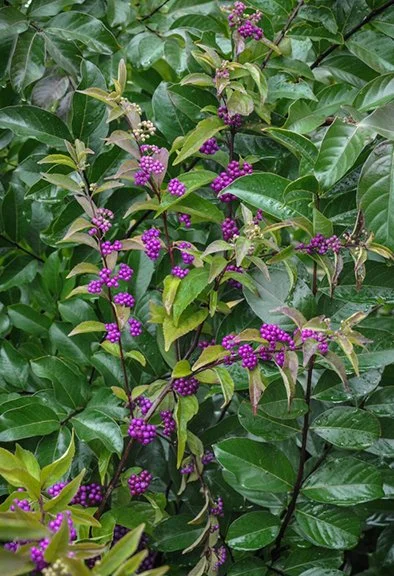
  • Callicarpa dichotoma: Beauty Bush with beautiful lavender berries.

    • Early Amethyst: A smaller variety

    • Pearl Glam: A new Proven Winner cultivar, with dark foliage.

  • Callicarpa japonica Leucocarpa: An upright beauty berry with white berries. Pale pink-white flowers in summer.

  • Fothergilla: A native shrub known for its fall color. It blooms in June and later lights up your yard with red and purple fall color. If you need a large shrub the species to get is major. There is a dwarf species available called gardenii, for a smaller shrub.

  • Hamamelis (Witch Hazel): Large native shrubs known for their fall color.

    • Hamamelis virginiana: A fall yellow bloomer

    • Hamamelis vernalis: Blooms in February

  • Hydrangeas: Many of the panicle hydrangeas fade to pink and hold the dried blooms way into the fall. There are some late summer bloomers that bloom into fall.

  • Symphoricarpos (Snow Berry): A season extender. This shrub has large white berries.

  • Vaccinium Corymbosum (High bush blueberry): Native to Martha’s Vineyard. Typically grows to 8’x 6’. Great fall color! Plant in full sun. Deer resistant.

  • Viburnums: There are many which have fabulous fall color and berries.

    • Viburnum dentatum (arrowwood viburnum): Native to Martha’s Vineyard. Non-fragrant flat-topped white flowers appear in late spring. Flowers give way to blue-black, berries which are quite attractive to birds and wildlife. Tolerates light shade.

    • Viburnum dilatatum: Known for their drooping berries. We carry Cardinal Candy with red berries and Michael Dodge with yellow berries.

    • Viburnum plicatums: These are Chris Wiley’s favorite Viburnum in flower.

Viburnum dilatatum Michael Dodge and some Virginia Creeper

late season spent flowers of Hydrangea macrophylla

Callicarpa dichotoma Beauty Berry

VINEYARD GARDENS LANDSCAPING
AUTUMN GARDEN
In SEPTEMBER, FALL PLANTS, SHRUBS, TREES, FIELD NOTES Tags fall trees, fall shrubs, viburnum, bayberry, False Holly, Franklin Tree, crape myrtle, maple trees, japanese maple tree, fothergilla, high bush blueberry
Comment

ASTERACEAE: THE ASTER FAMILY

September 3, 2026 Karen Logan

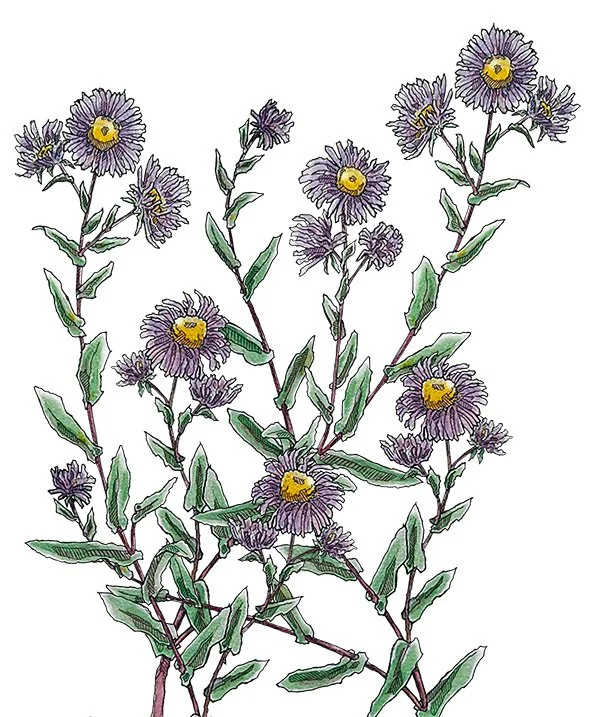
New England Asters [illustration by karen blackerby logan]

ASTERACEAE

THE ASTER FAMILY

by Patrick Best

Asters are the hallmark of the late-season garden. While many associate plants like the native white wood aster (Aster divaricatus) or the long-blooming Monch aster (Aster frikartii) with the term “aster”, you may be surprised to learn that the aster family encompasses a huge variety of late-blooming perennials. From goldenrods (Solidago) to sunflowers (Helianthus), and from black-eyed Susans (Rudbeckia) to mums (Chrysanthemum), asters are everywhere!

Vineyard natives, white wood aster (Aster divaricatus) and hay-scented fern (Dennstaedtia punctilobula), pair nicely in the late-season garden.

Blue wood aster (Aster cordifolius) is a native aster that is well adapted to partial shade, unlike most asters which prefer sunny conditions.

Morphology

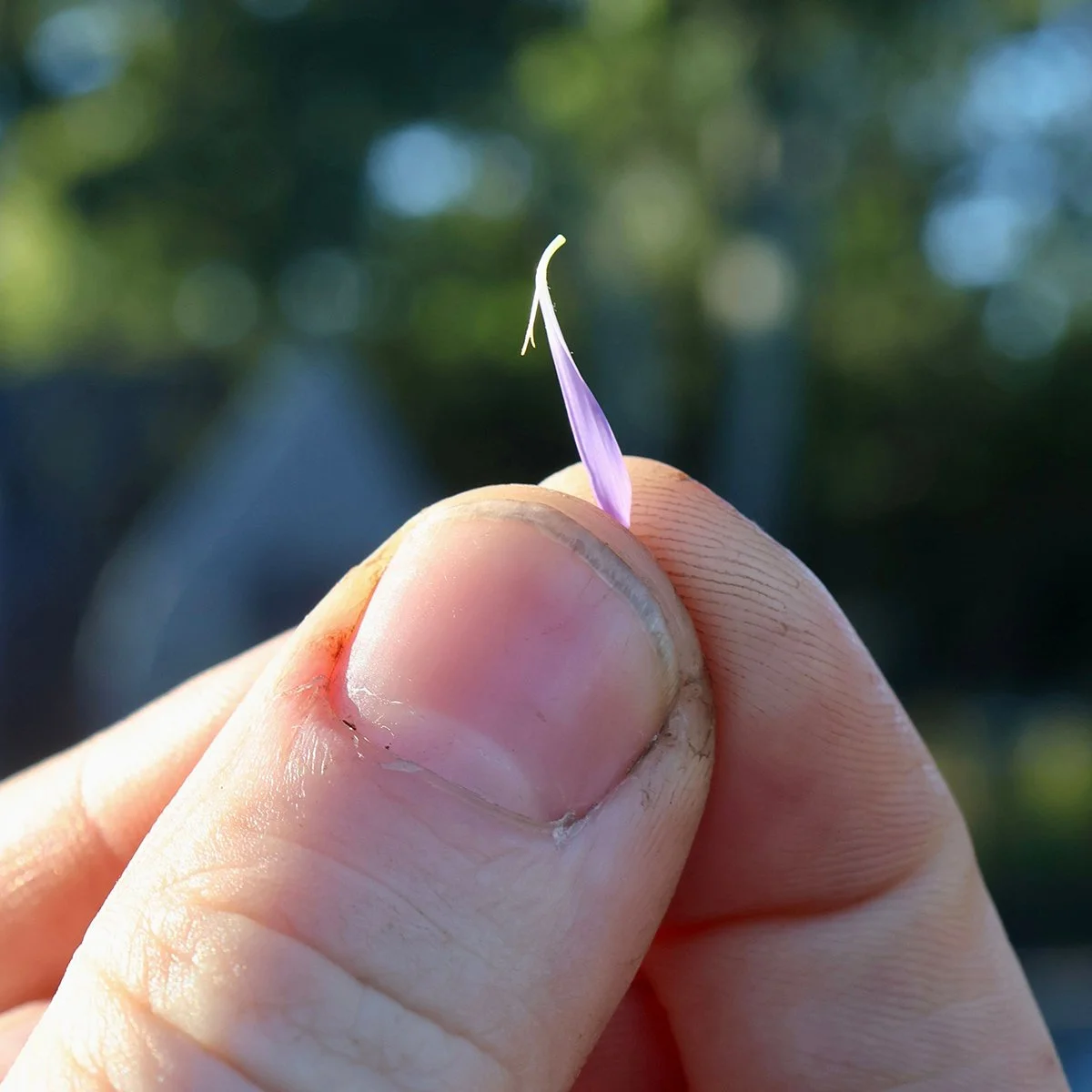
Looking closely at an aster flower, you can see that these compound flowers are actually made up of many smaller, individual florets. Disk flowers make up the center of the bloom and lack petals, while ray flowers encircle the central disk and have one petal each. Not all asteraceous plants have blooms consisting of both disk and ray flowers, but their presence is a helpful way to tell that you’re looking at a species in the aster family.

Aster ‘Raydon’s Favorite’ exhibits the dual-floret morphology typical of the family, with the yellow disk flowers in the center and the purple ray flowers around the edge.

A close-up of a single ray flower.

Ecosystem

In the ecosystem, these nectar-rich plants provide forage for a host of insects, especially the pollinators and bees looking for their final meals before the cold weather sets in. Native asters are far more valuable to the wider ecosystem than annual mums. Next time you walk by a mum, notice the absence of pollinators and then consider planting native asters in your fall pots!

Single-flowered annual mums offer the nectar-rich disk flowers valuable for late-season pollinators. The double-flowered mums only consist of ray flowers and are ecologically inert.

Dahlias are a popular late-season bloomer in the aster family and are well-suited to bouquets.

Garden Uses

Generally starting in August, the asters commonly grown on Martha’s Vineyard bloom well into October, allowing the Vineyard gardener to enjoy a profusion of flowers into the fall.

Zinnias, an aster-family annual, provide a long season of color in the landscape

In the garden, it is vital to ensure that a plant’s habit matches the goals you have for that space. Some plants are more useful for their clumping habit, others for their freely-seeding nature, and still others for their rhizomatous spread, more commonly thought of as groundcover behavior, which allows for colonization of larger spaces. As there are a host of beautiful native plants in the Aster family, it is nice to know that any accidental spread of these plants into the wildlands is an act of ecosystem restoration, and not a sign of invasiveness.

Helen’s Flower (Helenium autumnale) blooms throughout the summer in the Vineyard Gardens display bed.

This fall at the nursery, we have a large variety of Asteraceous plants available:

True Asters:

  • Twilight (rhizomatous spread)

  • Little Carlow (clumping)

  • Blue wood aster (clumping)

  • White wood aster (rhizomatous spread)

  • Vasterival (rhizomatous spread)

  • Prof. Anton von Kippenberg

  • Aster novi-angliae Alma Potschke (clumping)

  • Winston Churchill

OTHER PLANTS IN THE ASTERACEAE FAMILY:

  • Coreopsis

    • Zagreb

    • Moonbeam

    • C. tripteris Gold Standard

  • Echinacea

    • E. pallida

  • Eupatorium/Eutrochium

    • Joe Pye Weed

    • Boneset

  • Helenium

    • Moerheim Beauty

    • Sombrero

    • H. autumnale

  • Helianthus

    • Lemon Queen (rhizomatous spread)

    • Maximillian (rhizomatous spread)

  • Heliopsis

    • Summer Sun

    • Summer Nights

    • Bleeding Hearts

  • Leucanthemum/Nipponanthemum

    • Shasta Daisies (cvs.)

    • Montauk Daisies

  • Liatris

    • L. microcephala

    • Kobold

    • Floristan White and Purple

  • Solidago

    • Loysden Crown

    • S. canadensis ‘Crown of Rays’

    • Little Lemon

  • Rudbeckia

    • R. triloba Prairie glow (short-lived, seeds around non-aggressively)

    • R. subtomentosa Little Henry (clumping)

    • R. laciniata Autumn Sun/Herbstsonne (clumping)

  • Vernonia

    • V. noveboracensis

  • Chrysanthemum

    • Hardy (Claire Curtis, Igloo Series, Matchstick…)

    • Annuals

Familiar Annuals in the Asteraceae Family:

Dahlia, Cosmos, Marigold, Ageratum, Zinnia

In PLANT PROFILES, FALL PLANTS, NATIVE PLANTS, SEPTEMBER Tags asters, dahlias, mums, fall blooming plants, late blooming pollinators
Comment

AUTUMN GARDEN

September 1, 2026 Karen Logan

Cornus kousa (Asian dogwood) fruit at Polly Hill Arboretum

AUTUMN GARDEN

by Keith Kurman / Updated by Patrick Best

Martha’s Vineyard has long, warm falls that can often linger into December, allowing the ambitious year-round gardener to extend the traditional summer bloom season by months. With insightful planning, you, too, can engineer a full and floriferous garden from early spring straight through the first frost and beyond. Indeed, as the climate continues to warm, the Vineyard gardener need only suffer a few weeks in the dead of winter without something in bloom. However, a garden like this takes careful planning. Some plants don’t begin flowering until September or later, so space must be provisioned such that they may perform to their fullest potential that late in the growing season, when other plants are competing for space. Yielding space in the middle and back of your borders can allow late-blooming perennials to lend texture and substance alongside earlier flowering annuals and bulbs and space to grow into gaps left vacant by the late spring perennial displays. Take this space allocation into consideration when planning your garden beds. Distribute your late flowering plants evenly through the border and stagger height and depth, allowing space for earlier flowers.

Autumn tones in the display gardens at Vineyard Gardens

Challenges With Late-Blooming Plants:

1. STAKING or HEADING BACK: Chrysanthemums (hardy mums), Asters, Phlox paniculata (garden phlox), Nipponanthemum nipponicum (Montauk daisy), and other late-season perennials need pinching back before early July. The extent to which this is done can vary from a conservative tip-out to a more drastic cutting back by one-third to one-half. The Anglophiles among us may know this as the “Chelsea Chop,” in reference to the Chelsea Flower Show, which is held in late spring each year. It’s important to provide support for some of the tall growing perennials early in the season to allow them to grow into your staking system. Bamboo stakes and jute twine are probably the most straightforward approach, but peony hoops and tomato cages can be very effective as well. Staking may seem a little fussy and early in the season, but you’ll be glad you did when the late season storms return.

2. DROUGHT: Irrigation requires constant monitoring, and gardens often require supplemental water during long dry spells. Over the course of the gardening year, any number of things can happen to disturb a basic irrigation system: from root blockage to punctured lines.

3. HERBIVORY: Across the island, it seems that few gardeners are safe from the animals who would make your garden their dinner. From deer to rabbits and chipmunks to avians, there is no shortage of hungry animals as wild habitats are consumed by new development. Regular applications of Bobbex can help dissuade deer from browsing your plants, but I have heard many reports that rabbits are unfazed by the stench and continue munching. For bunny damage, I recommend hot pepper wax (capsaicin), available as a spray and applied regularly to lower growing plants. In areas where repellants fall short, physical barriers such as caging and fencing are the best options. Sorry, up-islanders, I’m talking to you.

4. CATEPILLARS (and other insects): Many native plants play host to the caterpillar larvae of some fantastic moths and butterflies. Considering this, I always recommend doing some research before impulsively reaching for insecticide. If the damage isn’t widespread, I urge you to accept this as a sign that your garden is a part of the wider ecosystem, which is surely something to celebrate! If treatment is necessary, organic options such as Safer Soap, Neem Oil, Pyrethrum, or Bt are best.

Lespedeza thunbergii (bush clover) and Pycnanthemum muticum (mountain mint) at Polly Hill Arboretum

September border with Crape Myrtles, Vitex, and Rudbeckia

PLANTS THAT ARE LOOKING FANTASTIC IN THE GARDENS RIGHT NOW

PERENNIALS:

Asters, Eupatorium/Eutrochium (Boneset/Joe Pie Weed, both lovely natives), Vernonia (Ironweed), Chrysanthemum/Dendranthema (Hardy Mum), Agastashe (Anise Hyssop), Phlox, Anemone, Tricyrtis (Toad Lilies), Late-Blooming Hostas, Helianthus (Perennial Sunflowers), Hibiscus moscheutos (Rose Mallow), Rudbeckia (Black Eyed Susan and relatives), Kirengeshoma palmata (Yellow Wax Bells), Aconitum (Monkshood), Chelone (Turtlehead), Patrinia scabiosifolia, Pycnanthemum (Mountain Mint), Physostegia (not-so Obedient Plant), Solidago (Goldenrod), Ceratostigma plumbaginoides (Hardy Plumbago), Garden Sage (Salvia glabrescens, Salvia koyamae, Salvia uliginosa), Hardy Plectranthus/Rabdosia species, Dicentra ‘White Diamonds’ and ‘Bacchanal’ (Everblooming Bleeding Hearts), Geranium (Cranesbill), Eucomis (Pineapple Lily), Nipponanthemum (Montauk Daisy), Begonia grandis (Hardy Begonia), Persicaria, Colchicum (Fall Crocus), some Sedum, Caryopteris divaricata

View fullsize Autumn Crocus, Colchicum ‘Waterlily’
Autumn Crocus, Colchicum ‘Waterlily’
View fullsize Rudbeckia hirta, self-seeding annual
Rudbeckia hirta, self-seeding annual
View fullsize Hardy Mum, Chrysanthemum ‘Clara Curtis’
Hardy Mum, Chrysanthemum ‘Clara Curtis’
View fullsize Kirengeshoma palmata, Dryopteris marginalis
Kirengeshoma palmata, Dryopteris marginalis
View fullsize New England Aster (Aster novae-angliae)
New England Aster (Aster novae-angliae)
View fullsize Patrinia scabiosifolia
Patrinia scabiosifolia
View fullsize Ginger Lily (Hedychium gardinerianum)
Ginger Lily (Hedychium gardinerianum)
View fullsize Japanese Anemone and Impatiens balfourii
Japanese Anemone and Impatiens balfourii

ANNUALS: 

Tropical Salvias (Salvia guaranitaca, Salvia leucantha, etc), Chrysanthemums, Dahlias, Cosmos, Marigolds, Rudbeckia hirta, Tithonia (Mexican Sunflower), Arctotis, Petunias, Celosia, Browallia, Ricinus, Coleus, Hedychium (Ginger Lilies)… and oh so many more!

Petunia and Coleus

Coleus and Tithonia ‘Torch’

Dahlias with Salvia guaranitaca ‘Black and Blue’

Petunia violacea

FLOWERING SHRUBS:

Hydrangea paniculata (Panicle Hydrangea), Buddleia (Butterfly Bush) and Spirea (if dead- headed throughout the season), Caryopteris x clandonensis (Bluebeard), Lespedeza thunbergii (Bush Clover), Lagerstroemia (Crape Myrtle), Vitex (Chastetree), Abelia x grandiflora, Fall-Blooming Camellias (like ‘Winter’s Snowman’), some Illicium (a highly deer-resistant evergreen for shade, look for ‘Orion’), Mahonia x media (‘Winter Sun’, ‘Charity’, and ‘Arthur Menzies’ are common), some Daphne (Daphne x transatlantica blooms through November), Hibiscus syriaca (Rose of Sharon), Hamamelis virginiana (native witch hazel blooms fragrant yellow flowers)

A yellow-leafed selection of Bluebeard (Caryopteris x clandonensis ‘Aurea’)

The fading flowers of Hydrangea macrophylla add moodiness to the garden

Hydrangea paniculata ‘Tardiva’ with Hydrangea arborescens ‘Annabelle’ in the foreground

Abelia x grandiflora

PLANTS for FOLIAGE:

Fothergilla (bottlebrush), Itea virginica (sweetspire), Clethra (sweet pepperbush) Parthenocissus quinquefolia (Virginia creeper), Rhus sp. (sumac), Hamamelis/Parrotia (witch hazel family), Grasses (Hakonechloa, Panicum, Schizachryium, Andropogon, Carex, Calamagrostis, Pennisetum, etc.), Ferns (Dryopteris, Athyrium, Osmunda, Onoclea, Polystichum, Dennstaedtia, etc.), Nyssa (tupelo), Acer (maples), Lindera benzoin (spicebush)

Viburnum dilatatum ‘Michael Dodge’ and Virginia Creeper

Northern Sea Oats (Chasmanthium latifolium)

PLANTS for FRUIT:

Viburnum, Ilex (winterberry and hollies), Callicarpa (beautyberry), Roses, Crabapples

Tea roses will continue flowering well past first frost

Japanese Beautyberry (Callicarpa dichotoma)

These lists are just a starting point and there are so many more wonderful plants to choose from. Fall is a great time to plant and many of the plants listed above are available for sale at the nursery, including many specialty plants.

Come explore the late bloomers and extend your garden’s bloom season today!

In SEPTEMBER, FALL PLANTS, FIELD NOTES Tags Fall Gardens, Fall perennials, Fall Annuals, Fall shrubs, Asters, Mums, Rudbeckia, Autumn Crocus, Japanese Anemone, Salvias, Petunia, Coleus, Dahlias, Caryopteris, Hydrangea, Beauty Berry

ANEMONE

August 28, 2026 Karen Logan

Anemone [illustration by karen blackerby logan]

ANEMONE

WINDFLOWER

The common name windflower comes from the way the delicate, poppy-like blossoms sway gracefully in the breeze, a trait reflected in the Greek word anemos, meaning "wind." Ranging from native spring ephemerals to summer and autumn bloomers, anemones can offer a continuous display from spring through fall. Don't let their whimsical blooms fool you, many varieties are remarkably tough because they spread via underground rhizomes and can form robust colonies over time.

**********

JAPANESE ANEMONES

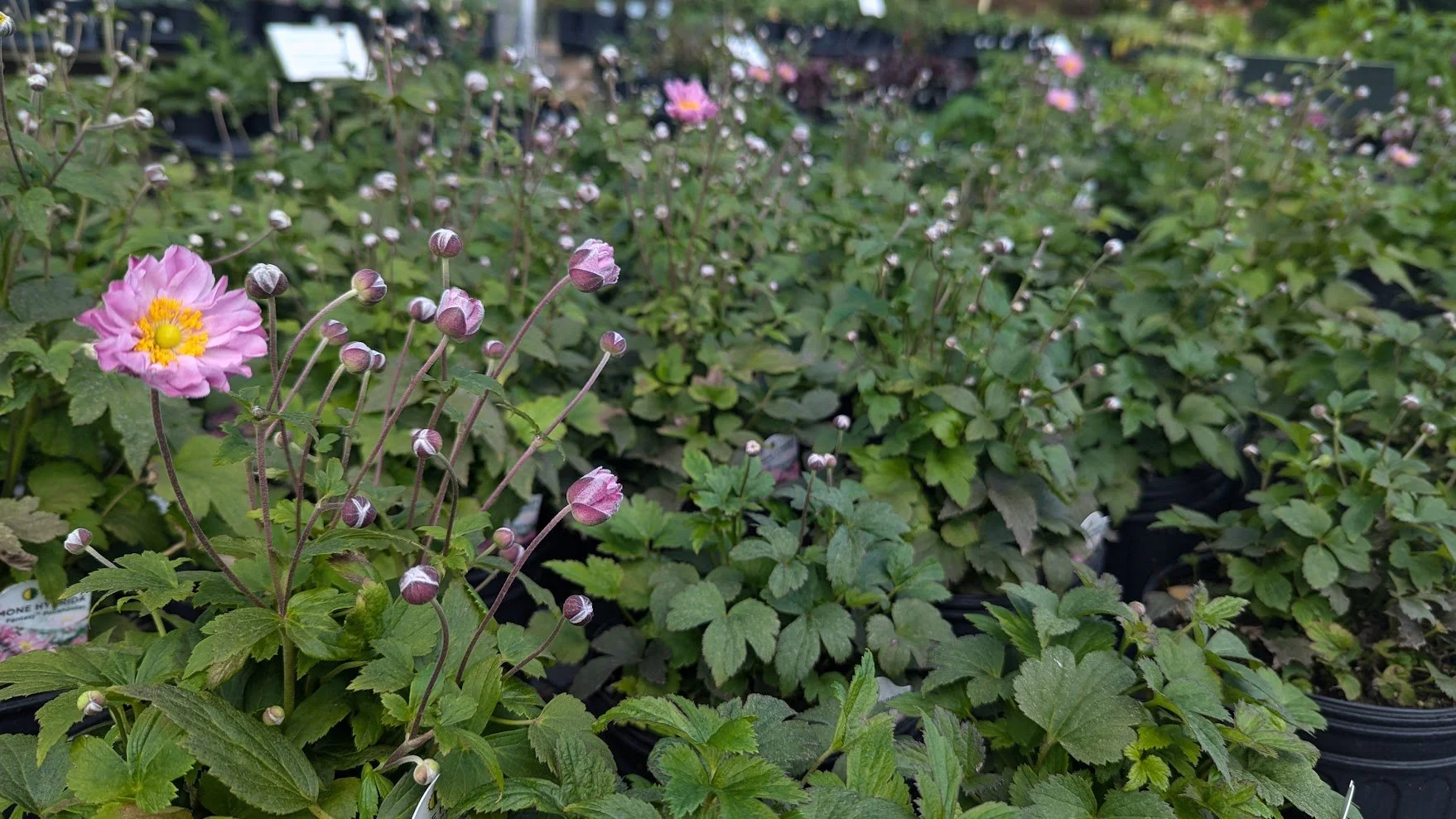
Japanese anemones add a magnificent splash of color to the autumn garden when most perennials are beginning to fade. They are exceptional garden extenders that spread happily when sited in moist soils and space to roam.

CARE:

  • Sunlight: Thrive best in partial shade and protection from harsh afternoon sun. They can tolerate full sun as long as the soil remains consistently moist.

  • Soil: Prefer rich, moisture-retentive soil. Water regularly during dry spells.

  • Bloom Time: Mid-summer to late fall.

LANDSCAPE USES:

  • Mixed borders, cottage gardens, coastal gardens, and naturalized areas.

  • Moonlight Gardens: White-blooming anemones stand out strikingly at twilight, catching the evening light to create a luminous, glowing effect.

Japanese Anemones We Carry at Vineyard Gardens

Most garden-variety Japanese anemones are hybrids (Eriocapitella × hybrida), varying in height up to 3 to 4 feet. While many popular selections feature single blossoms, we also offer double-flowered forms like 'Pamina'.

  • 'Wild Swan': White blossoms featuring a distinctive bluish-violet band on the reverse of the sepals.

  • 'Honorine Jobert': Classic white single flowers.

  • 'September Charm': Silvery-pink single flowers.

  • 'Robustissima': Vigorous grower with clear pink single flowers.

  • 'Bressingham Glow': Deep, rich rose-pink flowers.

  • 'Pamina': Deep rose-pink double flowers.

Flowering abundantly from mid-summer through late fall, Japanese anemones are a brilliant, elegant alternative to traditional autumn mums.

**********

NATIVE ANEMONES ON MARTHA’S VINEYARD

Wood Anemone (Anemone quinquefolia)

A native spring ephemeral. It blooms early before the overhead tree canopy leafs out, utilizing the spring sun before dying back to dormancy as shade takes over. It typically has 5 sepals (which function as petals) that linger longer than true petals and is why it’s scientific name is quinquefolia meaning five leafed.

Tall Thimbleweed / Tall Windflower (Anemone virginiana)

Thrives in partly shaded locations with moist to moderately dry soils. In early summer, it produces greenish-white sepals above dark green foliage. Following the bloom, it develops characteristic thimble-like seed heads that turn fluffy as they disperse in autumn.

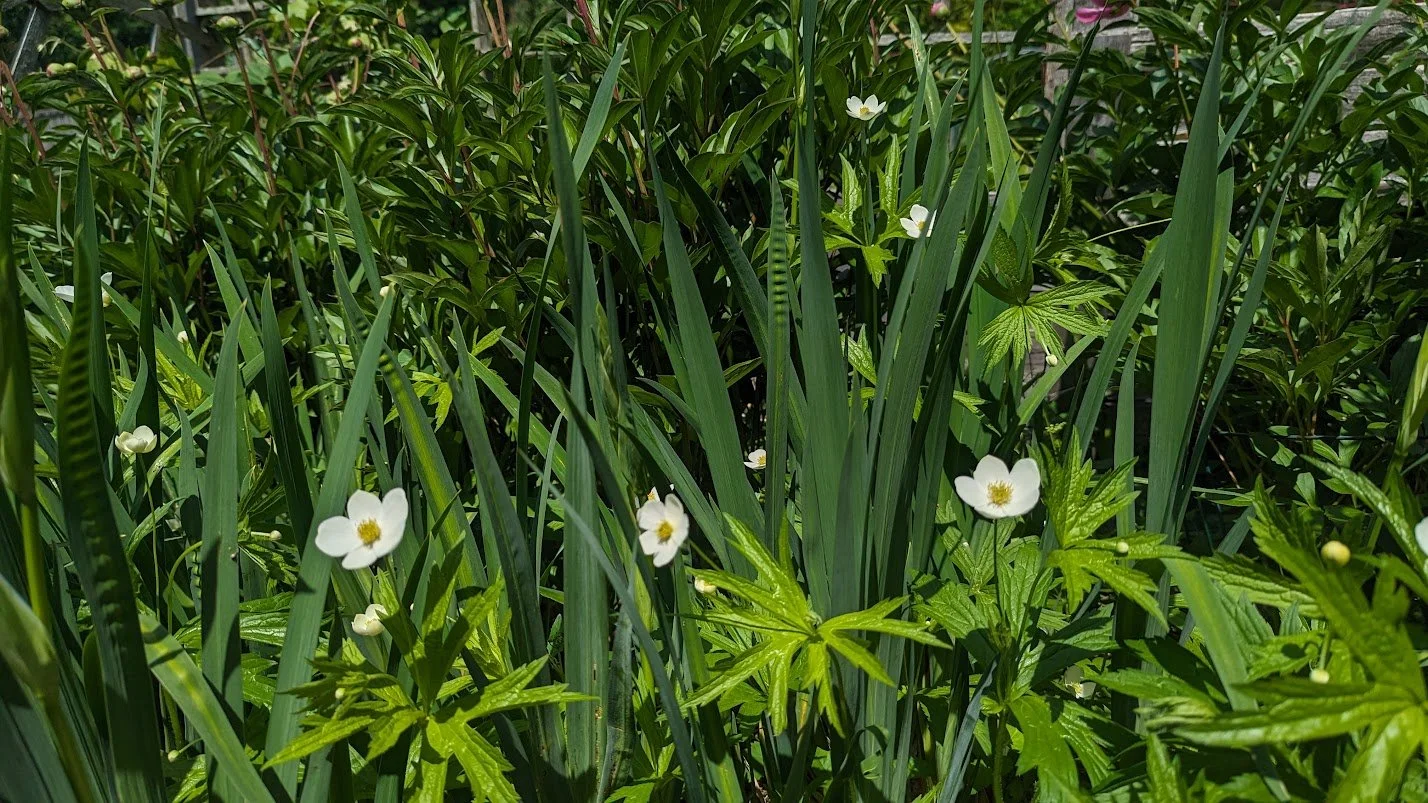
Canada Anemone (Anemone canadensis)

Features long stems topped with white blossoms from May to June. While its foliage looks delicate, it is a very hardy plant that forms dense colonies in moderate to moist soils with partial to full sun.

An excellent choice for a deer deterrent border because most Anemones have a natural bitter compound that make it unpalatable to deer and rabbits.


Anemone canadensis

Wood Anemone (Anemone nemerosa ‘Vestal’

In FALL PLANTS, PLANT PROFILES, AUGUST Tags perennial plant, Anemone, Japanese Anemone, fall blooms, native anemone
Comment

484 State Rd. West Tisbury, MA 02575

Mon - Fri : 8am - 4:30pm

Sat : 8am-4:00pm

Closed Sundays

(508) 693.8512